
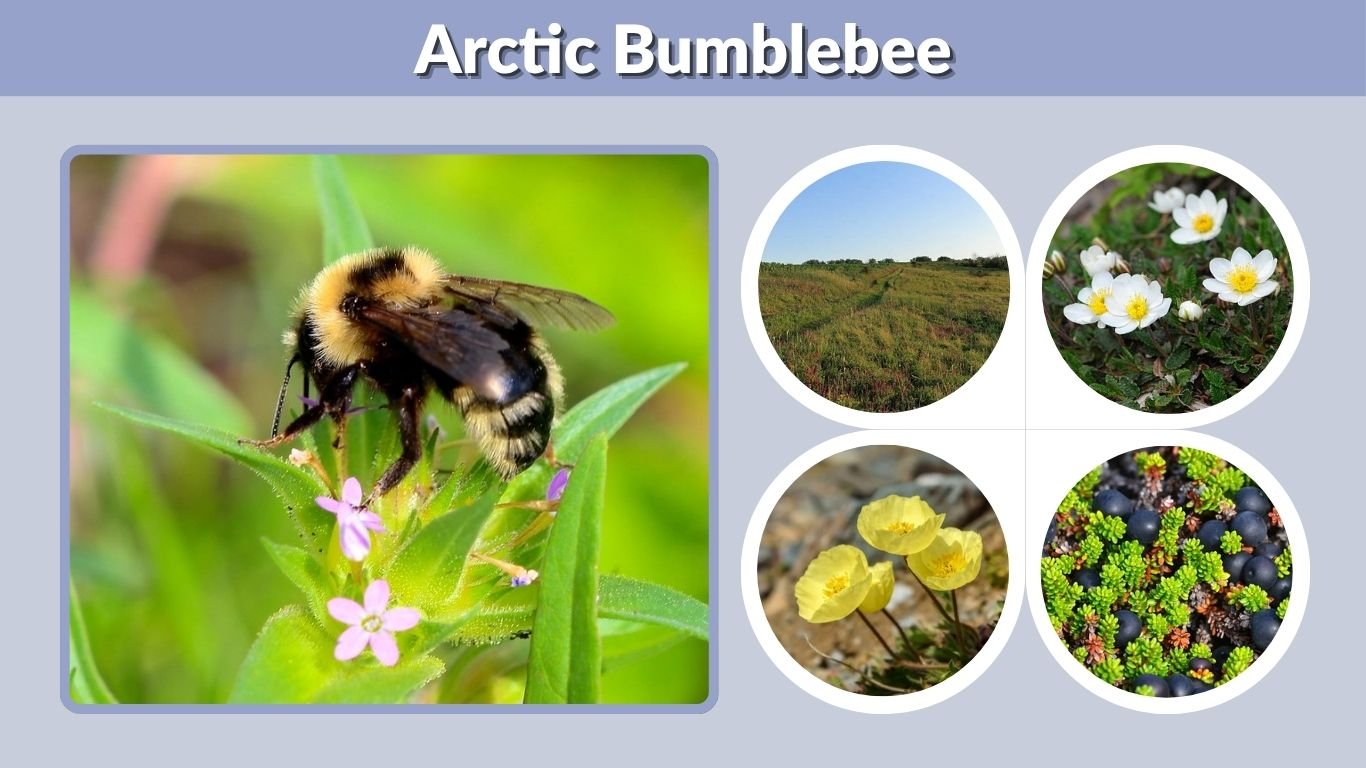
The Arctic bumblebee (Bombus polaris) is a cold-adapted pollinator found across northern tundra regions. Its dense hair, powerful flight muscles, and ability to generate body heat allow it to forage in conditions that challenge most insects. Queens emerge during the brief Arctic spring and quickly establish small colonies before winter returns. By visiting willows, Arctic poppies, mountain avens, and other tundra flowers, these bees support plant reproduction in an ecosystem where relatively few pollinating insects can survive.
Arctic Bumblebee Identification
The Arctic bumblebee is a robust, densely haired insect belonging to the family Apidae. Its exact coloring can vary among individuals and across its extensive northern range. Thick body hair is one of its most important features, helping reduce heat loss while the bee flies and forages in cold, windy environments.
Physical Characteristics
- Scientific name: Bombus polaris
- Phylum: Arthropoda
- Class: Insecta
- Order: Hymenoptera
- Family: Apidae
- Body shape: Large, rounded, and robust
- Body covering: Exceptionally dense insulating hair
- Common colors: Black with yellow, brownish, or orange-yellow bands
- Wings: Transparent to lightly tinted
- Legs: Female workers have pollen baskets on their hind legs
- Antennae: Elbowed and sensitive to odors
- Mouthparts: Adapted for drinking nectar
Queens are the largest individuals, while workers are smaller and somewhat variable in size. Males lack pollen baskets and usually have longer antennae than females.
Size and Appearance
Arctic bumblebee queens can reach approximately 18–22 mm in length, while workers are commonly about 10–16 mm long. Males generally fall between the sizes of smaller workers and queens. Measurements vary because nutrition, climate, location, and colony conditions influence adult development.
Its thick hair creates a bulky appearance. Yellow or golden bands may be visible across the thorax and abdomen, although color patterns can differ. Identification should therefore consider location, body structure, and markings rather than relying on color alone.
Female and Male Differences
Queens and workers are female and can carry pollen in smooth, flattened baskets on their hind legs. Workers perform most of the colony’s foraging, while the queen produces eggs.
Male Arctic bumblebees do not collect pollen for larvae and have no functional pollen baskets. They also lack stingers. Their primary role is to locate and mate with newly emerged queens near the end of the short nesting season.
Arctic Bumblebee Habitat and Distribution
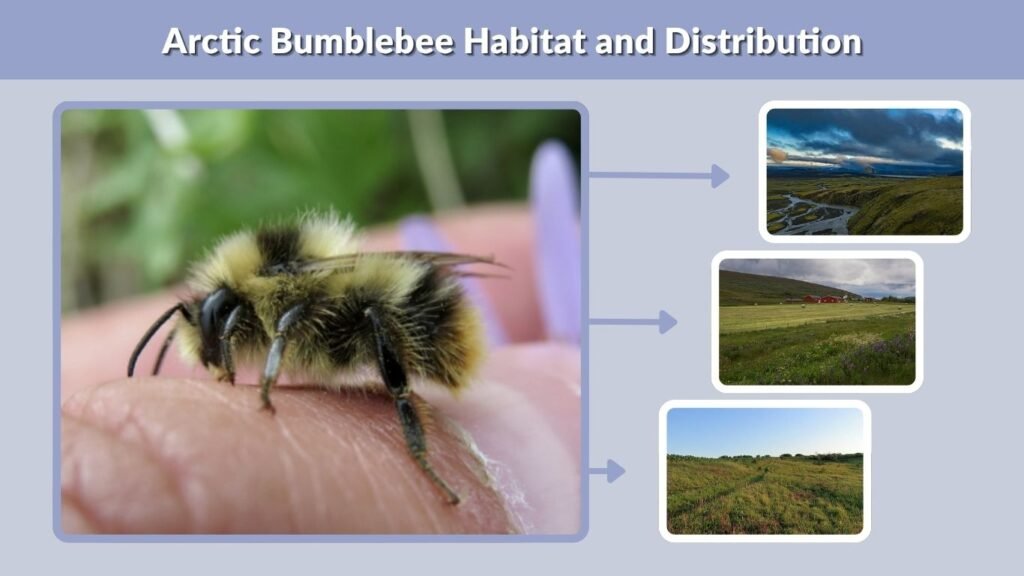
The Arctic bumblebee inhabits some of the coldest environments occupied by social insects. It occurs across circumpolar regions, including northern North America, Greenland, Scandinavia, and northern Eurasia. Its distribution is closely connected to tundra vegetation, suitable nesting ground, and flowers available during the brief summer.
Common Arctic Habitats
- Lowland tundra
- Coastal tundra
- Arctic meadows
- Sheltered river valleys
- Heath-covered slopes
- Areas near melting snowfields
- Dwarf-willow communities
- Rocky tundra with flowering plants
- Northern grasslands
- Sheltered spaces around research settlements
Although the environment appears barren for much of the year, tundra can produce abundant flowers during summer. Bumblebees concentrate their activity in warmer, sheltered locations where nectar and pollen are easiest to obtain.
Life on the Tundra
The tundra presents several challenges, including strong wind, low temperatures, sudden snowfall, and a very short growing season. Flowers may be scattered across considerable distances, forcing workers to use energy carefully while foraging.
Arctic bumblebees frequently fly close to the ground, where wind speeds may be lower. Sun-warmed rocks, sheltered depressions, and south-facing slopes provide temporary places to rest and raise body temperature.
Adaptations of the Arctic Bumblebee
Survival in the Arctic requires more than thick hair. The Arctic bumblebee combines physical, behavioral, and physiological adaptations to maintain the body temperature needed for flight. These abilities allow queens and workers to become active when many other insects remain immobilized by the cold.
Important Cold-Climate Adaptations
- Dense body hair: Traps a layer of air and slows heat loss.
- Large body size: Helps queens retain heat in cold conditions.
- Heat production: Flight muscles can generate warmth before takeoff.
- Muscle shivering: Rapid internal muscle contractions increase thoracic temperature.
- Dark coloration: Dark areas of the body absorb solar heat.
- Low flight posture: Flying near the ground reduces exposure to strong wind.
- Sun basking: Bees may rest in sunny locations to warm themselves.
- Rapid colony development: The life cycle progresses quickly during the short summer.
- Flexible foraging: Workers use many available tundra flowers.
- Insulated nests: Underground sites protect colonies from wind and temperature changes.
How Can It Fly in Cold Weather?
A bumblebee’s wing muscles must reach an adequate temperature before flight. The Arctic bumblebee can separate the movement of its flight muscles from the wings, contracting the muscles without immediately taking off. This process produces heat inside the thorax.
Once warm enough, it can fly while outside temperatures remain comparatively low. Its circulation then distributes some heat through the body. However, extended rain, extreme wind, or sudden freezing conditions can still prevent normal activity.
Coping With the Short Summer
The colony has limited time to develop. Queens must locate food, establish nests, raise workers, and produce reproductive bees before winter arrives. Workers forage for long periods when conditions are favorable, taking advantage of nearly continuous daylight in parts of the Arctic.
Colonies remain relatively small compared with those of some temperate bumblebee species. Producing fewer individuals helps the colony complete its reproductive cycle with limited time and food.
Arctic Bumblebee Life Cycle
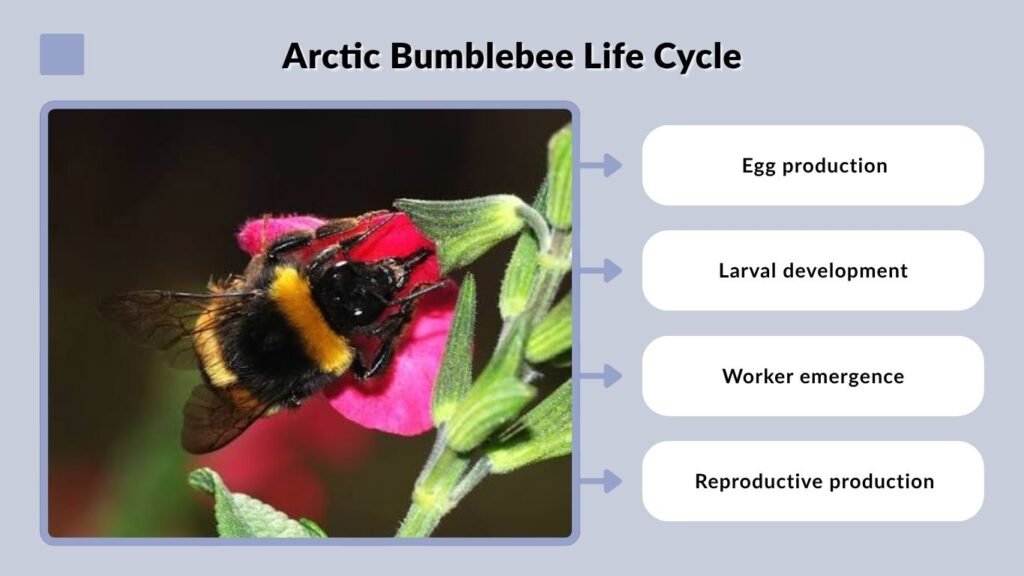
The Arctic bumblebee has an annual colony cycle. Only newly mated queens normally survive winter. They remain dormant beneath soil, vegetation, or other protective material before emerging when warmer temperatures and early flowers signal the beginning of another short growing season.
Stages of the Life Cycle
- Queen emergence: A fertilized queen leaves hibernation during late spring or early summer.
- Feeding period: She drinks nectar and collects pollen to restore her energy.
- Nest selection: The queen searches for an underground or sheltered nesting cavity.
- Egg production: She creates wax cells and lays her first batch of eggs.
- Larval development: The larvae receive pollen and nectar collected by the queen.
- Worker emergence: Female workers take over most food collection and nest maintenance.
- Colony expansion: The queen concentrates on laying additional eggs.
- Reproductive production: The colony begins producing males and new queens.
- Mating: Young queens mate before seeking winter shelters.
- Colony decline: Workers, males, and the original queen die as freezing conditions return.
Nest and Colony Structure
Arctic bumblebees commonly establish nests underground, sometimes using abandoned rodent burrows or natural gaps beneath vegetation. An underground location provides protection from wind, rain, predators, and sudden temperature changes.
Inside the nest are wax brood cells, cocoons, and small storage pots for pollen and nectar. The colony does not create the organized vertical comb associated with honeybees. Its population is generally modest because of the extremely short season.
Larvae and Lifespan
The larvae are pale, legless grubs that remain protected inside brood cells. They consume protein-rich pollen and nectar before pupating inside silk cocoons. Adults later emerge by opening the cocoons.
Workers and males generally live for only several weeks. A successfully mated queen may survive close to a year when her long winter dormancy is included. However, environmental conditions make survival difficult at every stage.
Arctic Bumblebee Diet and Role in the Food Chain
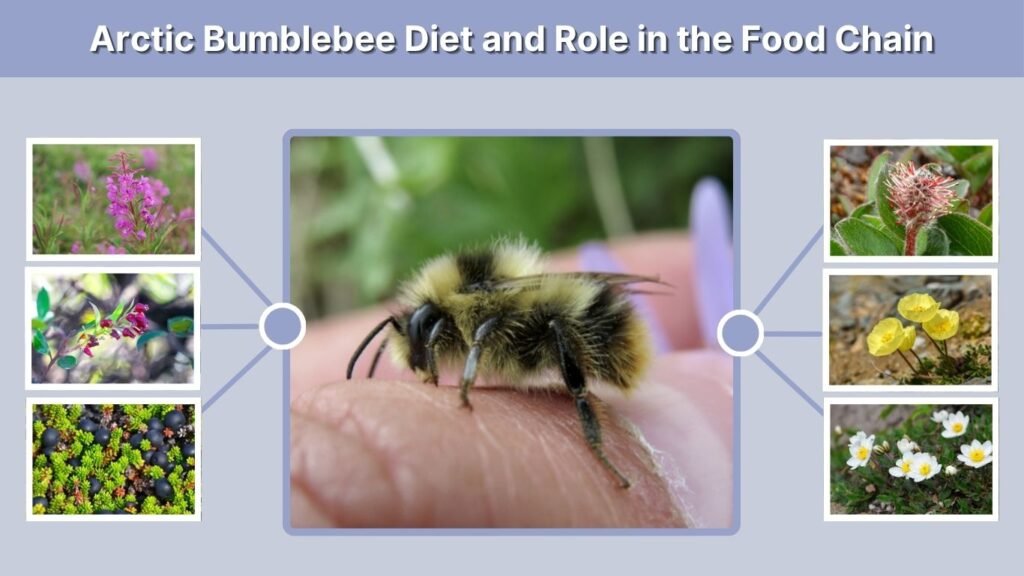
Arctic bumblebees depend completely on flowering plants. Adults drink sugar-rich nectar for energy, while pollen provides protein, fats, vitamins, and minerals for developing larvae. Their flower visits also make them essential pollinators within tundra food webs.
Common Food Plants
- Arctic willow
- Arctic poppy
- Mountain avens
- Purple saxifrage
- Fireweed
- Blueberry and bilberry flowers
- Northern legumes
- Lousewort
- Alpine milkvetch
- Crowberry
- Dwarf shrubs
- Other seasonal tundra wildflowers
The exact diet varies by region and flowering time. Workers may repeatedly visit highly productive flower patches, but they can switch plants when preferred resources become unavailable.
Arctic Poppy and Bumblebee Relationship
Arctic poppies provide nectar and pollen, while visiting bumblebees can carry pollen between flowers. This benefits the bee through food and helps the plant reproduce. However, the relationship is not exclusive because bumblebees visit numerous plants, and Arctic poppies may receive visits from other insects.
Poppy flowers can follow the sun, creating a warmer environment inside the bloom. This warmth may make the flower particularly attractive to cold insects seeking both food and temporary shelter.
Predators and Parasites
Adult Arctic bumblebees may be eaten by birds, spiders, and predatory insects. Small mammals can uncover nests and consume brood, stored food, and adult bees. Harsh weather and starvation may cause greater losses than predators during some seasons.
The high Arctic bumblebee, Bombus hyperboreus, is a specialized social parasite associated with Arctic bumblebees. It may enter an established nest, take control, and use the resident workers to raise its reproductive offspring.
Arctic Bumblebee Sting, Honey, and Human Safety
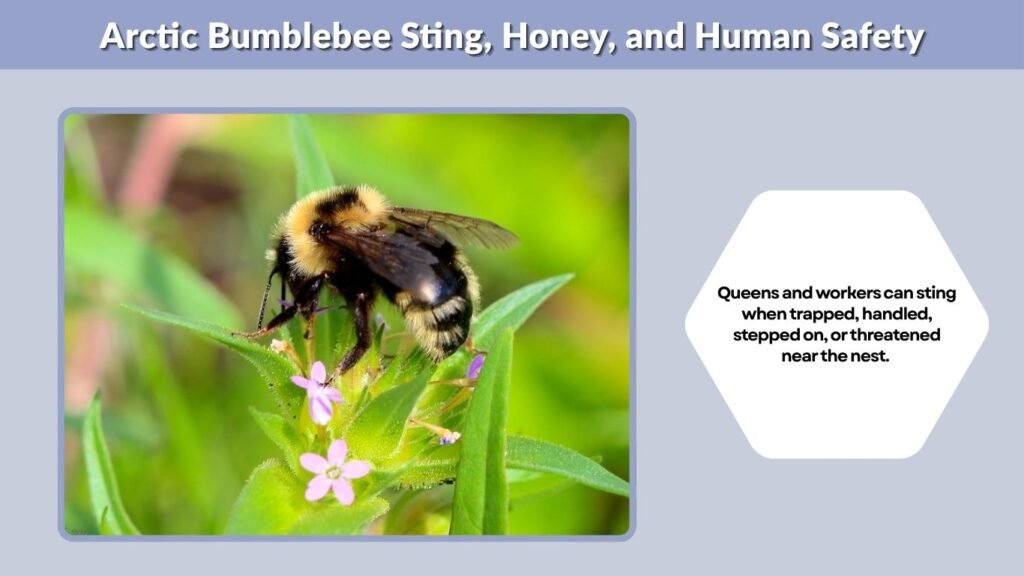
Arctic bumblebees rarely encounter people across much of their remote habitat. When researchers, travelers, or northern residents see them, the bees are generally focused on flowers or their nest. They are not naturally aggressive, but females retain a stinger for defense.
Do Arctic Bumblebees Sting?
Queens and workers can sting when trapped, handled, stepped on, or threatened near the nest. Their stingers are relatively smooth, so they can sting more than once. Males cannot sting.
A typical sting produces temporary pain, redness, itching, and swelling. Serious allergic reactions require immediate medical attention, particularly when symptoms include breathing problems, dizziness, or swelling around the mouth and throat.
Do Arctic Bumblebees Make Honey?
Arctic bumblebees collect nectar and store small quantities inside wax pots. These reserves support adults and larvae during bad weather. However, they do not create large, long-lasting honey supplies like honeybees.
Their colonies die at the end of the season, and only new queens overwinter. Therefore, Arctic bumblebee nests are not a practical or sustainable source of harvestable honey.
FAQs
1. What is the scientific name of the Arctic bumblebee?
Its scientific name is Bombus polaris. It belongs to the bee family Apidae and the order Hymenoptera.
2. Where does the Arctic bumblebee live?
It inhabits tundra regions across northern North America, Greenland, Scandinavia, and northern Eurasia.
3. How does an Arctic bumblebee survive the cold?
Dense hair, large body size, heat-generating flight muscles, sun basking, and sheltered nests help it remain active under cold Arctic conditions.
4. What eats the Arctic bumblebee?
Birds, spiders, predatory insects, and small mammals may consume adults or raid nests. Colonies can also be affected by social parasites.
5. Why is the Arctic bumblebee important?
It pollinates tundra flowers and supports the reproduction of plants that provide food and habitat for other Arctic wildlife.
You have not enough Humanizer words left. Upgrade your Surfer plan.
