
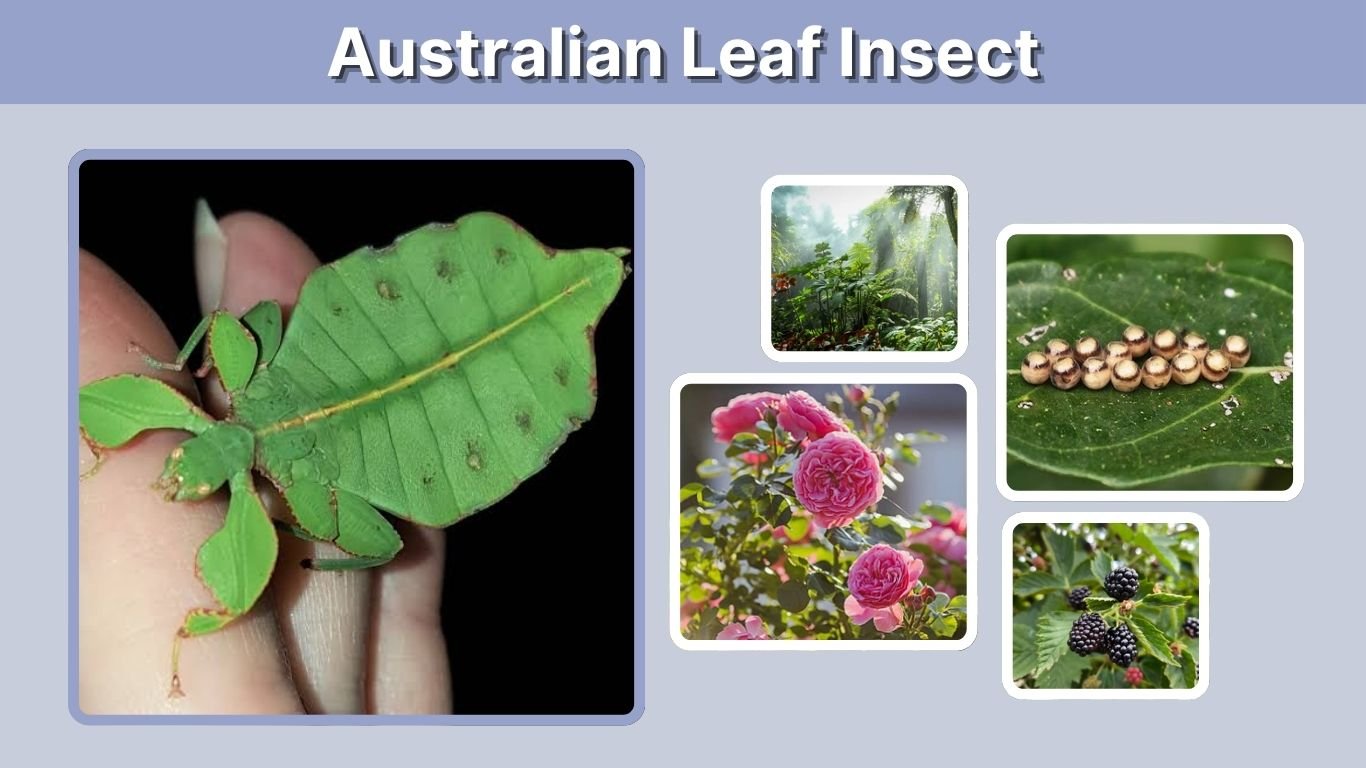
The Australian leaf insect is a remarkable example of natural camouflage. With a flattened green body, leaf-like legs, and markings that resemble plant veins, it can be extremely difficult to spot among foliage. One of Australia’s best-known true leaf insects is Monteith’s leaf insect, often referred to as Phyllium monteithi in older classifications.
Australia is also home to the famous spiny leaf insect, but despite its common name, it looks quite different from true leaf insects. Below, we explore Australian leaf insect identification, habitat, food, eggs, behavior, and care.
What Is an Australian Leaf Insect?
The term Australian leaf insect usually refers to true leaf insects belonging to the family Phylliidae. These insects are relatives of stick insects and belong to the order Phasmatodea.
One particularly well-known Australian species is Monteith’s leaf insect, a large green species found in northeastern Australia.
Australian Leaf Insect Identification
Common features include:
- Broad, flattened green body
- Leaf-shaped abdomen
- Vein-like markings on the body
- Flattened extensions on the legs
- Green, yellow-green, or occasionally brownish coloration
- Slow, gentle movement
- Strong resemblance to surrounding foliage
- Females generally larger and broader than males
The insect’s body does not merely share the color of a leaf. Its shape, texture, and markings work together to create a highly convincing disguise.
What Is the Scientific Name of the Australian Leaf Insect?
Monteith’s leaf insect has traditionally been known as Phyllium monteithi. Taxonomic classifications of leaf insects have changed over time, so newer references may place some Australian species into revised genera.
For general identification, the common name Monteith’s leaf insect remains useful.
It should not be confused with the Australian spiny leaf insect, whose scientific name is Extatosoma tiaratum.
Australian Leaf Insect vs. Australian Spiny Leaf Insect
These two insects are commonly confused because both use plant-like camouflage.
True Australian Leaf Insect
A true leaf insect has a broad, flat body that closely resembles a green leaf. Its abdomen, wings, and legs appear expanded and leafy.
Australian Spiny Leaf Insect
The Australian spiny leaf insect has a more irregular, curled, and thorny appearance. Females can resemble dried leaves or pieces of bark rather than fresh green leaves.
Spiny leaf insects are also commonly called giant prickly stick insects.
Both belong to the stick insect order, but they are not the same species.
Where Do Australian Leaf Insects Live?
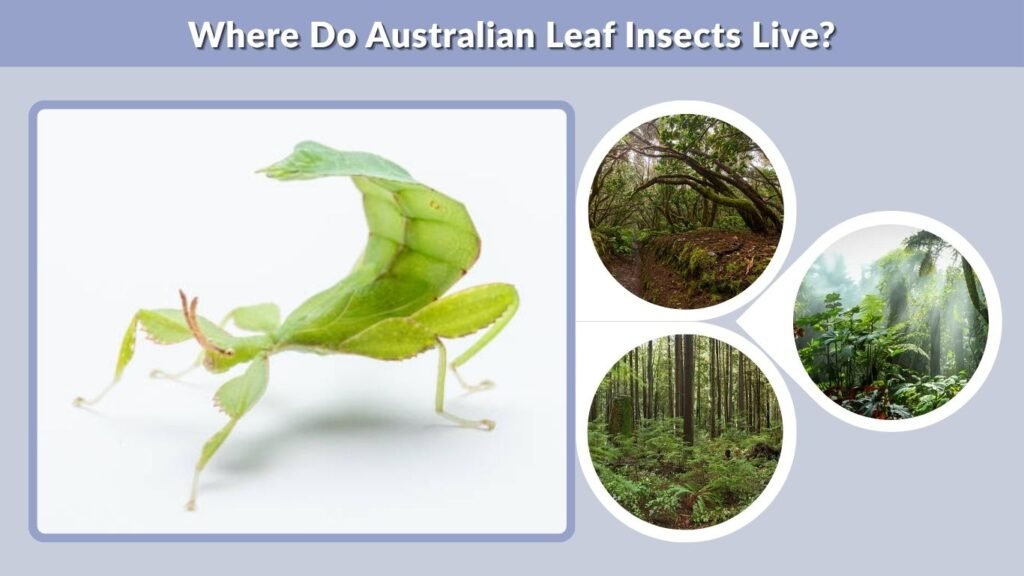
Australian leaf insects occur mainly in warm, vegetated environments.
Monteith’s leaf insect is associated particularly with northeastern Queensland, where suitable rainforest habitats provide warmth, moisture, and abundant foliage.
Australian Leaf Insect Habitat
Suitable natural environments can include:
- Tropical rainforest
- Subtropical forest
- Dense shrubs
- Forest edges
- Tree canopies
- Areas with abundant leafy vegetation
Living among leaves allows the insect’s camouflage to function effectively.
During the day, an individual may remain almost completely motionless to avoid being detected.
Why Do Australian Leaf Insects Look Like Leaves?
Leaf mimicry is primarily a defensive adaptation.
Birds, reptiles, spiders, and other predators often search vegetation for insects. Resembling an ordinary leaf makes the insect far less noticeable.
Camouflage Adaptations
Australian leaf insects may imitate several plant characteristics, including:
- Leaf veins
- Uneven edges
- Green coloration
- Brown patches
- Damaged areas
- Irregular shapes
Their flattened legs also help hide the normal outline expected from an insect.
Some individuals gently rock while walking. This swaying movement can make them look like leaves moving in a breeze.
What Do Australian Leaf Insects Eat?
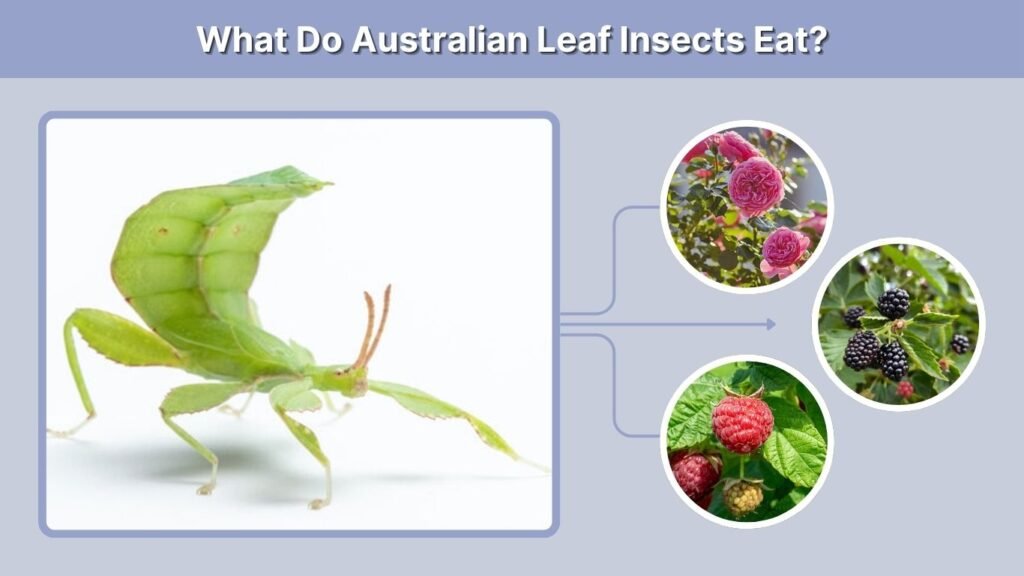
Australian leaf insects are herbivores.
They feed on foliage rather than hunting other insects.
Australian Leaf Insect Food
Depending on species, captive leaf insects may accept leaves such as:
- Eucalyptus
- Rose
- Bramble
- Blackberry
- Raspberry
- Other suitable host plants
The exact diet can differ between species, so keepers should confirm appropriate food plants before keeping one.
Fresh leaves must be free from pesticides and other chemicals.
How Do They Eat?
Leaf insects use chewing mouthparts to eat along the edges and surfaces of leaves.
Their feeding damage often appears as irregular sections missing from foliage.
They usually feed more actively at night while remaining relatively still during much of the day.
Australian Leaf Insect Life Cycle
Australian leaf insects undergo incomplete metamorphosis.
This means they develop without a caterpillar or pupal stage.
Their life cycle consists of three major stages.
Egg
Adult females produce small eggs that usually fall to the ground.
Leaf insect eggs can resemble seeds, which may help protect them from predators.
Depending on temperature and species, incubation can last several months.
Nymph
A newly hatched leaf insect is called a nymph.
Young nymphs may look very different from adults. Some emerge with brownish, reddish, or darker coloration before becoming greener after feeding and growing.
Adult
Nymphs grow by repeatedly shedding their exoskeleton.
After several molts, they reach adulthood and develop their full leaf-like appearance.
Females generally grow larger than males.
Australian Leaf Insect Eggs
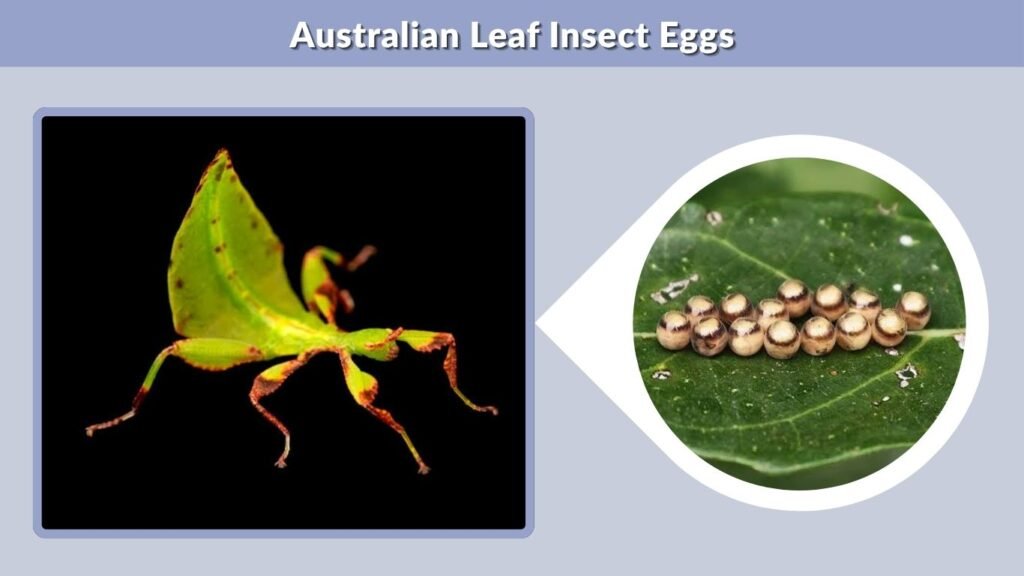
Leaf insect eggs are one of the most unusual parts of their biology.
Rather than carefully attaching each egg to a leaf, females may simply release them so they drop onto the forest floor.
What Do the Eggs Look Like?
They are often:
- Small
- Brown or gray
- Hard-shelled
- Seed-like
- Irregularly textured
This resemblance to seeds may make them harder for predators to recognize.
The eggs often require patience in captivity because they can take months to hatch.
Female Australian Leaf Insects
Female leaf insects tend to have the strongest leaf-like appearance.
They are usually larger, wider, and heavier than males.
Their broad bodies help them blend almost perfectly with foliage.
Male vs. Female
Males generally have:
- Slimmer bodies
- Longer antennae
- Better-developed flight ability
- Smaller overall size
Females tend to spend more time resting and feeding, while adult males may move around more frequently in search of mates.
Can Australian Leaf Insects Fly?
Flight ability differs between males and females.
Adult males of many leaf insect species are capable of flying because they are relatively light and have functional wings.
Females are much heavier and broader. Their wings may not provide the same flight capability, so they rely primarily on walking and camouflage.
Australian Leaf Insect Care
Australian leaf insects can be fascinating animals to observe, but successful captive care requires attention to their environmental needs.
Enclosure
A suitable enclosure should provide:
- Plenty of vertical height
- Good airflow
- Climbing branches
- Fresh foliage
- Appropriate warmth
- Suitable humidity
Vertical space is especially important because leaf insects hang downward while molting.
The enclosure should ideally be several times taller than the insect’s body length.
Humidity and Ventilation
Leaf insects generally require enough humidity to molt successfully.
However, an enclosure should not remain constantly wet.
High moisture combined with poor ventilation can promote mold and unhealthy conditions. A balance of humidity and airflow is much safer.
Feeding
Fresh food leaves should be replaced regularly.
Branches can be placed in water to keep foliage fresh, but water containers should be covered so insects cannot fall inside.
Always avoid leaves collected from areas that may have been sprayed with pesticides.
Australian Leaf Insect as a Pet
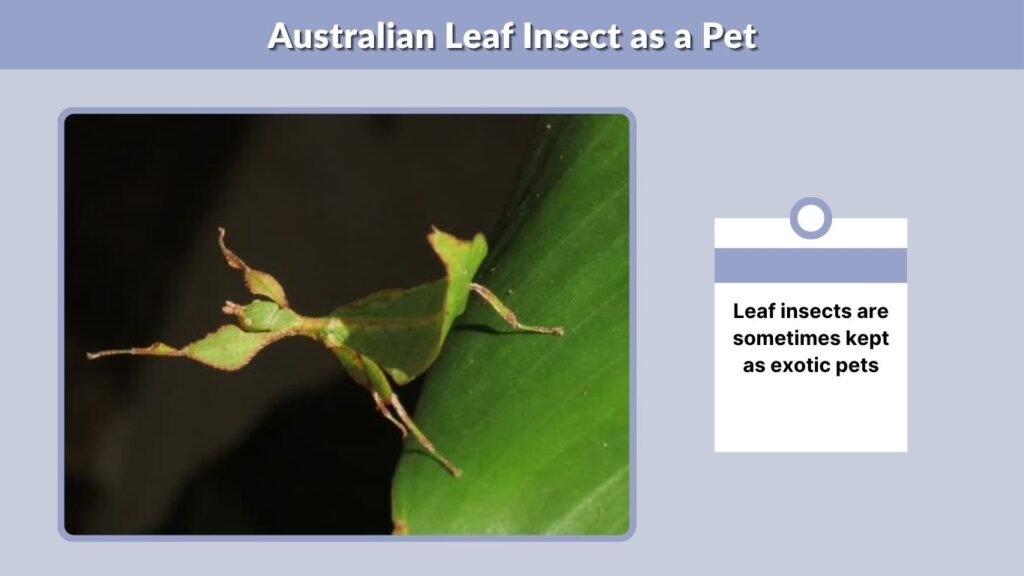
Leaf insects are sometimes kept as exotic pets because they are quiet, unusual, and require relatively little space.
However, local laws may regulate the keeping, collecting, transporting, or selling of native Australian insects.
Handling
Australian leaf insects should be handled gently.
Their legs are delicate, and pulling one from a branch can cause injury.
It is better to place a hand nearby and allow the insect to walk onto it voluntarily.
They do not sting and are not venomous.
Are Australian Leaf Insects Dangerous?
No. Australian leaf insects are generally harmless to humans.
They are plant-eating insects and have no interest in attacking people.
Their main defense is camouflage.
When threatened, they may remain motionless, sway, move away slowly, or drop into vegetation where their leaf-like appearance makes them difficult to find.
Australian Leaf Insect Predators
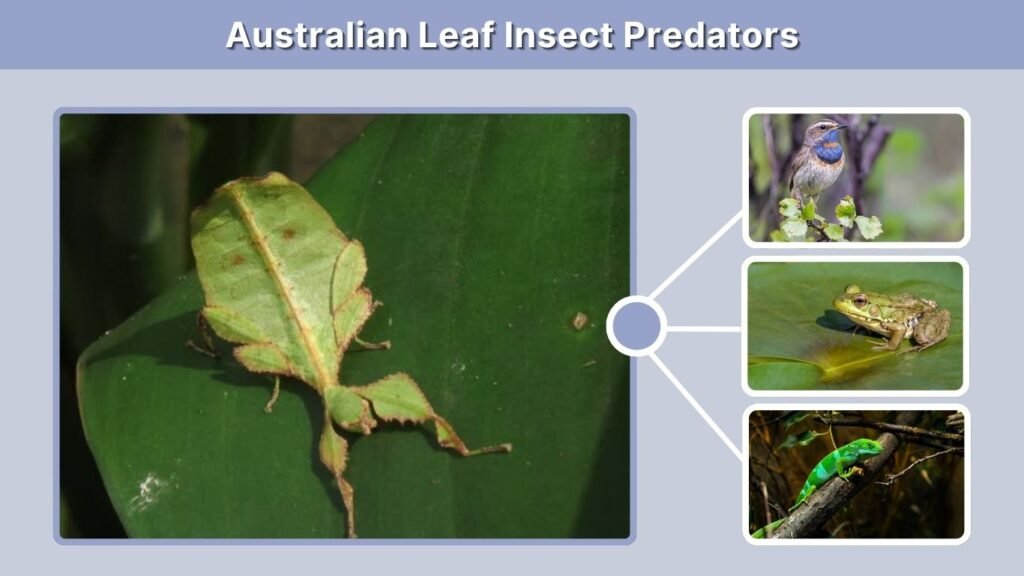
Despite their outstanding camouflage, leaf insects still face numerous predators.
Potential predators include:
- Birds
- Lizards
- Frogs
- Spiders
- Predatory insects
- Small mammals
Staying motionless among vegetation is often their best defense.
Their unusual body shape can make a predator overlook them even at relatively close range.
Interesting Australian Leaf Insect Facts
- They belong to the same insect order as stick insects.
- Their bodies can closely resemble living leaves.
- Females are generally larger than males.
- Males are usually better flyers.
- They eat plants rather than other insects.
- Their eggs can resemble seeds.
- Nymphs grow through repeated molts.
- They may sway to imitate leaves moving in the wind.
- Monteith’s leaf insect is associated with northeastern Australia.
- The spiny leaf insect is different from a true leaf insect.
- Their camouflage protects them from predators.
- They are generally harmless to humans.
FAQs
What is the Australian leaf insect called?
One of Australia’s notable true leaf insects is commonly known as Monteith’s leaf insect. It has historically been referred to as Phyllium monteithi. Australia also has the spiny leaf insect, Extatosoma tiaratum, which is a different type of phasmid.
What do Australian leaf insects eat?
They are herbivores that consume fresh foliage. Suitable plants depend on the species, but eucalyptus and various other leafy plants may be eaten. Captive food should always be fresh and completely free from insecticides, herbicides, and other harmful chemicals.
Are Australian leaf insects poisonous?
No. Australian leaf insects are not venomous or poisonous to humans. They rely primarily on camouflage rather than chemical or physical defenses. Their delicate appearance reflects their strategy of hiding among foliage instead of confronting predators.
Can Australian leaf insects fly?
Adult males of many leaf insect species can fly and typically have relatively long wings and lightweight bodies. Females are larger and heavier and generally depend more heavily on walking and camouflage than on flight.
Is the Australian spiny leaf insect a true leaf insect?
Not exactly. The Australian spiny leaf insect, Extatosoma tiaratum, belongs to the stick insect order but is not the same as the broad, flat-bodied true leaf insects. It often resembles dried leaves, bark, or curled plant material rather than a fresh green leaf.
