
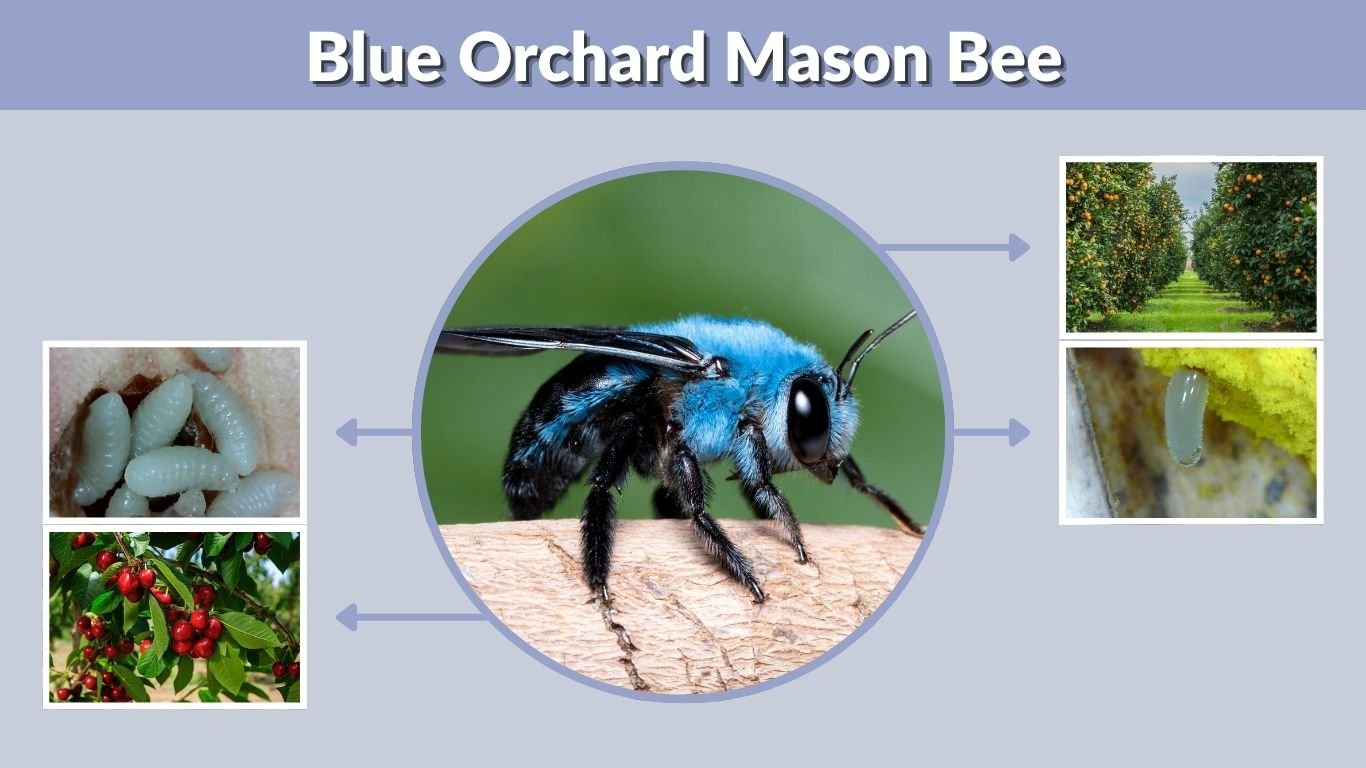
The Blue Orchard Mason Bee (Osmia lignaria) is a metallic blue native bee of North America and an exceptionally valuable spring pollinator. Also called the blue orchard bee or orchard mason bee, it is especially effective at pollinating apples, cherries, pears, peaches, and other early-blooming fruit crops. Unlike honey bees, Blue Orchard Mason Bees are solitary: every female constructs her own nest in an existing hole or tube. They are gentle, easy to support in gardens, and readily use properly designed bee houses.
What Does a Blue Orchard Mason Bee Look Like?
Blue Orchard Mason Bees have a compact, robust shape that can initially resemble a small dark honey bee. In good light, however, their bodies reveal a distinctive metallic blue, blue-green, or nearly blue-black sheen. Females carry pollen on specialized hairs beneath the abdomen rather than in pollen baskets on their hind legs.
Identification
- Scientific name: Osmia lignaria
- Family: Megachilidae
- Metallic dark blue to blue-green body
- Compact, rounded abdomen
- Hairy thorax
- Clear to smoky wings
- Pollen often visible beneath a female’s abdomen
- Female roughly honey-bee sized
- Male slightly smaller than female
- Male has more pale facial hair
- Male antennae are somewhat longer
Oregon State describes both sexes as shiny dark blue-green, with females approximately honey-bee sized and males somewhat smaller.
Why Are They Called Blue Orchard Bees?
“Blue” refers to their metallic blue-black coloration, while “orchard” reflects their importance as pollinators of spring-blooming fruit trees.
They are also called mason bees because females gather mud and use it to build partitions between individual brood cells inside their nests.
Blue Orchard Mason Bee Range and Habitat
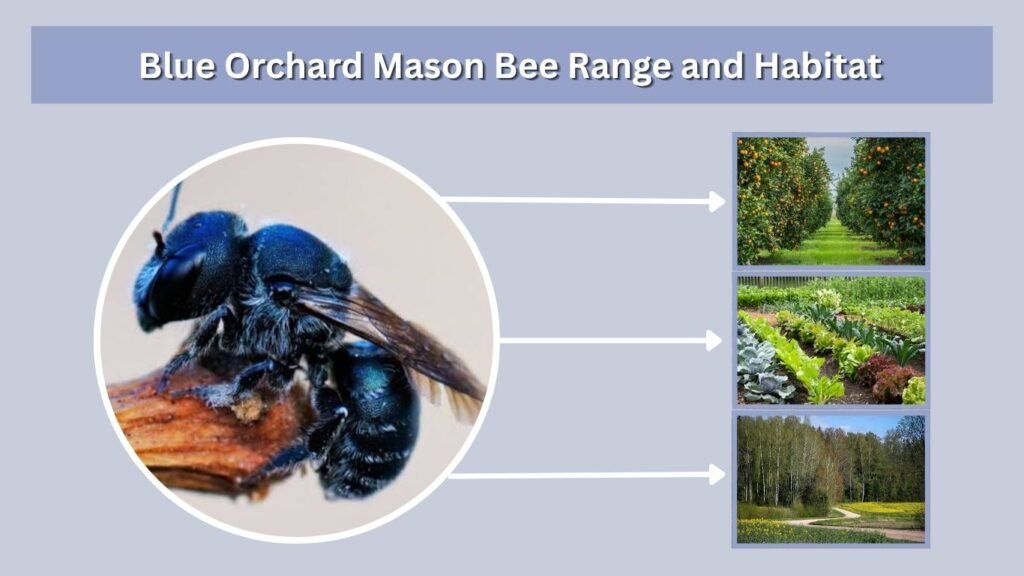
The Blue Orchard Bee is native to North America. It occurs in habitats where suitable spring flowers and nesting cavities are available and is especially well known in western North America because it is actively managed for orchard pollination.
Where Do Blue Orchard Mason Bees Live?
They may occur around:
- Orchards
- Gardens
- Woodland edges
- Shrubby habitats
- Farms
- Parks
- Residential landscapes
- Areas containing dead wood or hollow stems
Natural nests are established in pre-existing cavities, including abandoned beetle holes in wood and hollow plant stems. They do not normally chew their own tunnels into solid wood.
Blue Orchard Bees in Virginia and Other States
Because Osmia lignaria is a North American native rather than a species restricted to one western state, populations occur beyond Oregon and California.
Local abundance varies according to climate, flowers, nesting sites, and regional populations. In western orchards, the species is particularly well studied and commercially managed.
Blue Orchard Mason Bee Nest
A Blue Orchard Mason Bee does not build a hive. Each female independently finds a narrow cavity and constructs a row of individual chambers inside it. She gathers pollen and nectar for each chamber, lays one egg, then closes the cell with mud before starting another.
What Does the Nest Look Like?
A typical nest contains:
- A narrow tunnel
- Several brood cells in a row
- Mud partitions between cells
- Pollen and nectar provisions
- One egg per brood cell
- A thick mud plug sealing the entrance
Female eggs are generally placed deeper inside the nest, while male offspring tend to occupy cells closer to the entrance.
Why Do They Use Mud?
Mud gives mason bees their common name.
A female collects moist soil with her mandibles, carries it back to the cavity, and molds it into walls separating one brood chamber from another.
She eventually creates another mud barrier across the entrance.
Blue Orchard Mason Bee House and Tubes
Blue Orchard Bees readily accept artificial nesting sites, which is one reason they can be managed in orchards and backyard gardens. Suitable nest structures mimic naturally occurring narrow cavities.
Common Nesting Materials
They may use:
- Hollow reeds
- Cardboard nesting tubes
- Properly drilled wooden blocks
- Natural hollow stems
- Removable nesting inserts
Utah State University notes that Osmia lignaria readily uses artificial wooden tunnels, hollow reeds, and cardboard tubes.
Where Should a Bee House Be Placed?
A bee house should be firmly secured in a sheltered location where tunnels remain relatively dry.
Nearby flowering plants and access to moist soil are also important. The female needs flowers for pollen and nectar and mud for constructing her brood cells.
Avoid treating bee houses or nearby flowering plants with insecticides that can harm pollinators.
Blue Orchard Mason Bee Life Cycle
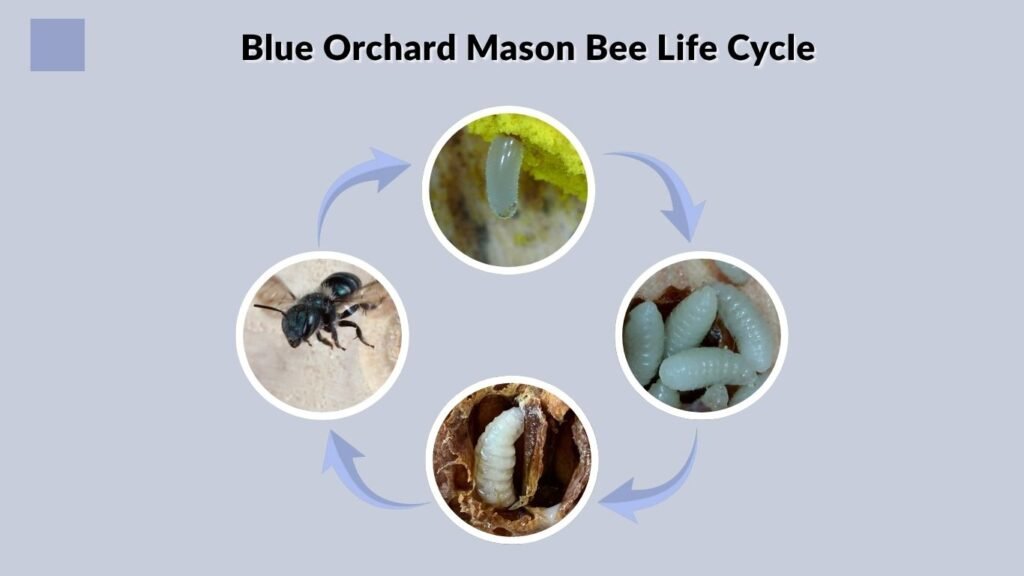
Blue Orchard Bees have an annual life cycle closely synchronized with spring flowering. Eggs laid during spring develop through the larval and pupal stages over summer. By fall, the new generation has become adult bees but remains protected inside cocoons through winter.
Life Cycle Stages
- Egg: Female lays one egg on a pollen-nectar provision.
- Larva: The larva eats the stored food.
- Pupa: It transforms within a cocoon.
- Adult: The adult develops before winter.
- Overwintering: Adult remains inside its cocoon.
- Spring emergence: Adults exit and begin another generation.
Blue Orchard Bees therefore live on approximately a one-year developmental cycle.
When Do Blue Orchard Bees Emerge?
They are early-spring bees.
Males generally emerge first. Females follow shortly afterward, mate, and begin searching for nesting cavities.
Utah State Extension describes mason bees as active primarily from March through June in its region, with peak activity around April. Exact emergence varies with climate and flowering conditions.
What Do Blue Orchard Mason Bees Eat?
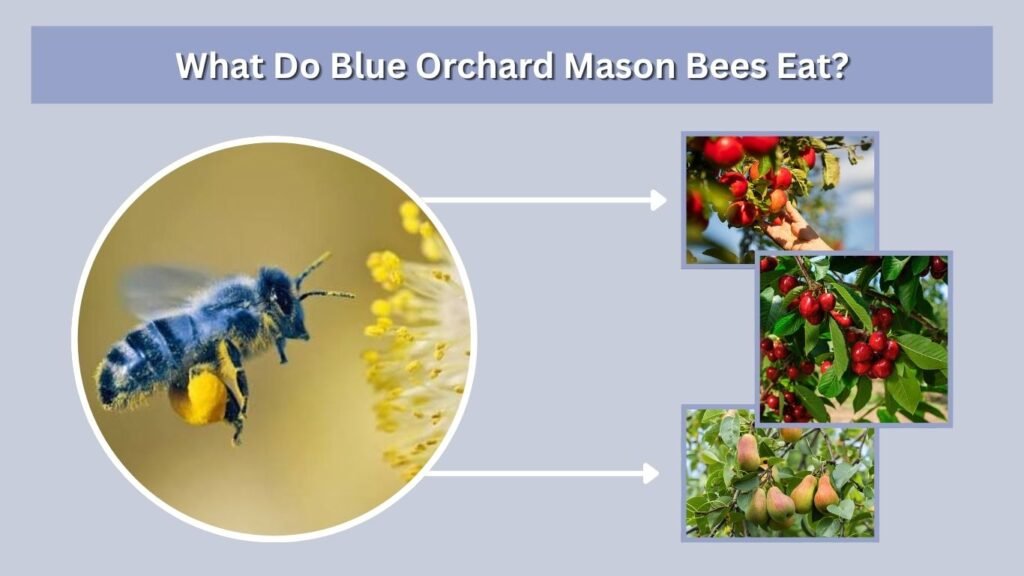
Adults collect both pollen and nectar from spring flowers. Females use these foods not only for themselves but also to create pollen-nectar provisions for their larvae.
Favorite Flowers
Blue Orchard Bees are particularly associated with plants in the rose family, including:
- Apple
- Cherry
- Pear
- Peach
- Almond
- Other early fruit-tree blossoms
- Caneberries
- Various native spring flowers
Utah State reports a strong preference for rosaceous fruit crops, while Oregon State highlights their value for apples, pears, and cherries.
Why Are Blue Orchard Bees Good Pollinators?
Blue Orchard Bees are exceptionally effective orchard pollinators because of how they collect pollen and move between blossoms. They frequently contact reproductive flower structures while gathering pollen and can transfer substantial amounts between flowers.
Oregon State reports that Blue Orchard Mason Bees commonly transfer more pollen than honey bees when visiting fruit-tree blossoms.
Important Crops They Pollinate
They are especially valuable for:
- Apples
- Pears
- Cherries
- Peaches
- Almonds
- Caneberries
- Other spring-blooming crops
Their spring activity also makes them valuable in home gardens and community landscapes.
Do Blue Orchard Mason Bees Sting?
Female Blue Orchard Bees are physically capable of stinging, but they are very gentle and reluctant to sting. Males cannot sting.
Because they are solitary, there is no communal hive, queen, or honey supply for workers to defend. This makes them much less defensive around nesting sites than honey bees or social wasps.
When Might They Sting?
A female might sting if she is:
- Squeezed
- Roughly handled
- Trapped against the skin
- Directly threatened
Utah State Extension describes mason bees as docile and unlikely to sting except in self-defense, while Oregon State describes them as relatively nonaggressive.
Simply standing near a Blue Orchard Bee house usually poses little risk.
Blue Orchard Bee vs Honey Bee
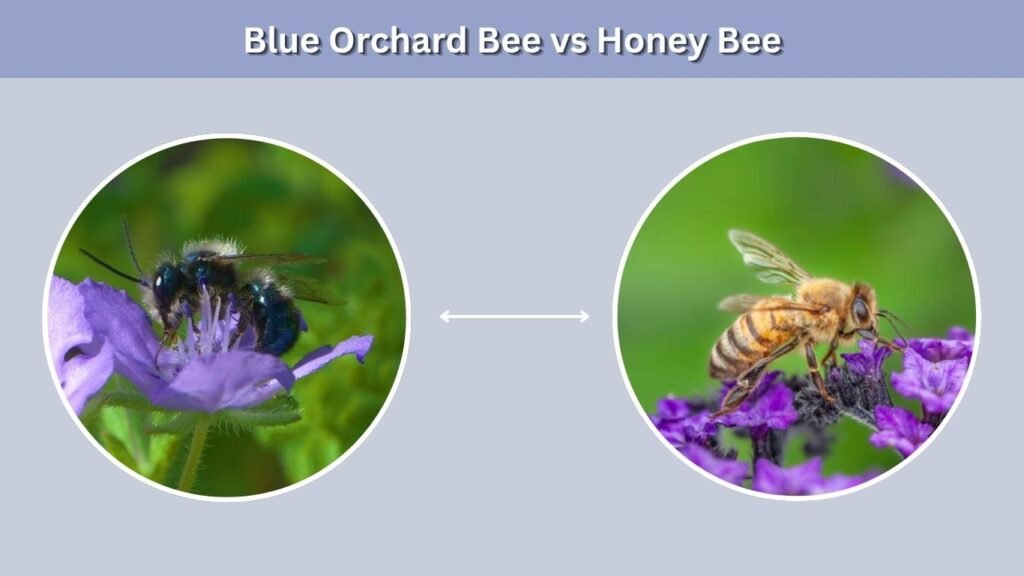
These two useful pollinators have very different lifestyles.
| Feature | Blue Orchard Bee | Honey Bee |
| Lifestyle | Solitary | Social colony |
| Appearance | Metallic blue-black | Brown/yellow striped |
| Nest | Individual cavity | Large hive |
| Nest material | Mud partitions | Wax comb |
| Honey production | No | Yes |
| Pollen transport | Under abdomen | Hind-leg baskets |
| Spring orchard pollination | Excellent | Excellent |
| Aggressiveness | Very low | More defensive near hive |
A cluster of mason bees using one nesting block is therefore not a colony. Each female maintains her own tunnel independently.
How to Attract Blue Orchard Mason Bees
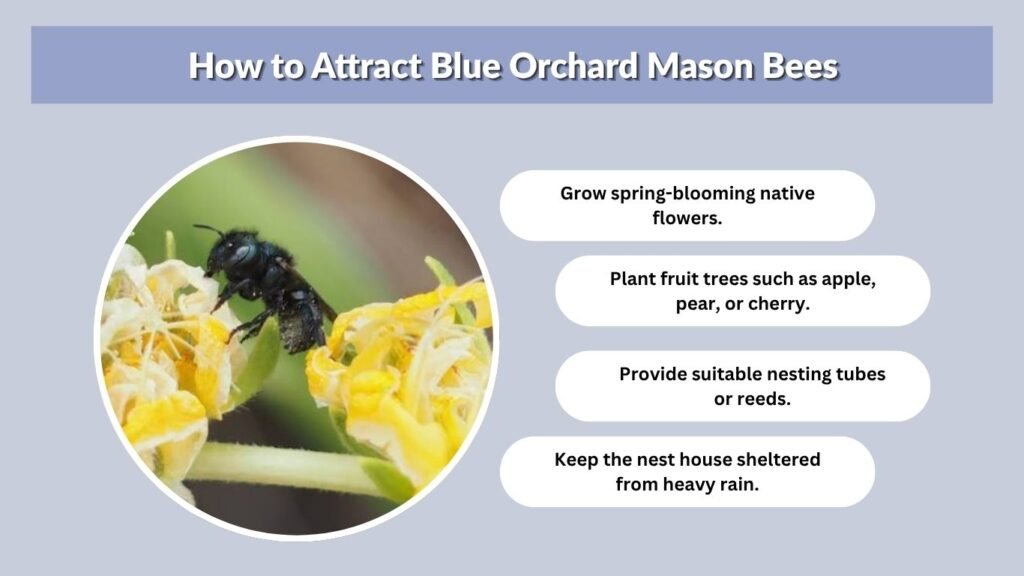
A garden can support these bees by combining suitable nesting spaces with abundant early-season flowers.
Best Ways to Attract Them
- Grow spring-blooming native flowers.
- Plant fruit trees such as apple, pear, or cherry.
- Provide suitable nesting tubes or reeds.
- Keep the nest house sheltered from heavy rain.
- Provide access to moist, pesticide-free soil.
- Avoid spraying flowering plants with insecticides.
- Maintain diverse flowering plants nearby.
The goal is to provide all three resources females require: food, nesting cavities, and mud.
FAQs
1. Is the Blue Orchard Bee the same as a mason bee?
Yes. The Blue Orchard Bee, Osmia lignaria, is a species of mason bee.
2. Where do Blue Orchard Mason Bees live?
They are native to North America and use gardens, orchards, woodland habitats, and other areas providing flowers and pre-existing nesting cavities.
3. Do Blue Orchard Mason Bees sting?
Females can sting but rarely do so unless handled or trapped. Males cannot sting.
4. What do Blue Orchard Bees pollinate?
They are particularly effective at pollinating apple, cherry, pear, peach, and other early-blooming fruit crops.
5. How long does a Blue Orchard Mason Bee live?
Its complete life cycle lasts approximately one year. Eggs laid in spring develop into adults by fall, overwinter inside cocoons, and emerge the following spring.
