
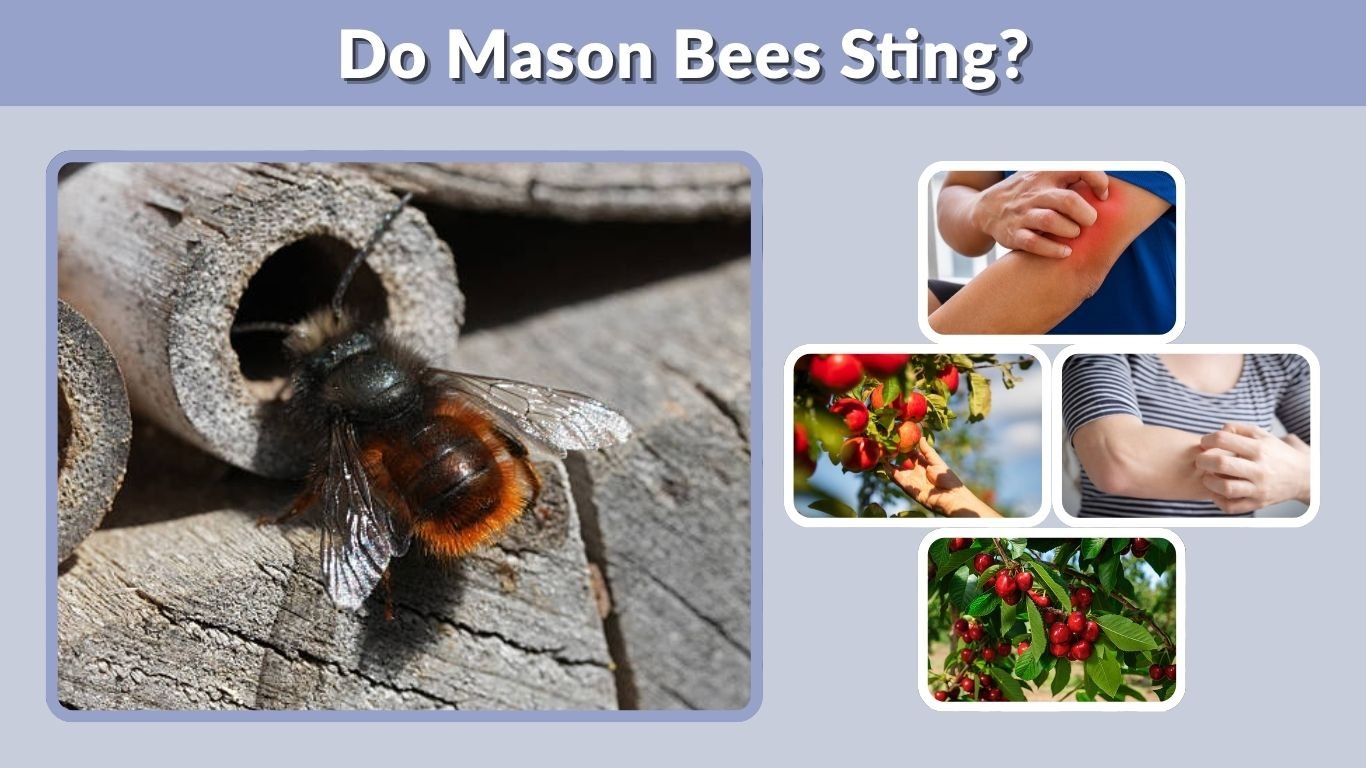
Mason bees can sting, but they are among the least aggressive bees people are likely to encounter. Only female mason bees have functional stingers, and they usually sting only when squeezed, trapped in clothing, or handled roughly. Male mason bees cannot sting. Because mason bees are solitary and do not defend a large colony or honey supply, they have little reason to attack people near their nests. For gardeners and homeowners, mason bees are generally considered gentle, beneficial pollinators that can safely nest close to human activity.
Do Mason Bees Sting?
Yes, female mason bees can sting, but stings are uncommon. Oregon State University Extension notes that mason bees generally sting only when handled roughly or trapped beneath clothing. Unlike social bees, they do not have thousands of nestmates, a queen, or stores of honey to defend.
When Might a Mason Bee Sting?
A female may sting if she is:
- Squeezed in your hand
- Stepped on accidentally
- Trapped beneath clothing
- Roughly handled
- Physically restrained
- Threatened while unable to escape
Simply walking near a mason bee house, watching females enter nesting tubes, or working near flowers normally does not trigger defensive behavior.
Solitary bees typically choose to fly away instead of confronting people.
Do All Mason Bees Have Stingers?
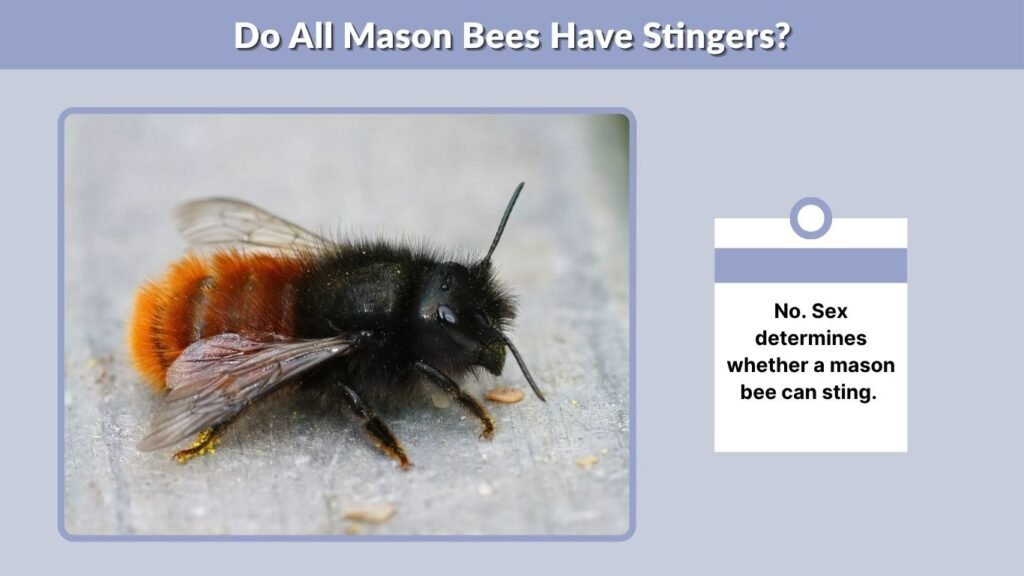
No. Sex determines whether a mason bee can sting. Mason bees belong to a group of insects in which the sting evolved from an egg-laying structure, so males lack functional stingers.
Male vs Female Mason Bees
Female mason bees: Have stingers and can sting in self-defense.
Male mason bees: Cannot sting.
Female mason bees also perform most nesting work. Each female finds a cavity, gathers pollen and nectar, lays eggs, and builds partitions—often with mud—between developing offspring.
Do Mason Bees Bite?
Mason bees have mandibles, but they are not considered biting pests of humans.
Their jaws are useful for manipulating nesting materials and performing other everyday tasks. A mason bee confronted by a person relies mainly on escape, with a female capable of stinging if physically threatened.
Sting vs Bite
If someone feels pain after trapping or squeezing a female mason bee, a sting is the more likely explanation.
Mason bees do not behave like blood-feeding insects and do not bite humans for food.
How Painful Is a Mason Bee Sting?
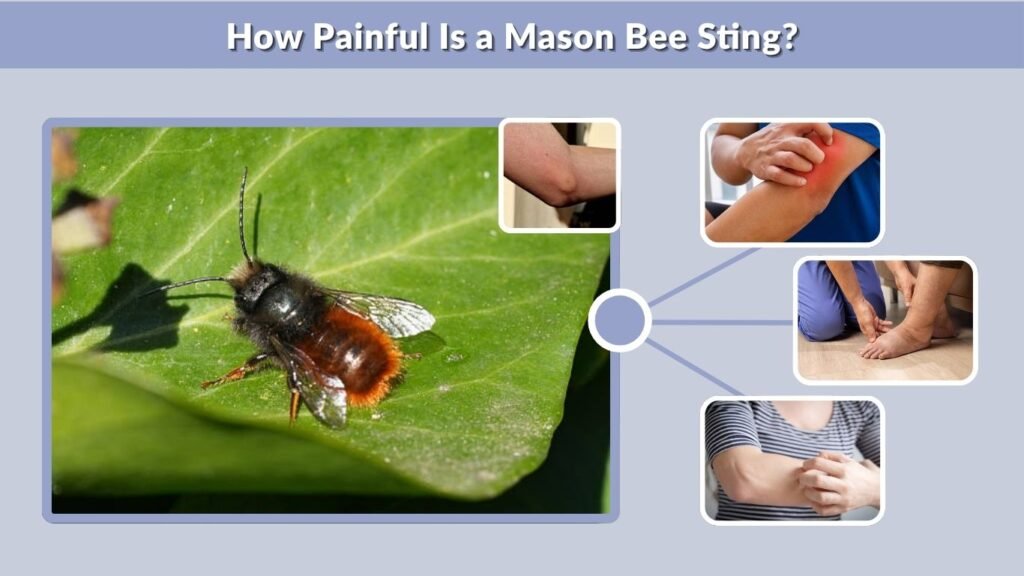
A mason bee sting is generally regarded as mild compared with the defensive stings people associate with honey bees or social wasps.
Oregon State University describes mason bees as relatively nonaggressive, while extension material characterizes their sting as mild and notes that people rarely need to worry about being stung.
Possible Sting Symptoms
A normal local reaction may include:
- Brief sharp pain
- Redness
- Mild swelling
- Itching
- Tenderness around the sting site
Individual reactions vary. Any bee sting can potentially cause a serious allergic reaction in someone who is sensitive to bee venom.
Difficulty breathing, widespread hives, dizziness, or swelling of the face or throat requires urgent medical attention.
Do Mason Bees Die After Stinging?
Mason bees do not normally die simply because they sting.
The familiar “bee dies after stinging” phenomenon is mainly associated with worker honey bees, whose barbed stingers can become embedded in mammalian skin and tear away as the bee escapes. Most other stinging bees and wasps can withdraw their stingers.
Do Mason Bees Leave Their Stinger Behind?
Generally, no.
A mason bee does not normally leave behind the barbed sting apparatus typical of a honey bee worker. This means a female can survive a defensive sting.
Still, repeated stinging is unusual because mason bees are not aggressive insects attempting to defend a colony.
Why Are Mason Bees So Gentle?
The answer lies largely in their solitary lifestyle. Honey bees live in large colonies containing valuable brood and food reserves, so defensive workers protect the hive collectively. Mason bees live very differently.
Every female mason bee essentially operates independently.
Mason Bees Do Not Have
- A worker army
- A communal queen
- Large honey stores
- A large social colony
- A defensive hive requiring collective protection
Many females may use holes beside one another in the same bee hotel, but this is an aggregation of individual nests rather than a honey-bee-style colony.
Because each female’s survival directly affects her ability to reproduce, avoiding unnecessary conflict is advantageous.
Do Orchard Mason Bees Sting?
Yes, female orchard mason bees (Osmia lignaria) are physically capable of stinging.
However, they are especially well known for their calm behavior and are widely managed as fruit-tree pollinators.
Orchard Mason Bee Behavior
Oregon State University Extension reports that:
- Males cannot sting.
- Females are nonaggressive.
- Females generally sting only when handled roughly or trapped beneath clothing.
This makes orchard mason bees well suited to gardens, orchards, schools, and other places where people may regularly be nearby.
Do Red Mason Bees Sting?
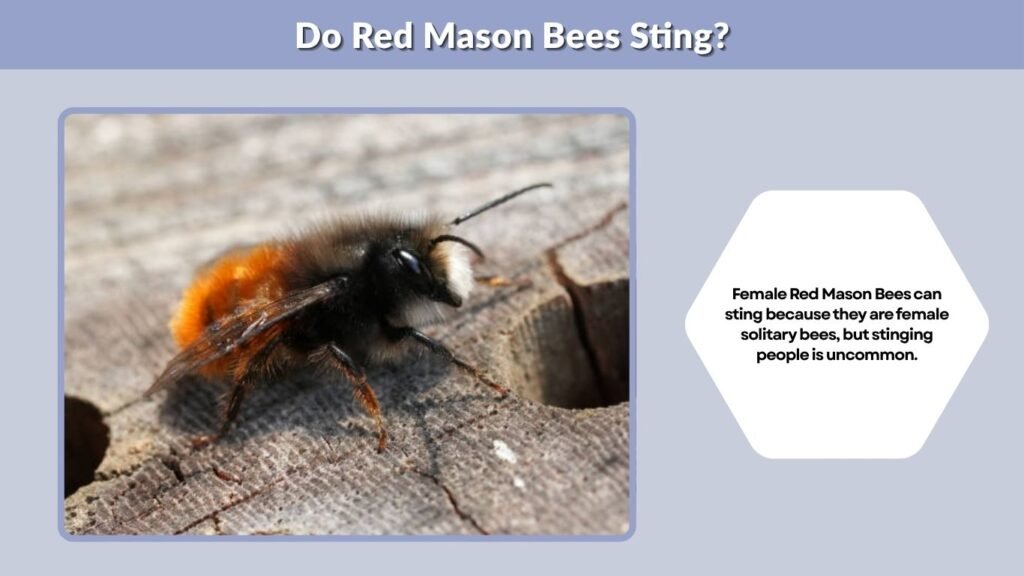
Female Red Mason Bees (Osmia bicornis) can sting because they are female solitary bees, but stinging people is uncommon.
Red Mason Bees are familiar garden pollinators across much of the UK. They commonly nest in brickwork, bee hotels, window frames, hollow stems, and other small cavities.
Red Mason Bees in the UK
The Royal Horticultural Society states that female bees have stings, but solitary bees are not aggressive and normally sting only if roughly handled.
Therefore, seeing multiple Red Mason Bees around a bee hotel is not comparable to encountering a defensive wasp nest.
Do Mason Bees Sting in the UK?
Yes, female mason bees in the UK are capable of stinging, but the likelihood is very low when the insects are left undisturbed.
Red Mason Bees are among the best-known British species and regularly live close to houses and gardens.
Are Bee Hotels Safe?
Generally, yes.
A properly placed mason bee hotel can have many females nesting side by side without creating an aggressive colony.
You can usually observe their nesting activity at close range without being attacked because each bee is independently provisioning its own nest.
What About Mason Bees in New Zealand?
The term “mason bee” should be used carefully because regional insect names can differ, and people sometimes confuse mason bees with mason wasps.
True mason bees belong mainly to the genus Osmia. Mason wasps are different insects and may have different defensive behavior.
If you are identifying an insect in New Zealand, confirm whether it is actually a solitary bee before applying general mason-bee information.
Mason Bee vs Honey Bee Sting
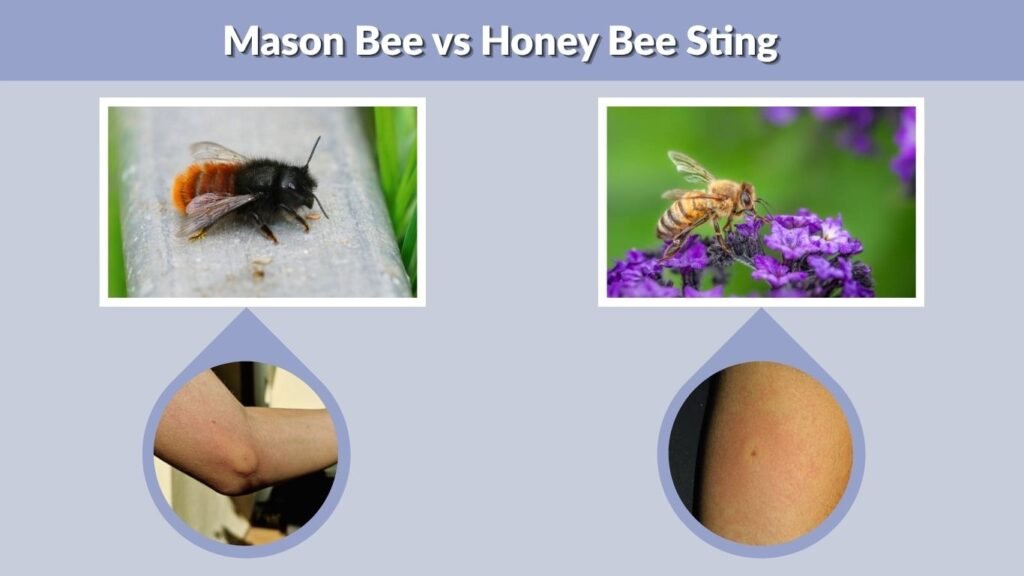
Despite both being bees, their defensive behavior is quite different.
| Feature | Mason Bee | Honey Bee |
| Colony type | Solitary | Highly social |
| Female can sting | Yes | Yes |
| Male can sting | No | No |
| Aggressiveness | Very low | More defensive near hive |
| Protects honey stores | No | Yes |
| Stinger usually remains | No | Often in mammalian skin |
| Bee usually dies after sting | No | Worker usually does |
Honey bee workers possess barbed stingers that often lodge in mammalian skin, while most other stinging bees withdraw theirs.
Can You Safely Handle Mason Bees?
Although mason bees are gentle, routinely handling adults is unnecessary.
The safest approach is simply to let them land, forage, and nest naturally.
Safe Behavior Around Mason Bees
- Do not squeeze or grab adults.
- Avoid blocking active nest holes.
- Shake out clothing if a bee flies inside.
- Do not spray bee hotels with pesticides.
- Allow bees an escape route.
- Teach children to watch rather than grab them.
You can usually approach a mason bee nesting area closely without provoking defensive behavior.
Are Mason Bees Dangerous?
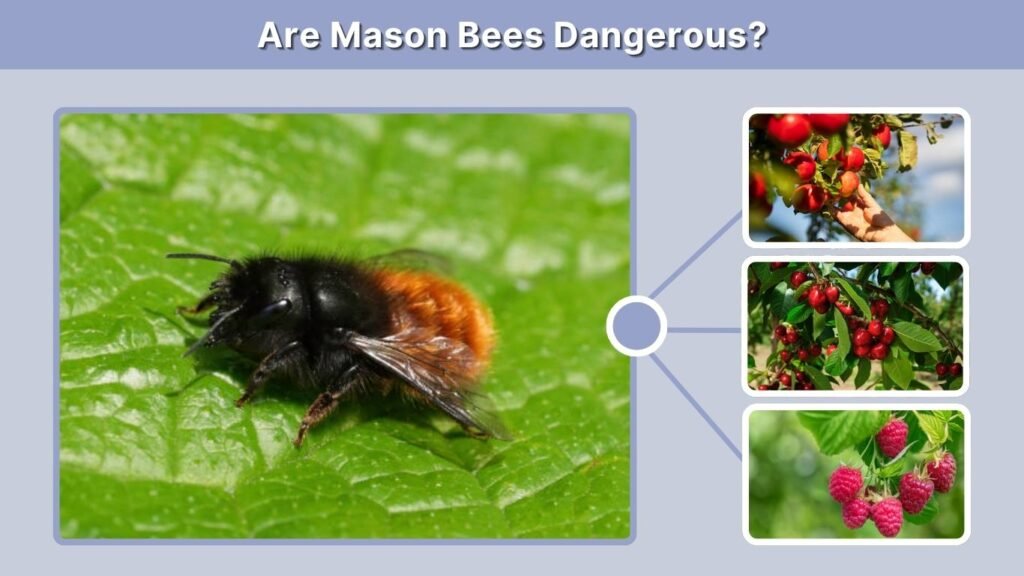
For most people, mason bees pose very little danger.
They are beneficial pollinators of fruit trees and many garden plants, and their reluctance to sting makes them particularly suitable around homes.
Benefits of Mason Bees
Mason bees pollinate:
- Apples
- Cherries
- Pears
- Blueberries
- Raspberries
- Blackberries
- Almonds
- Many spring flowers
North American Osmia species are considered important pollinators of several agricultural crops.
Their pollination value is a much stronger reason to welcome them than their very small sting risk is a reason to remove them.
FAQs
1. Do mason bees sting humans?
Female mason bees can sting humans, but stings are rare and usually occur only when the bee is squeezed, roughly handled, or trapped.
2. Do male mason bees sting?
No. Male mason bees do not have functional stingers.
3. Do mason bees leave their stinger behind?
Usually not. Unlike worker honey bees, mason bees do not normally leave a barbed stinger embedded in human skin.
4. Do mason bees die when they sting?
No. Mason bees do not normally die after stinging. The fatal sting mechanism is characteristic of honey bee workers when their barbed stinger becomes lodged in mammalian skin.
5. Are Red Mason Bees dangerous?
No. Red Mason Bees are gentle solitary pollinators. Females can sting defensively, but they are unlikely to do so unless roughly handled.
