
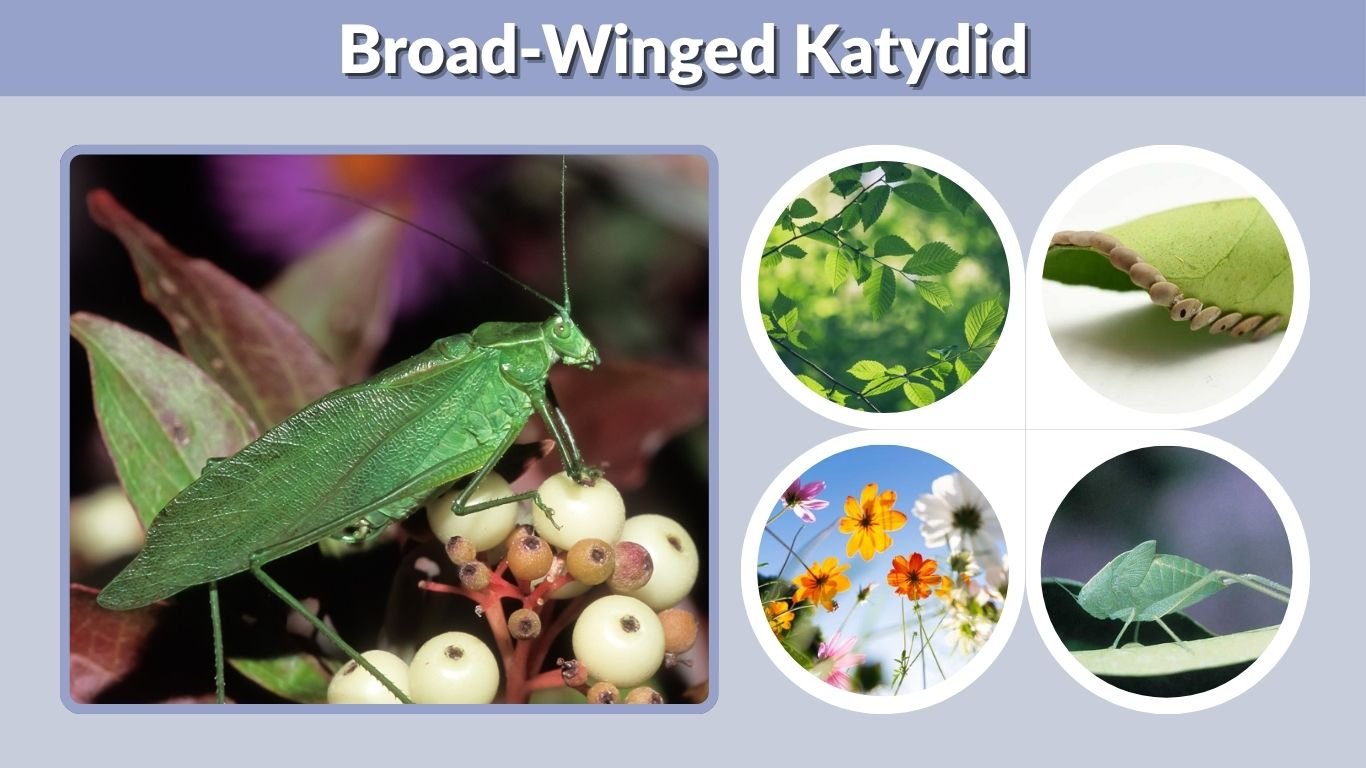
The broad-winged katydid (Microcentrum rhombifolium) is a large, bright-green insect whose wide wings closely resemble leaves. Also known as the greater angle-winged katydid in many references, it belongs to the family Tettigoniidae and commonly lives among trees, shrubs, and garden plants. Adults can reach about 2 to 2.5 inches long and are especially active after dark. Their unusual calls, excellent camouflage, egg-laying behavior, and occasional feeding damage make broad-winged katydids interesting visitors to yards and gardens.
Broad-Winged Katydid Identification
Broad-winged katydids are excellent leaf mimics. Their large green wings have visible veins that resemble those of a living leaf, allowing the insects to remain almost invisible among vegetation during daylight. They are members of the order Orthoptera, which also contains crickets and grasshoppers, but their exceptionally long antennae make them relatively easy to recognize.
Broad-Winged Katydid Characteristics
Important identification features include:
- Scientific name: Microcentrum rhombifolium
- Family: Tettigoniidae
- Color: Usually bright green
- Adult length: Around 2–2.5 inches
- Antennae: Thin and longer than the body
- Wings: Broad, leaf-shaped, and longer than the body
- Back: Distinctly humped
- Legs: Long, with enlarged hind legs for jumping
A small tooth on the front central edge of the pronotum can also help distinguish the broad-winged species from similar angular-winged katydids.
Why Do They Look Like Leaves?
Leaf mimicry provides excellent protection from predators. A motionless broad-winged katydid resting among green leaves can be extremely difficult for birds and other visually hunting predators to detect.
The broad wings contribute greatly to the disguise. Their shape, green coloration, and network of veins create an appearance remarkably similar to foliage.
How Big Is a Broad-Winged Katydid?
The broad-winged katydid is one of the larger katydids commonly encountered in North America. Adults generally measure about 2 to 2.5 inches long, with their wings contributing substantially to their overall length. UC Integrated Pest Management gives an adult length of approximately 2¼ inches.
Broad-Winged Katydid vs Grasshopper
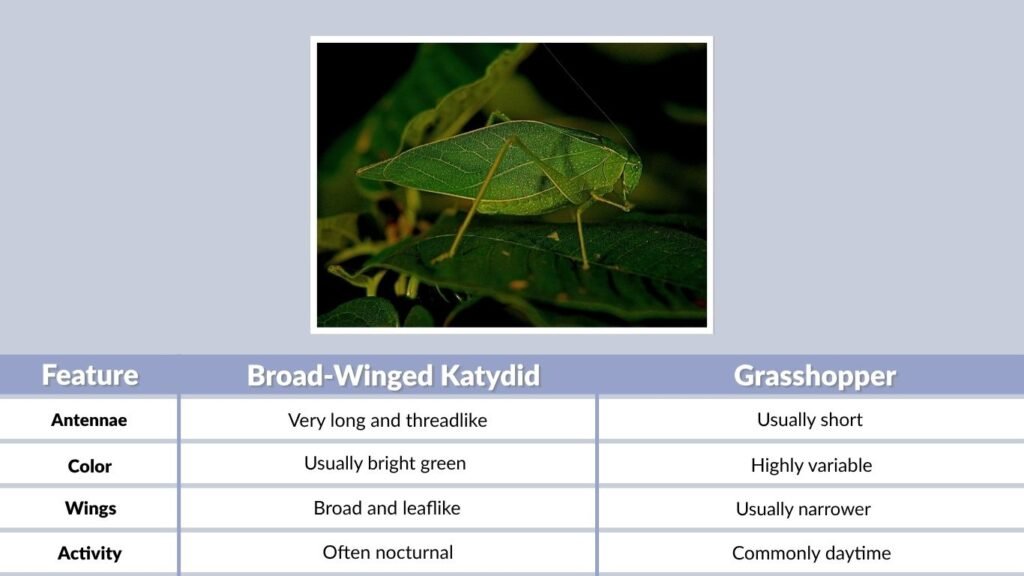
Despite their similar hind legs, katydids and grasshoppers have several noticeable differences.
| Feature | Broad-Winged Katydid | Grasshopper |
| Antennae | Very long and threadlike | Usually short |
| Color | Usually bright green | Highly variable |
| Wings | Broad and leaflike | Usually narrower |
| Activity | Often nocturnal | Commonly daytime |
| Family | Tettigoniidae | Usually Acrididae |
| Sound | Produced mainly with wings | Often legs and wings |
Their antennae are usually the fastest way to distinguish them. A katydid’s antennae may extend well beyond its body.
Broad-Winged Katydid Sound
The broad-winged katydid sound is primarily a mating signal produced by adult males. Like other singing katydids, males create sound by rubbing specialized areas of their forewings together. Calling is especially noticeable during warm evenings when adults are active in shrubs and trees.
What Does a Broad-Winged Katydid Sound Like?
The greater angle-winged or broad-winged katydid has a distinctive call that may include:
- A sharp introductory sound
- Individual calls separated by several seconds
- Short series of rapid ticking notes
- Repeated nighttime calling
Missouri’s Department of Conservation describes its song as a sharp call followed by a relatively even series of about 10–20 rapid ticks.
Why Do Broad-Winged Katydids Sing?
Male katydids sing primarily to attract females and communicate with members of their species.
Each species has a characteristic pattern, helping females recognize appropriate mates even when several species are calling from the same habitat.
Broad-Winged Katydid Life Cycle
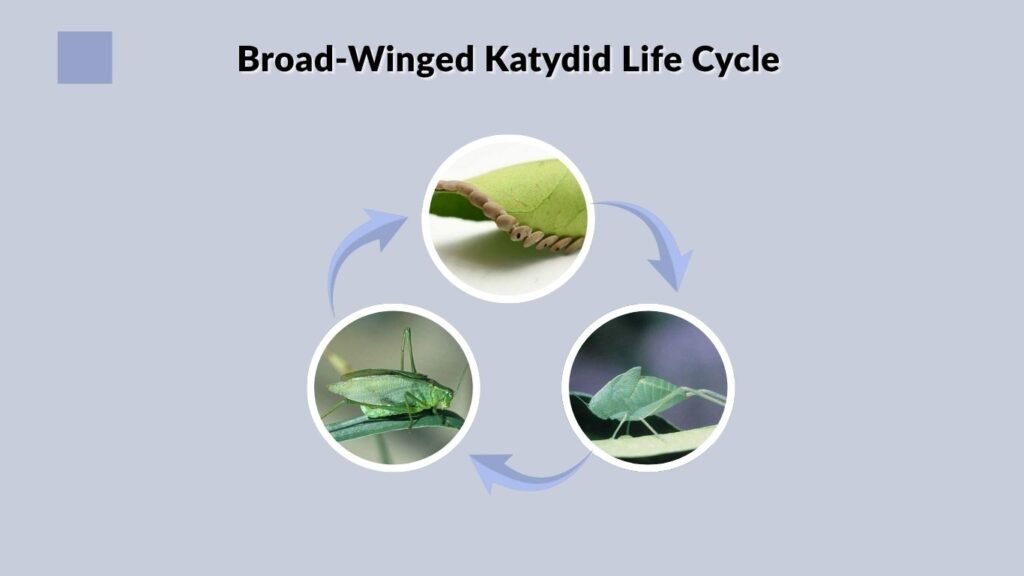
The broad-winged katydid life cycle has three major stages: egg, nymph, and adult. Unlike butterflies and beetles, katydids do not have a pupal stage. Instead, young nymphs gradually develop into adults through a series of molts, becoming larger and developing functional wings over time.
Life Cycle Stages
- Egg: Females deposit eggs on leaves, twigs, or other plant material.
- Nymph: Young katydids hatch looking like small wingless adults.
- Growing nymph: Each molt increases body size and wing development.
- Adult: Full-sized insects develop broad functional wings and reproduce.
- Egg laying: Females produce the next generation of eggs.
In some regions, eggs overwinter and hatch during spring. Adults become common during summer.
Broad-Winged Katydid Nymph
A broad-winged katydid nymph resembles a miniature adult but lacks fully developed wings.
Nymphs are typically green and have very long antennae. Their leaflike coloration provides camouflage while they feed and grow.
As the insect molts repeatedly, small wing pads become increasingly noticeable until the final molt produces the fully winged adult.
Broad-Winged Katydid Laying Eggs
Female broad-winged katydids deposit distinctive eggs on vegetation. In citrus, eggs may be placed in rows along leaf edges. The eggs are oval and typically brownish or gray. Other observations show eggs occurring in overlapping rows on twigs or similar surfaces.
What Do Broad-Winged Katydid Eggs Look Like?
Their eggs typically have:
- Oval or disk-like shape
- Gray or brown coloration
- Flattened appearance
- Arrangement in orderly rows
- Placement on leaves or twigs
- Firm attachment to plant surfaces
The orderly arrangement can make katydid eggs look quite different from randomly scattered insect eggs.
Should You Remove Katydid Eggs?
In most home gardens, removing them is unnecessary. Broad-winged katydids generally occur in numbers too low to cause major plant health problems.
If large numbers repeatedly damage young fruit trees, physically removing visible egg rows can reduce the number of nymphs emerging later. Routine pesticide treatment solely to destroy eggs is usually unnecessary.
What Do Broad-Winged Katydids Eat?
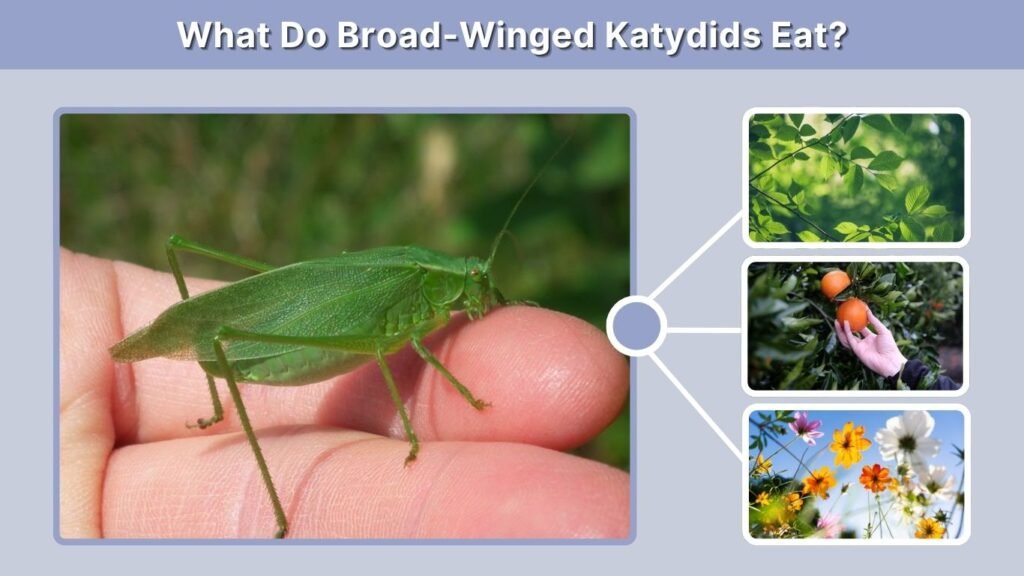
Broad-winged katydids primarily feed on plant material. Both adults and nymphs have chewing mouthparts capable of removing sections from leaves.
They may also feed on developing fruit, particularly in citrus-growing areas.
Common Foods
They may consume:
- Tree leaves
- Shrub foliage
- Citrus leaves
- Tender plant growth
- Flowers
- Young fruit
- Other plant material
Feeding typically creates irregular or jagged margins on leaves.
Broad-Winged Katydid Leaf Damage
Finding a broad-winged katydid eating plants does not automatically mean serious control is necessary. According to UF/IFAS, they can chew foliage and fruit, but extensive citrus damage is relatively uncommon. Young trees are more vulnerable than established mature plants.
Signs of Katydid Damage
Look for:
- Jagged leaf edges
- Irregular sections missing from leaves
- Small holes in foliage
- Chewed young fruit
- Smooth or slightly sunken feeding areas on fruit
- Increased damage on young trees
UC IPM similarly notes that katydid feeding generally affects only a few leaves and usually has little impact on overall plant health.
How to Get Rid of Broad-Winged Katydids
For a few insects, aggressive control is rarely necessary.
You can:
- Hand-remove visible katydids.
- Remove heavily infested plant material when necessary.
- Protect particularly vulnerable young plants.
- Inspect leaves and twigs for egg rows.
- Encourage natural predators.
- Avoid unnecessary broad-spectrum insecticides.
Established plants generally tolerate the small amount of foliage eaten by individual katydids.
Broad-Winged Katydid vs Broad-Winged Bush Katydid
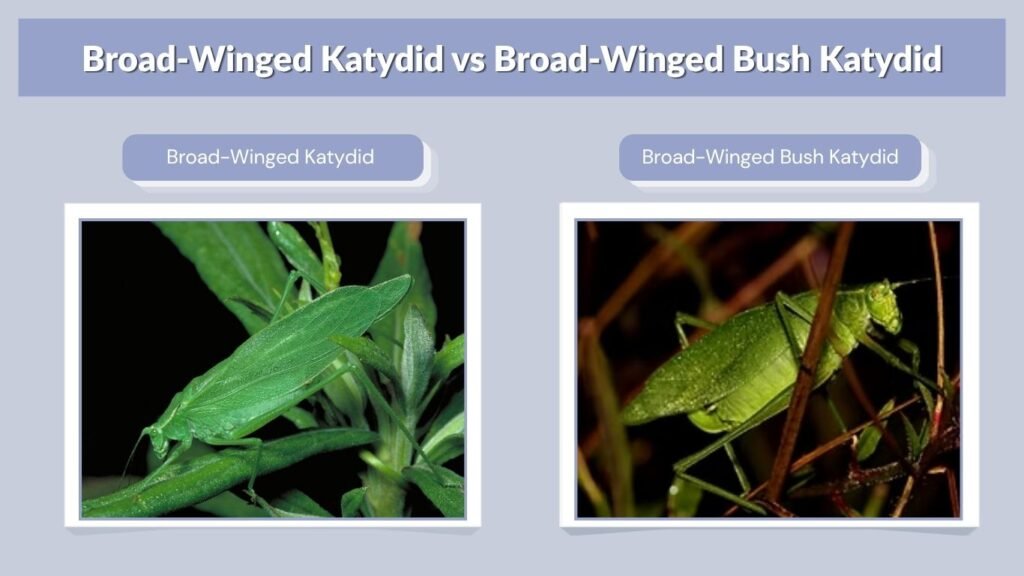
These names can create confusion. The broadwinged katydid is commonly identified as Microcentrum rhombifolium. However, “broad-winged bush katydid” has also been used for Scudderia pistillata in entomological checklists, meaning the names should not automatically be treated as referring to the same species.
Broad-Winged Katydid Range
Microcentrum rhombifolium has a broad North American distribution, including much of the eastern United States as well as portions of the Southwest. It inhabits areas containing suitable trees and shrubs where its leaflike body provides effective camouflage.
Adults may also visit outdoor lights at night.
Does a Broad-Winged Katydid Bite?
Broad-winged katydids have chewing mouthparts, but they are not blood-feeding insects and do not seek humans as prey.
A large katydid may potentially pinch with its mouthparts if it is grabbed or handled roughly. The easiest way to prevent this is simply to allow the insect to walk onto a container or plant rather than squeezing it with bare fingers.
Broad-Winged Katydid Spiritual Meaning
There is no scientific evidence that encountering a broad-winged katydid has a supernatural meaning. However, katydids are sometimes symbolically associated with patience, intuition, communication, change, and good fortune.
Its leaflike camouflage can also inspire personal interpretations involving adaptability or blending with one’s surroundings. These are cultural or individual symbolic interpretations rather than biological facts about the insect.
FAQs
What is a broad-winged katydid?
The broad-winged katydid is a large, green, leaf-mimicking katydid commonly identified as Microcentrum rhombifolium.
How big is a broad-winged katydid?
Adults generally reach about 2 to 2.5 inches long, making them relatively large katydids.
What does a broad-winged katydid sound like?
Males produce sharp calls accompanied by rapid ticking sequences, especially during warm evenings.
Do broad-winged katydids damage plants?
They can chew leaves and occasionally young fruit, but severe damage is uncommon on established plants. Young citrus trees can be more vulnerable.
Are broad-winged katydids dangerous?
No. They are not considered dangerous to humans. They are primarily plant-feeding insects and generally prefer escaping or remaining camouflaged when disturbed.
