
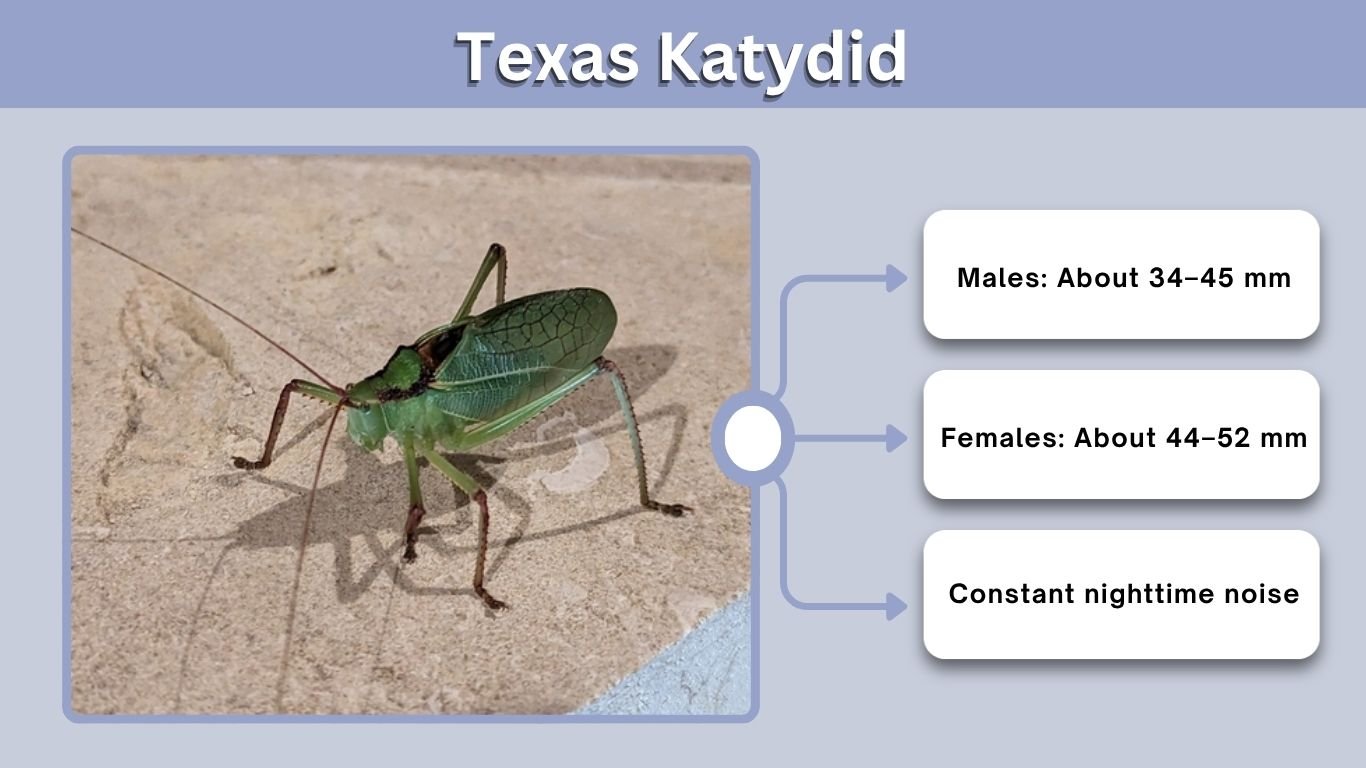
A Texas katydid can be anything from a delicate green leaf mimic to a large, red-eyed predatory insect. Texas supports numerous katydid species, including bush katydids, coneheads, meadow katydids, anglewings, and the unusual Central Texas leaf-katydid. Most have extremely long antennae, powerful jumping legs, and distinctive nighttime calls. Some species are mainly plant eaters, while others are aggressive predators of insects. Their size, color, sound, habitat, and seasonal activity make Texas katydids surprisingly diverse and easy to encounter.
What Does a Texas Katydid Look Like?
Katydids belong to the family Tettigoniidae and are close relatives of crickets and grasshoppers. Texas A&M describes them as generally medium to large insects measuring roughly 1 to 2.5 inches, with long threadlike antennae and powerful hind legs. Depending on species, they may be bright green, brown, reddish, or patterned.
Texas Katydid Identification
Common characteristics include:
- Extremely long, thin antennae
- Large hind legs for jumping
- Green, brown, red, or mixed coloration
- Leaflike wings in many species
- Chewing mouthparts
- Wings that may be long or reduced
- Sword-shaped ovipositor in many females
- Nighttime calling by adult males
Long antennae are one of the easiest ways to distinguish katydids from most grasshoppers, which usually have much shorter antennae.
Green and Brown Katydids in Texas
Many Texas katydids are green because this coloration provides excellent camouflage among leaves and grasses. Brown individuals can blend with dry vegetation, bark, and dead leaves.
Some species naturally occur in more than one color form, so finding a brown katydid in Texas does not necessarily mean it represents a separate species.
Common Texas Katydid Species
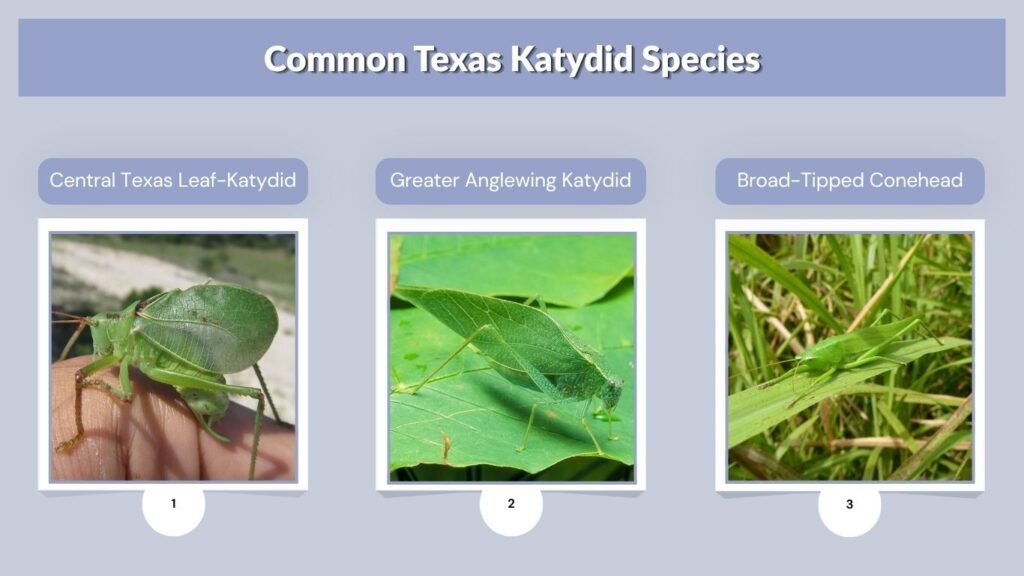
Texas contains several distinct katydid groups occupying habitats ranging from wetlands and forests to dry brush country. Representative species include coneheads, false katydids, true katydids, and predatory katydids.
Central Texas Leaf-Katydid
The Central Texas leaf-katydid (Paracyrtophyllus robustus) is also known as the truncated true katydid or red katydid.
It is particularly associated with Central Texas and is primarily tree-dwelling. It feeds heavily on oaks, and isolated individuals are commonly green while outbreak populations can contain many pinkish or red insects.
Its call is a short, raspy series of notes lasting roughly one-third of a second. When hundreds of individuals sing simultaneously, their combined calls can create an almost continuous pulsating sound.
Greater Anglewing Katydid
The greater anglewing, Microcentrum rhombifolium, is another recognizable Texas species. Its broad green wings resemble leaves and provide effective camouflage.
Its song consists of a rhythmic sequence of roughly 20 evenly spaced ticking sounds. Several Microcentrum species occur in or near Texas.
Broad-Tipped Conehead
The broad-tipped conehead, Neoconocephalus triops, occurs across most of Texas except the Panhandle. It can be green or brown and has the characteristic elongated head associated with conehead katydids.
Its call is a nearly continuous, thin buzzing sound. In Texas, it may be encountered relatively early in the year, particularly from about February through May.
Giant Texas Katydid
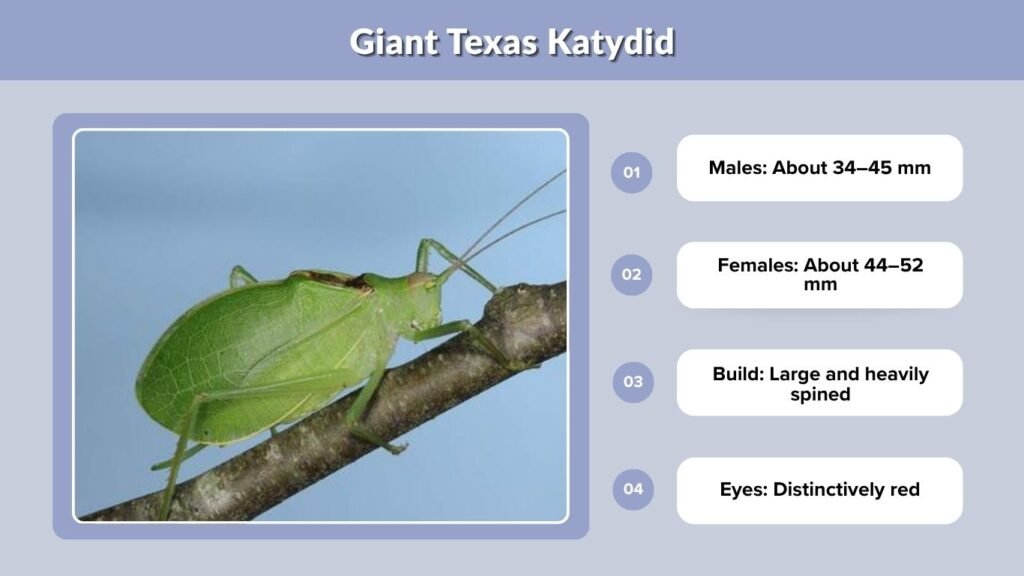
The insect commonly called the giant Texas katydid is often the greater arid-land katydid, Neobarrettia spinosa. It is also known as the red-eyed devil because of its striking eyes and intimidating appearance.
Unlike many leaf-eating katydids, this species is a spiny predatory katydid and is notably large and powerful.
Giant Texas Katydid Size
Adult greater arid-land katydids reach impressive dimensions:
- Males: About 34–45 mm
- Females: About 44–52 mm
- Build: Large and heavily spined
- Eyes: Distinctively red
- Activity: Mainly warm-season
- Range: Much of Texas into southeastern Arizona
Females can therefore exceed 2 inches in body length, making this one of the more imposing katydids likely to be encountered in Texas.
Where Does the Giant Texas Katydid Live?
The greater arid-land katydid occurs from the Red River south to the Rio Grande and extends west into southeastern Arizona. It favors oak-juniper woodland, mesquite, brush, and arid landscapes. Adults and nymphs may be encountered from spring into fall.
What Does the Giant Texas Katydid Eat?
Unlike katydids that primarily feed on foliage, Neobarrettia spinosa is strongly omnivorous and predatory.
It has powerful mouthparts and may capture insects and other small prey. Its sturdy legs and prominent spines give it a noticeably more formidable appearance than ordinary leaf katydids.
Texas Katydid Sound
Texas evenings can be filled with katydid songs. Male katydids produce sound by rubbing specialized structures on their wings together, a process known as stridulation. Females detect these signals using hearing organs located on their front legs.
What Does a Texas Katydid Sound Like?
The exact sound depends on species:
- Broad-tipped conehead: High, nearly continuous buzz
- Greater anglewing: Rhythmic series of ticking notes
- Central Texas leaf-katydid: Short raspy buzzing phrase
- Red-eyed devil: Short, high-pitched buzzing calls
Because each species has a characteristic song, sound can be useful for identifying katydids that are difficult to see in trees or grass.
Why Are Texas Katydids So Loud at Night?
Many katydids are most active after dark. Males call repeatedly to attract females, and numerous individuals singing from nearby trees can produce surprisingly loud nighttime choruses.
Central Texas leaf-katydid outbreaks can be especially noticeable because hundreds or even thousands of calling insects may create a continuous pulsating whine.
Central Texas Katydid Outbreaks
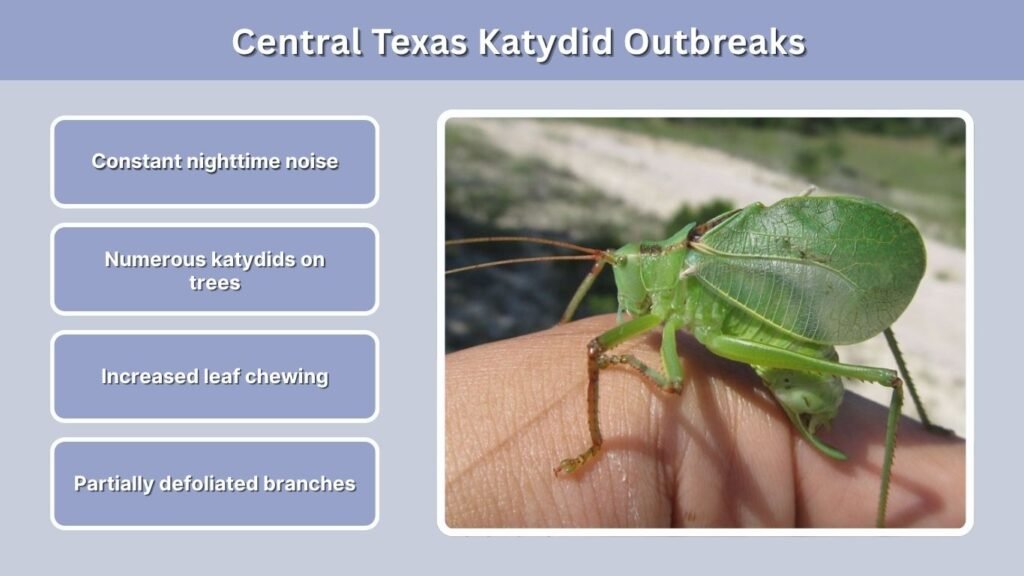
Occasionally, environmental conditions allow katydid populations to become unusually abundant. The Central Texas leaf-katydid is particularly known for periodic outbreaks in which red or pink individuals become highly noticeable.
Texas A&M Forest Service notes that katydid outbreaks are generally short-lived and populations typically decrease naturally. Even trees that experience substantial defoliation often recover.
Signs of a Katydid Outbreak
Large populations may produce:
- Constant nighttime noise
- Numerous katydids on trees
- Increased leaf chewing
- Partially defoliated branches
- Red or green insects around yards
- Katydids appearing around outdoor lights
The Central Texas leaf-katydid primarily feeds on oak trees and has one generation per year, with eggs serving as the overwintering stage.
Are Katydids Serious Texas Pests?
Most katydids are not major pests. Texas A&M notes that although many species eat plant tissues, they are seldom abundant enough to cause serious injury. Some species are predators rather than plant feeders.
Large outbreak populations can temporarily cause more noticeable foliage loss, particularly on favored host trees.
Are Texas Katydids Dangerous?
Ordinary Texas katydids are not considered dangerous insects. They do not have stingers and do not seek people as prey.
However, katydids possess chewing mouthparts and can bite defensively if handled incorrectly. Texas A&M specifically notes that katydids may bite when improperly held.
Giant Texas Katydid Bite
Extra caution is sensible with the red-eyed devil because it is larger and more predatory than most familiar katydids.
When threatened, Neobarrettia spinosa may rear upward in a defensive display. Careless handling can result in a bite powerful enough to draw blood.
It is best to observe the insect without grabbing it.
Texas Bush and Meadow Katydids
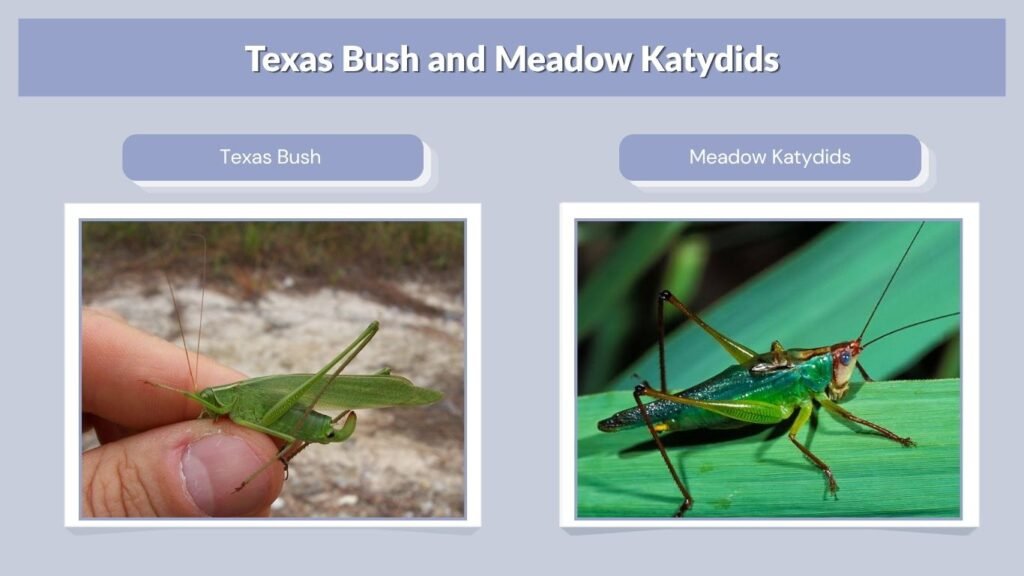
Not every Texas katydid is enormous. Bush and meadow katydids are generally more delicate insects that live among grasses, shrubs, and wet vegetation.
Texas Bush Katydid
Bush katydids in the genus Scudderia have broad, leaflike wings and long legs. Texas A&M lists Scudderia among the state’s recognizable “false katydids.” They are commonly green to brownish and primarily feed on vegetation.
Texas Meadow Katydid
The Texas meadow katydid, Orchelimum bullatum, is another North American member of the family Tettigoniidae. Meadow katydids generally favor grassy habitats, particularly areas with abundant vegetation.
FAQs
What is the giant Texas katydid?
The name usually refers to the greater arid-land katydid (Neobarrettia spinosa), also called the red-eyed devil. It is a large predatory katydid found across much of Texas.
How big is a giant Texas katydid?
Females can reach approximately 44–52 mm, while males are around 34–45 mm long.
Do Texas katydids bite?
They can bite defensively if handled, but ordinary katydids do not normally attack people. The large red-eyed devil can deliver a stronger bite capable of drawing blood.
What makes the loud katydid noise in Central Texas?
One important source is the Central Texas leaf-katydid. Large numbers calling together can produce a continuous pulsing or whining sound.
Are red katydids in Texas a different species?
Not necessarily. The Central Texas leaf-katydid can occur in green and reddish forms. During outbreaks, pink or red individuals can become particularly common.
