
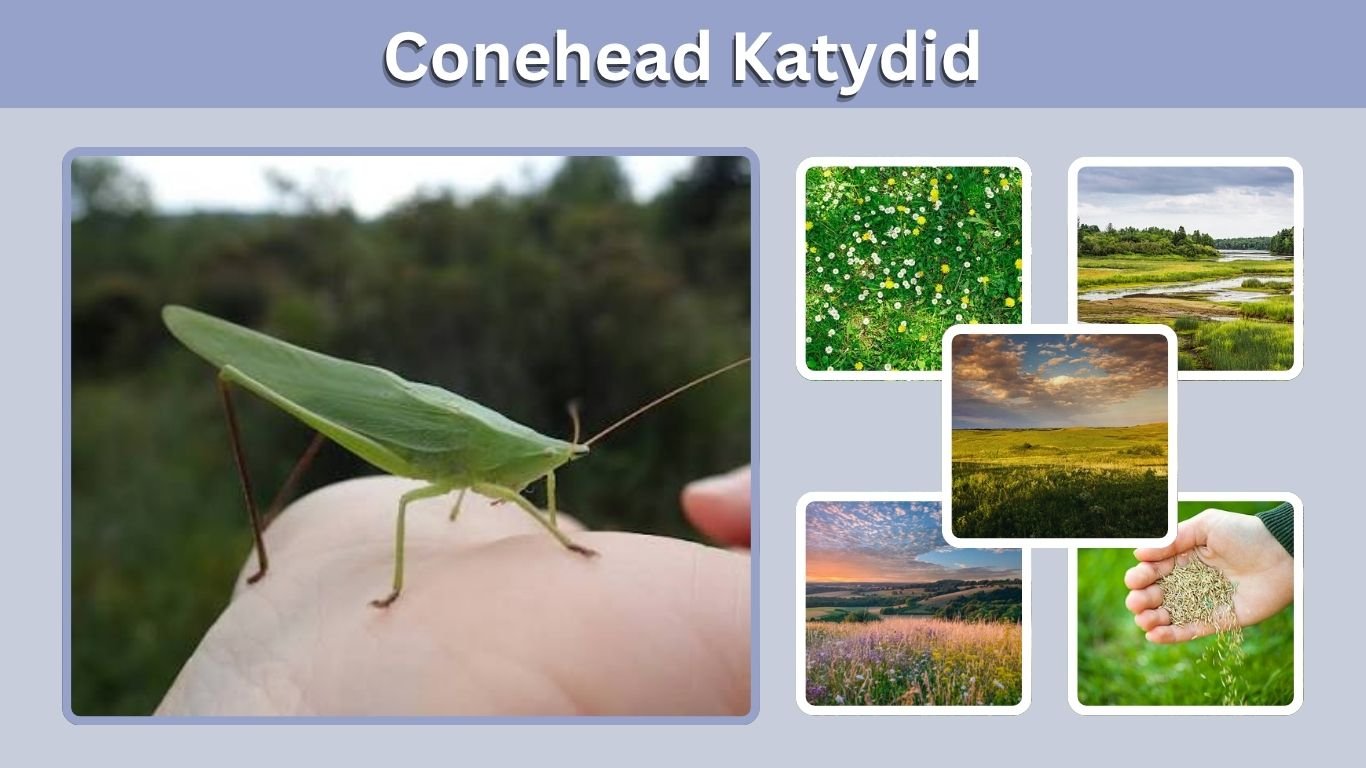
The conehead katydid is a distinctive long-horned insect named for the cone-shaped projection extending from its head. Most common coneheads belong to the genus Neoconocephalus and occur in grassy fields, wetlands, roadsides, and other vegetation-rich habitats. They may be green or brown, have extremely long antennae, and produce loud buzzing calls during warm evenings. Although coneheads have strong jaws and can deliver a painful defensive nip, they are not considered dangerous to humans. This guide covers identification, size, diet, sound, habitat, bites, nymphs, and common species.
What Is a Conehead Katydid?
Conehead katydids are members of the katydid family Tettigoniidae. The familiar common coneheads belong mainly to the genus Neoconocephalus. Their defining characteristic is a projection from the front of the head known as the fastigium, which gives the insect its cone-headed appearance. Common coneheads occur primarily in the Americas and are especially associated with grasses and other low vegetation.
Conehead Katydid Identification
Typical identification features include:
- Distinctive cone-shaped projection on the head
- Antennae often longer than the body
- Long, narrow body
- Powerful hind legs for jumping
- Green or brown coloration
- Long wings extending beyond the abdomen
- Strong chewing jaws
- Long ovipositor in adult females
In common coneheads, the cone is separated from the face by a noticeable gap and generally does not end in a sharply pointed tip. Species identification often depends heavily on the exact shape of the cone.
Conehead Katydid Size
Conehead katydids are relatively large compared with many other familiar insects. Their narrow bodies can make them look smaller until their long wings, legs, and antennae are considered. Size differs among species and between males and females, with females frequently being larger and carrying a conspicuous egg-laying structure extending from the abdomen.
How Big Is a Conehead Katydid?
Common Neoconocephalus species are generally about 37–74 mm long, or roughly 1.5–3 inches.
For example, the round-tipped conehead measures approximately 37–52 mm long. Broad-tipped conehead females may reach about 51–67 mm, while males typically measure around 43–60 mm.
Their antennae can extend much farther than the body, making an adult appear considerably larger.
Brown vs. Green Conehead Katydids
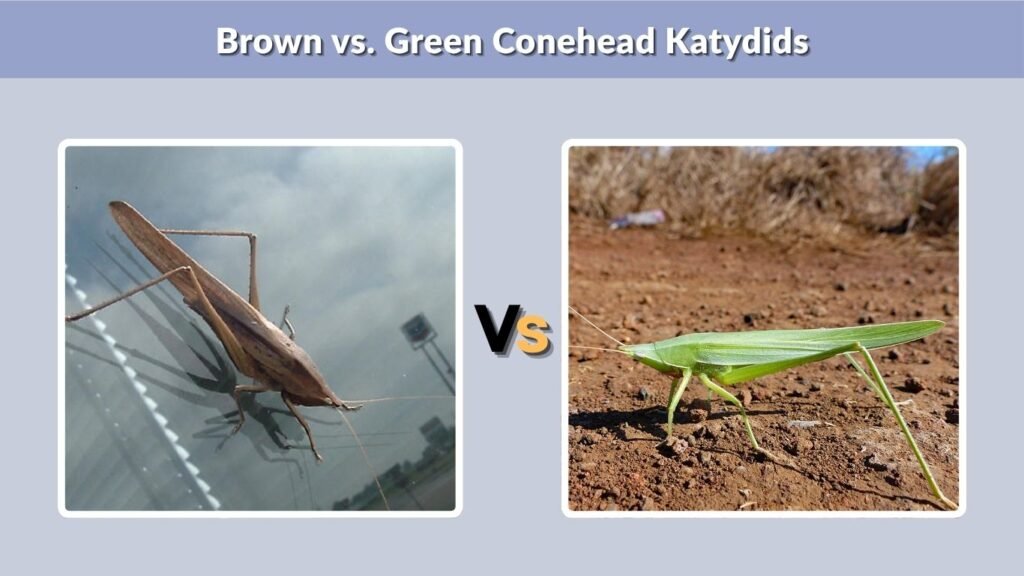
Seeing a brown conehead katydid does not necessarily indicate a different species from a green one. Several common coneheads occur in both brown and green color forms. Their coloration helps them blend into grass, dried leaves, or other surrounding vegetation, making these insects surprisingly difficult to notice during daylight hours.
Brown Conehead Katydid
Brown individuals often resemble dried grass or dead vegetation. The broad-tipped conehead provides a particularly interesting example because the frequency of brown and green individuals varies by season.
UF/IFAS reports that approximately 95% of overwintering males of the broad-tipped conehead are brown, while green coloration becomes much more common among summer adults.
Green Conehead Katydid
Green coneheads blend especially well with living grasses and leaves. Young broad-tipped coneheads initially develop as light green nymphs, and individuals that eventually become brown generally change color during later molts.
Color alone therefore should not be used to identify a conehead species.
Common Types of Conehead Katydids
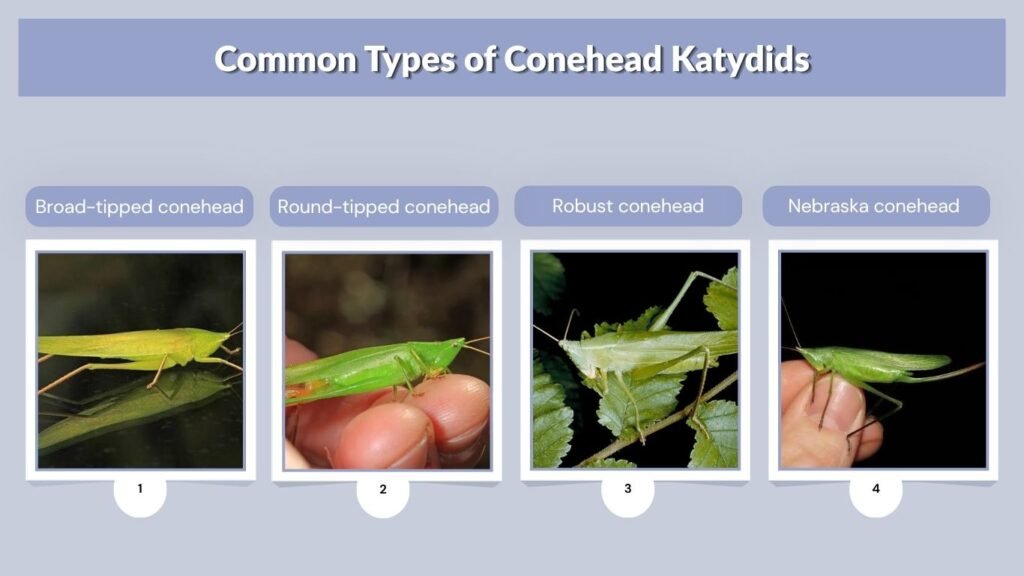
There are numerous coneheaded katydids, and many look remarkably similar until their head shape, size, song, or female ovipositor is examined closely. Common names often describe the shape of the cone or another obvious characteristic. Some species also differ significantly in habitat preference and seasonal activity.
Common Conehead Species
Some frequently discussed types include:
- Broad-tipped conehead – Neoconocephalus triops
- Round-tipped conehead – Neoconocephalus retusus
- Sword-bearing conehead – Neoconocephalus ensiger
- Robust conehead – Neoconocephalus robustus
- Slender or bog conehead – Neoconocephalus lyristes
- Nebraska conehead – Neoconocephalus nebrascensis
Differences in the underside of the cone are particularly useful for separating species within Neoconocephalus.
Broad-Tipped Conehead Katydid
The broad-tipped conehead, Neoconocephalus triops, has a fastigium that is wider than it is long. It occurs extensively across the southern United States as well as tropical portions of the Americas. Adults can be green or brown, and both males and females are capable fliers that may be attracted to lights.
Round-Tipped Conehead Katydid
The round-tipped conehead, Neoconocephalus retusus, is smaller, about 37–52 mm long. Its cone is only slightly longer than wide, and females have a very long, slender ovipositor.
It favors grassy or weedy open environments ranging from relatively dry roadsides to marsh edges.
What Does a Conehead Katydid Eat?
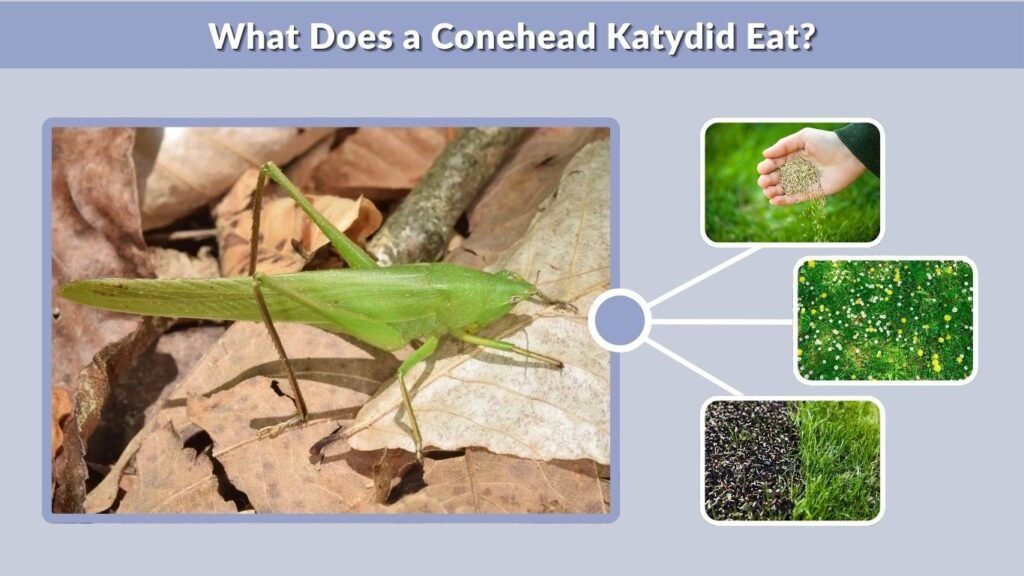
Conehead katydids possess surprisingly large jaws, but these mouthparts are primarily adapted for processing food. Most common coneheads feed heavily on plant material rather than hunting large animals. Grass seeds are particularly important, although feeding habits can vary somewhat among species and developmental stages.
Conehead Katydid Diet
Common foods include:
- Grass seeds
- Developing grass seeds
- Grass flowers
- Sedge seeds or fruits
- Some grass leaves
- Other plant material
- Occasionally small insects
Adults of Neoconocephalus feed predominantly on grass seeds, while nymphs commonly consume grass flowers and developing seeds. Other foods are reported less frequently.
Broad-tipped coneheads, for example, commonly feed on seeds from grasses such as bahiagrass and Vaseygrass.
Conehead Katydid Sound and Call
The conehead katydid sound is one of the easiest ways to detect these insects because they often remain hidden among dense vegetation. Male coneheads produce mating calls by rubbing specialized structures on their wings together. Different species produce distinctive patterns, allowing experienced listeners to identify many coneheads by sound without seeing them.
What Does a Conehead Katydid Sound Like?
Many species produce a long, fast buzzing or rattling sound. Calling is primarily nocturnal, although some species also sing during daylight.
The round-tipped conehead, for example, produces a relatively weak, continuous buzzing call from tangles of vegetation and may sing during both afternoons and nights.
Broad-tipped coneheads are particularly unusual because seasonal generations produce different call patterns. Summer individuals produce calls arranged into verses, while winter and early-spring adults produce more continuous calls.
Where Do Conehead Katydids Live?
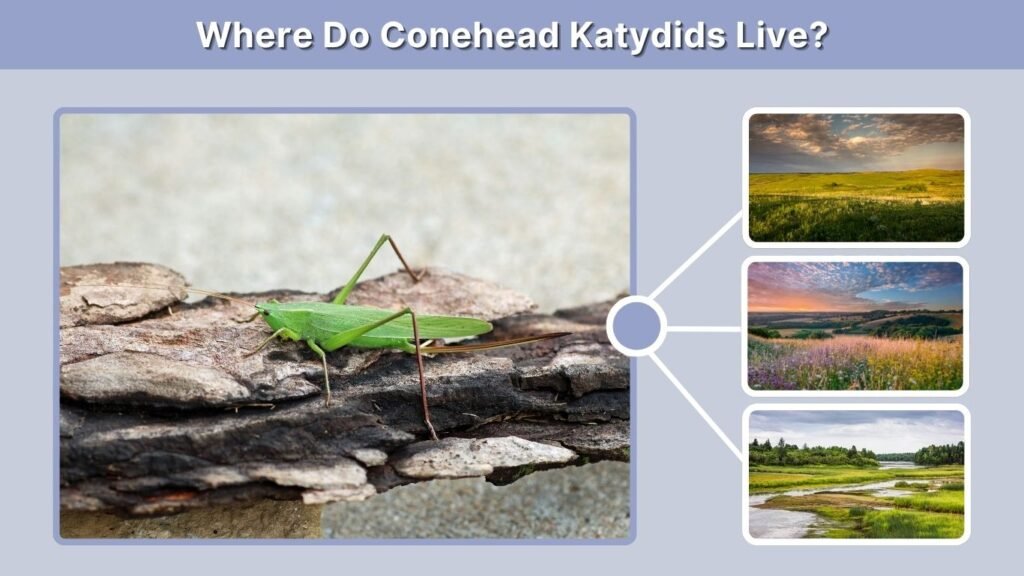
Coneheads generally favor habitats dominated by grasses and other relatively low-growing vegetation. Their elongated bodies and green or brown coloration provide excellent camouflage among stems. Different species occupy environments ranging from dry fields to wet marsh edges, making the group widespread across many temperate and tropical landscapes.
Conehead Katydid Habitat
Typical habitats include:
- Grasslands
- Meadows
- Old fields
- Roadsides
- Wetlands
- Marsh edges
- Thickets
- Weedy areas
- Cornfields
- Tall grass around ponds
Common coneheads occur primarily in the New World, with many North American species concentrated in eastern regions.
The broad-tipped conehead has an especially broad range extending through the southern United States, Caribbean, Central America, and parts of South America.
Does a Conehead Katydid Bite?
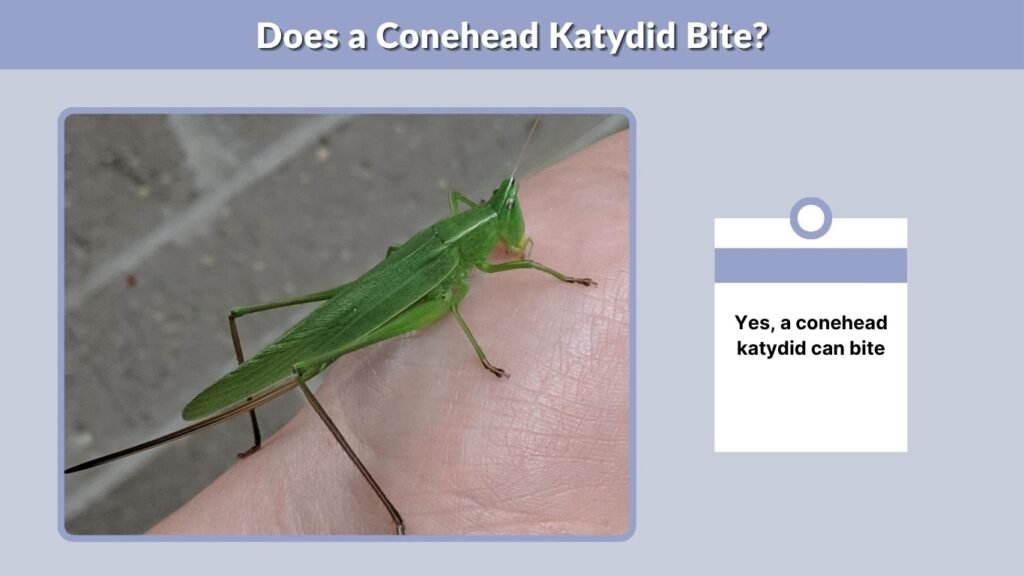
Yes, a conehead katydid can bite, particularly if it is grabbed, squeezed, or handled roughly. Large coneheads possess powerful chewing jaws used for cracking seeds. They do not normally pursue humans, however, and biting is primarily a defensive response when the insect cannot escape.
Is a Conehead Katydid Bite Dangerous?
Conehead katydids are not considered dangerous to humans. Missouri Department of Conservation notes that large katydids such as coneheads have strong jaws and can give a substantial nip.
A bite may cause temporary:
- Pinching pain
- Mild redness
- Minor swelling
- Small superficial skin damage
They do not possess a venomous stinger. A female’s long sword-shaped structure is an ovipositor used for laying eggs, not a weapon for stinging people.
If the skin is broken, washing the area with soap and water is generally sensible.
Conehead Katydid Nymph and Life Cycle
Conehead katydids undergo incomplete metamorphosis. This means there is no caterpillar or pupal stage. Young coneheads resemble small adults but initially lack fully developed wings and reproductive structures. As they grow, they repeatedly shed their exoskeleton until the final molt produces a winged adult.
What Does a Conehead Katydid Nymph Look Like?
Nymphs generally have:
- Smaller bodies than adults
- Long antennae
- Enlarged jumping legs
- Cone-shaped heads
- No functional adult wings
- Green coloration in many species
Broad-tipped conehead nymphs are initially light green and typically pass through about seven immature stages before adulthood. Young individuals commonly feed on grass flowers and developing seeds.
Most common coneheads overwinter as eggs, although the broad-tipped conehead is unusual because it can overwinter as an adult.
FAQs
Conehead katydids can appear intimidating because of their pointed heads, large bodies, strong jaws, and extremely long antennae. In reality, they are mostly grass-feeding insects whose loud nighttime songs are a familiar part of summer environments. Understanding their behavior helps distinguish their dramatic appearance from any actual risk to people.
Are Conehead Katydids Dangerous?
No. Conehead katydids are not considered dangerous, although large individuals have powerful jaws and may give a painful defensive nip if handled.
Do Conehead Katydids Bite Humans?
Yes, they can bite when restrained or handled roughly, but they do not normally attack people.
What Does a Conehead Katydid Sound Like?
Many species produce long buzzing or rattling calls. The exact rhythm and frequency vary between species and can be useful for identification.
What Do Conehead Katydids Eat?
Common coneheads mainly eat grass seeds. Nymphs commonly feed on grass flowers and developing seeds, with other plant foods and occasional insects also reported.
Why Does a Conehead Katydid Have a Pointed Head?
The apparent “cone” is a projection called the fastigium. Its exact shape differs among species and is one of the most useful characteristics for identifying common coneheads.
