
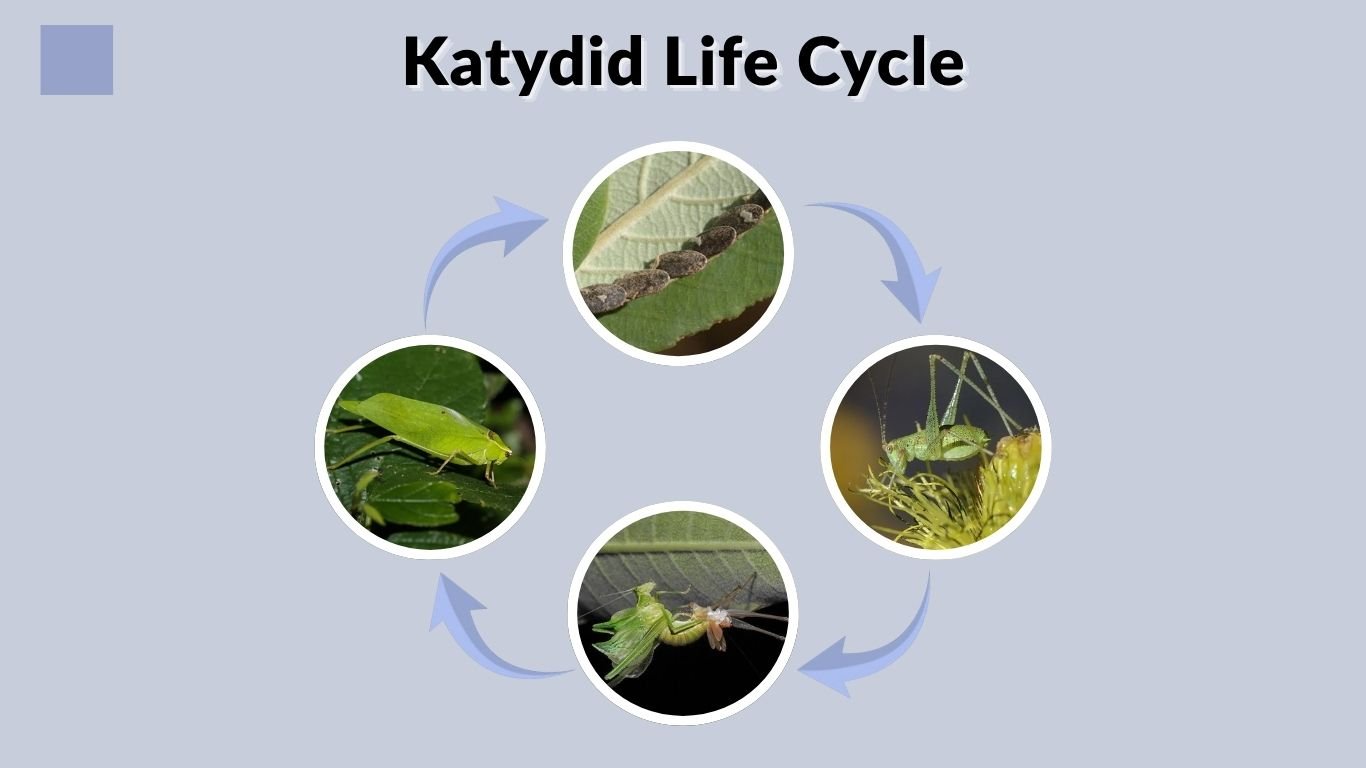
The katydid life cycle consists of three main stages: egg, nymph, and adult. Unlike butterflies or beetles, katydids do not pass through larval and pupal stages. Instead, they undergo incomplete metamorphosis, with young nymphs resembling small, wingless versions of adults. In many temperate species, females lay eggs during late summer or fall, the eggs survive winter, and nymphs hatch the following spring. They molt repeatedly before becoming winged adults that spend summer feeding, calling, mating, and eventually producing the next generation.
What Is the Life Cycle of a Katydid?
Katydids belong to the insect family Tettigoniidae, a group known for extremely long antennae and the loud calls produced by many species. Their development differs from insects that undergo complete metamorphosis. Instead of changing from a larva into a pupa, a katydid gradually develops adult characteristics through successive molts.
Three Katydid Life Stages
The basic katydid life cycle is:
- Egg – The female deposits eggs in or on suitable plant material or soil.
- Nymph – A wingless young katydid hatches and grows through several molts.
- Adult – The final molt produces a sexually mature katydid with developed wings.
There is no pupal stage between the nymph and adult. This type of development is called incomplete metamorphosis.
Stage 1: Katydid Eggs
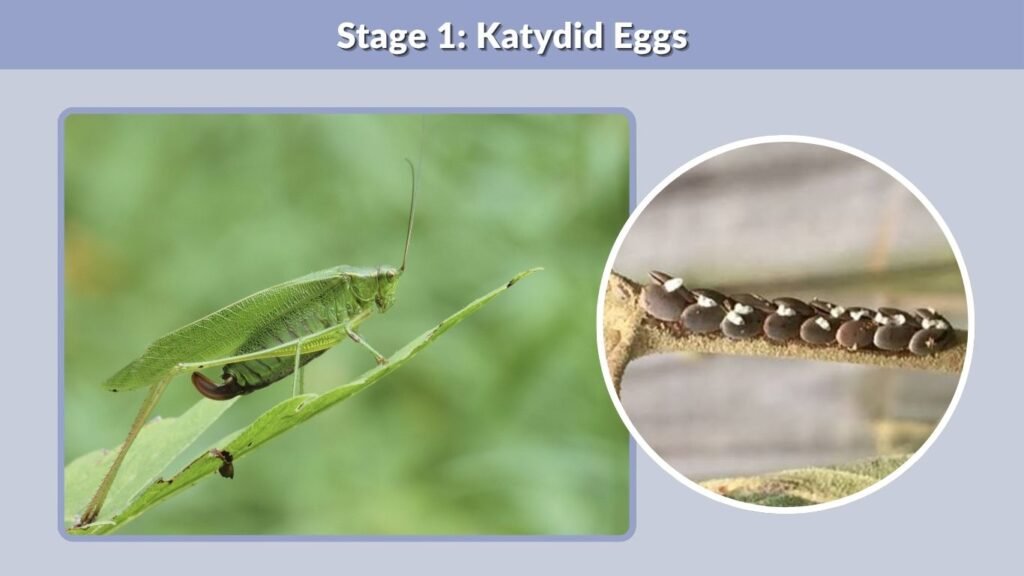
The katydid life cycle begins when a mature female deposits eggs. Where she places them depends heavily on the species. Katydids have an ovipositor, a specialized egg-laying structure extending from the rear of the female’s abdomen. Some species insert their eggs into vegetation, while others use bark, stems, leaves, or soil.
Where Do Katydids Lay Eggs?
Possible egg-laying locations include:
- Tree bark and bark crevices
- Twigs and branches
- Plant stems
- Leaves
- Soil
- Protected plant tissue
For example, female common true katydids insert eggs into crevices in tree bark. Wisconsin Extension notes more broadly that katydids may deposit eggs in soil, plant stems, or tree bark.
What Do Katydid Eggs Look Like?
Appearance varies among species. Some katydid eggs are flattened and oval, resembling tiny seeds attached in rows to twigs or leaves. Others are inserted into plant tissue or hidden in soil and are much harder to find.
The placement helps protect the developing insect from weather and predators until conditions become suitable for hatching.
Do Katydid Eggs Survive Winter?
In many temperate katydid species, the egg is the overwintering stage. Adults die as cold weather arrives, while their eggs remain protected through winter.
When temperatures rise and vegetation becomes available the following spring, the eggs hatch and begin a new generation.
Katydid Life Cycle in Fall and Winter
A common seasonal pattern is:
- Late summer: Adults mate.
- Late summer to fall: Females lay eggs.
- Winter: Eggs remain dormant or develop slowly.
- Spring: Nymphs hatch.
- Spring to early summer: Nymphs grow and molt.
- Summer: Adults appear, call, mate, and reproduce.
Not every species follows exactly the same calendar, particularly in warmer climates, but this pattern is typical of many temperate North American katydids.
Stage 2: Katydid Nymph
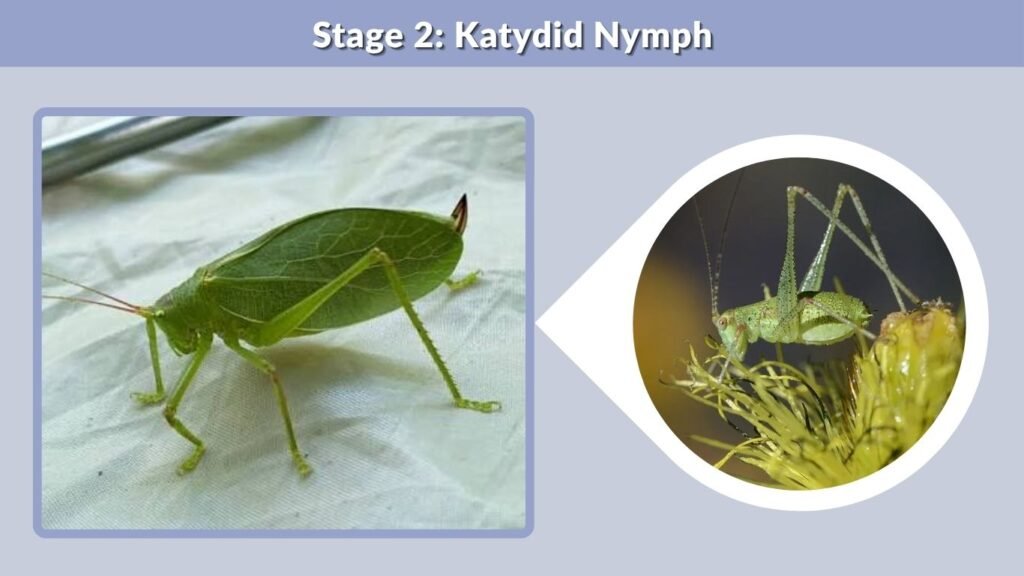
A newly hatched katydid is called a nymph. Nymphs already have the basic appearance of a katydid, including long hind legs and unusually long antennae. However, they are much smaller than mature individuals and do not initially have fully developed wings or reproductive organs.
What Does a Katydid Nymph Look Like?
A typical nymph has:
- Six legs
- Large hind legs for jumping
- Very long antennae
- A relatively small body
- No fully developed wings
- Increasingly visible wing buds as it matures
Many nymphs are green and resemble leaves, but coloration depends on species. Some katydids may also be brown, yellow, or even unusually pink.
How Do Katydid Nymphs Grow?
A katydid’s external skeleton cannot expand continuously with its body. To grow larger, the nymph must periodically shed its old exoskeleton in a process called molting.
After each molt, the new exoskeleton initially remains relatively soft before hardening. The nymph becomes larger, and its adult features become increasingly noticeable.
How Many Times Does a Katydid Molt?
The exact number varies with species, but Wisconsin Extension notes that katydids generally pass through about five successive molts during incomplete metamorphosis.
With successive molts:
- The body becomes larger.
- Wing buds become increasingly obvious.
- Adult coloration develops.
- Reproductive structures mature.
- The final molt produces a winged adult.
Unlike a butterfly emerging from a chrysalis, the transformation happens gradually.
Stage 3: Adult Katydid
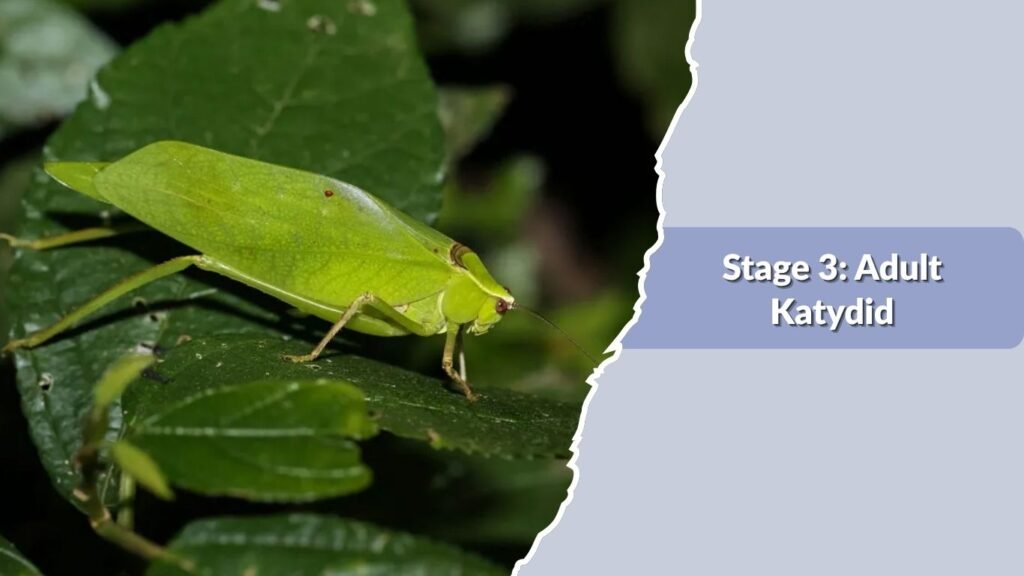
After its final nymphal molt, a katydid reaches the adult stage. Its wings are now developed, reproductive organs are mature, and the insect can participate in mating. Adults are especially noticeable during summer because many males produce loud nighttime calls from trees, shrubs, grasses, and other vegetation.
What Happens During the Adult Stage?
Adult katydids primarily focus on:
- Feeding
- Finding mates
- Calling
- Flying or moving between plants
- Reproduction
- Laying eggs
Most species are active at night. The familiar summer sounds associated with katydids are primarily related to communication and reproduction.
Once females deposit eggs, the next generation is ready to continue the cycle.
Katydid Mating and Egg Laying
Sound plays an important role in katydid reproduction. Males of many species produce characteristic calls by rubbing specialized portions of their wings together. These mating songs help males and females of the same species locate one another, particularly in dense nighttime vegetation.
The exact rhythm and pitch vary dramatically among different katydid species.
What Happens After Mating?
After mating, the female eventually uses her ovipositor to place fertilized eggs in a location appropriate for her species.
The common true katydid, for example, inserts eggs into bark late in the season. Those eggs remain through winter before hatching during spring.
This completes the cycle:
Adult → eggs → nymphs → adults → eggs
How Long Does the Katydid Life Cycle Take?
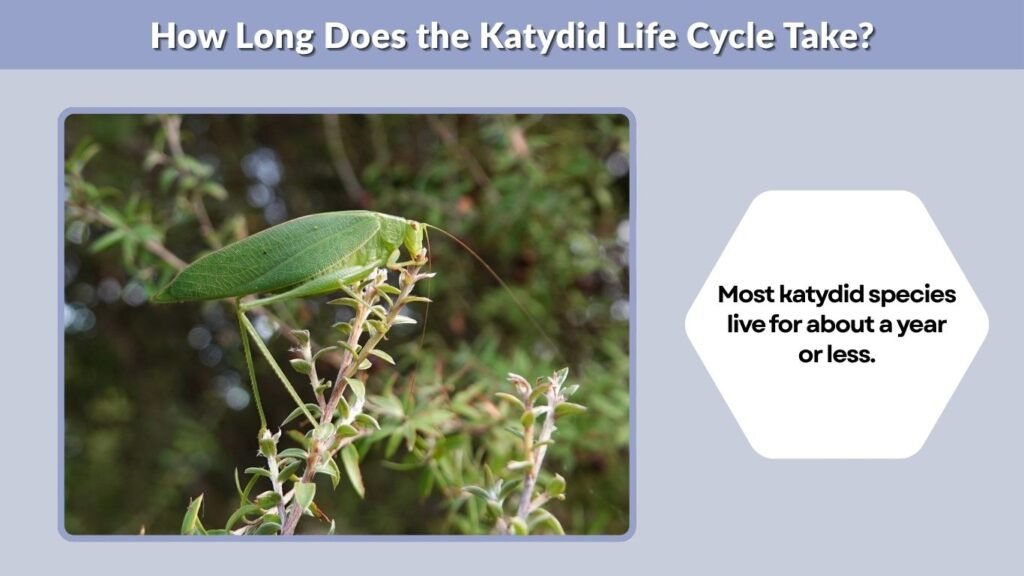
There is no single lifespan for every katydid because the family contains thousands of species living in different climates. Nevertheless, most familiar temperate species complete approximately one generation per year. Their eggs may spend months overwintering, while the nymph and adult stages occupy the warmer part of the year.
Katydid Lifespan
Most katydid species live for about a year or less, although much of that period may be spent inside the egg. Tropical species can have different schedules, and some may survive considerably longer than temperate species.
Adults generally represent only part of the complete lifespan. In climates with cold winters, adult katydids commonly disappear after late-season reproduction while their eggs survive to start the following year’s population.
Do All Katydids Have the Same Life Cycle?
All katydids share the basic egg–nymph–adult pattern, but the timing can vary significantly. Species living in warm climates may develop on different seasonal schedules than those exposed to freezing winters. Even closely related North American species can differ in when eggs hatch and how many generations occur during a year.
Life Cycle Differences Between Species
Examples include:
- Angular-winged katydids – typically have one generation per year.
- Broad-winged katydids – typically have one generation annually.
- Fork-tailed bush katydids – usually follow an annual cycle, but some eggs can hatch during summer and produce a partial second generation.
- Common true katydids – have one generation each year, with eggs overwintering in bark.
- Tropical katydids – may have different seasonal cycles where winter temperatures do not limit activity.
These differences explain why katydid nymphs may appear at somewhat different times depending on species and geographic location.
Katydid Life Cycle Diagram Explained
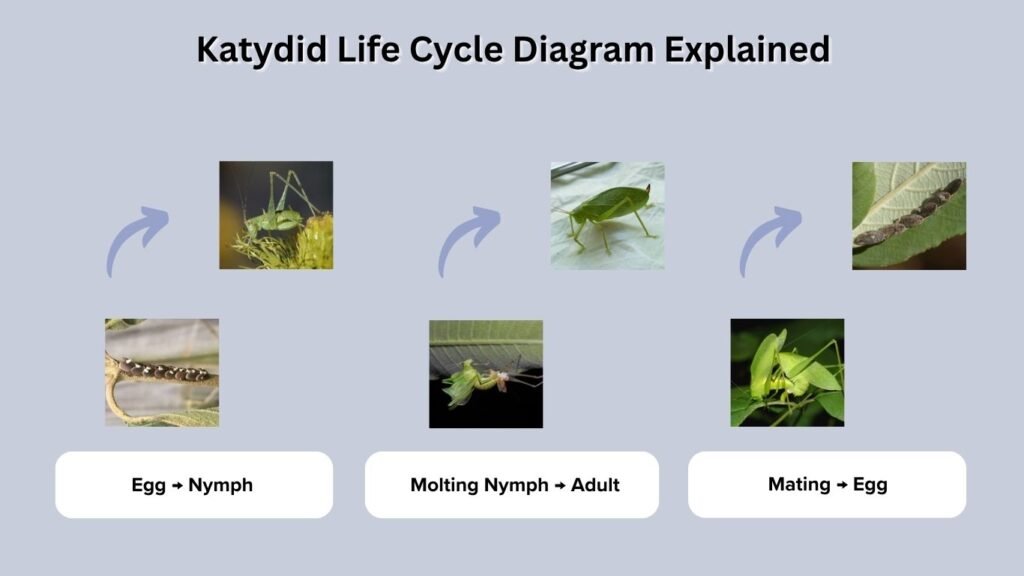
A simple katydid life cycle diagram does not need the four stages commonly shown for butterflies.
Instead, it should show:
Egg → Nymph → Molting Nymph → Adult → Mating → Egg
The “molting nymph” is not technically a separate major life stage. It simply helps illustrate how the young insect gradually changes as it passes through several immature instars before its final molt.
Why Is There No Pupa?
Katydids undergo incomplete metamorphosis, so they never become pupae. A nymph continuously resembles the basic adult body form.
This differs from complete metamorphosis:
Butterfly: Egg → Larva → Pupa → Adult
Katydid: Egg → Nymph → Adult
The gradual appearance of wings during nymphal development is one of the clearest examples of incomplete metamorphosis.
FAQs
The timing of katydid development varies by species and climate, but the underlying process remains similar. Understanding the egg, nymph, and adult stages also makes it easier to distinguish young katydids from other insects and explains why adults suddenly become abundant and noisy during summer.
What Are the Three Stages of a Katydid’s Life Cycle?
The three main stages are egg, nymph, and adult. Katydids undergo incomplete metamorphosis and therefore have no larval or pupal stage.
How Long Does a Katydid Live?
Most species live for approximately one year or less, although lifespan and seasonal timing vary. Tropical species can sometimes live longer.
Where Do Katydids Lay Their Eggs?
Depending on species, eggs can be deposited in soil, stems, leaves, twigs, or tree bark.
What Does a Baby Katydid Look Like?
A baby katydid is called a nymph. It resembles a miniature adult with long antennae and jumping legs but initially lacks fully developed wings and reproductive organs.
Do Katydids Die in Winter?
In many temperate species, adults die as cold weather arrives while their eggs survive the winter and hatch the following spring.
