

Crazy ants are fast-moving household ants known for their erratic, unpredictable behavior. Instead of forming neat straight trails like many ants, crazy ants run in chaotic patterns, often appearing suddenly in large numbers. They commonly invade homes, apartments, and commercial buildings, where they contaminate food, overrun living spaces, and even damage electronics. Understanding how to identify crazy ants and recognize early infestation signs is the first step toward effective control.
What Are Crazy Ants?
Crazy ants are a group of small ants belonging mainly to the genera Paratrechina and Nylanderia. Several species fall under the common name “crazy ants,” including black crazy ants, yellow crazy ants, and the increasingly problematic tawny crazy ant.
They are believed to originate from tropical and subtropical regions but have spread widely through shipping, trade, and human travel. Today, crazy ants are established in many warm regions and are increasingly found in urban and suburban environments.
Unlike many native ants, crazy ants form massive interconnected colonies rather than isolated nests. This allows them to dominate large areas and displace other ant species, making infestations especially severe.
Scientific Name and Classification
Crazy ants belong to the family Formicidae. Common species include Paratrechina longicornis (longhorn crazy ant) and Nylanderia fulva (tawny crazy ant). The name “crazy ant” does not refer tos a single species but to their distinctive movement and behavior patterns.
Why They Are Called “Crazy” Ants
Crazy ants get their name from the way they move. Instead of following straight pheromone trails, they dart rapidly in random, jerky directions. Their long legs and antennae make their motion appear frantic and disorganized, especially when disturbed.
This unpredictable behavior makes them difficult to track and control. They often seem to appear everywhere at once, giving the impression of a sudden, uncontrollable invasion.
Identification Guide for Crazy Ants

Correct identification is essential because crazy ants are often confused with other small ants. Several physical and behavioral traits help distinguish them.
- Size: Small to medium, usually about 2–3 mm long
- Color: Ranges from dark brown and black to reddish or tawny
- Body shape: Slender body with long legs and antennae
- Movement: Extremely fast, erratic, and non-linear
- Odor: Some species release a faint musty smell when crushed
Workers are usually the ants seen indoors, but winged reproductive forms may appear seasonally.
Types of Crazy Ants
Different crazy ant species share similar behaviors but vary in appearance and impact.
Tawny Crazy Ants (Raspberry Crazy Ants)
Tawny crazy ants are light brown to reddish ants known for forming enormous supercolonies. They gained attention for spreading rapidly in parts of the United States and overwhelming homes, electrical equipment, and outdoor ecosystems.
These ants often nest in soil, under debris, inside wall voids, and around foundations. Their populations can reach millions, making them one of the most difficult invasive ants to manage.
Black Crazy Ants
Black crazy ants are darker in color and are often confused with little black ants. However, black crazy ants have longer legs, move much faster, and do not follow straight trails. They frequently invade kitchens, storage rooms, and commercial spaces.
Yellow Crazy Ants
Yellow crazy ants are lighter in color and are major invasive pests in some tropical regions. They are known to harm wildlife, damage crops, and disrupt ecosystems. In homes, they behave similarly to other crazy ants, forming massive infestations.
Where Crazy Ants Are Commonly Found

Crazy ants are highly adaptable and can nest both indoors and outdoors. They prefer warm, humid environments but can survive in a wide range of conditions.
Crazy Ants in the House
Indoors, crazy ants are commonly found in kitchens, bathrooms, basements, and wall voids. They enter homes through cracks, utility lines, and foundation gaps. Once inside, they spread quickly, appearing in multiple rooms.
They are strongly attracted to sweets, greasy foods, and pet food. Unlike many ants, crazy ants may also invade electronics such as televisions, routers, outlets, and appliances, sometimes causing short circuits and equipment failure.
Crazy Ants Outdoors
Outside, crazy ants nest under rocks, mulch, leaf litter, landscape timbers, and debris. They often establish colonies around foundations, gardens, patios, and electrical boxes.
Because they form supercolonies, outdoor nests can extend over large areas. When populations increase or weather conditions change, workers frequently migrate indoors in search of food and shelter.
Crazy Ants in Warm Regions
Crazy ants thrive in tropical and subtropical climates. Warm temperatures allow colonies to grow year-round, leading to rapid population explosions. In these regions, infestations often become chronic, requiring ongoing management rather than one-time treatments.
Signs of a Crazy Ant Infestation
Crazy ant infestations are usually very noticeable due to their sheer numbers and unusual behavior.
Common signs include:
- Large numbers of fast-moving ants with no clear trails
- Ants appearing suddenly in multiple rooms
- Heavy activity around kitchens, pet food, and trash
- Ants inside electronics, outlets, and appliances
- Rapid return even after cleaning or spraying
These signs typically indicate nearby outdoor nests or extensive indoor satellite colonies.
Do Crazy Ants Bite or Sting?
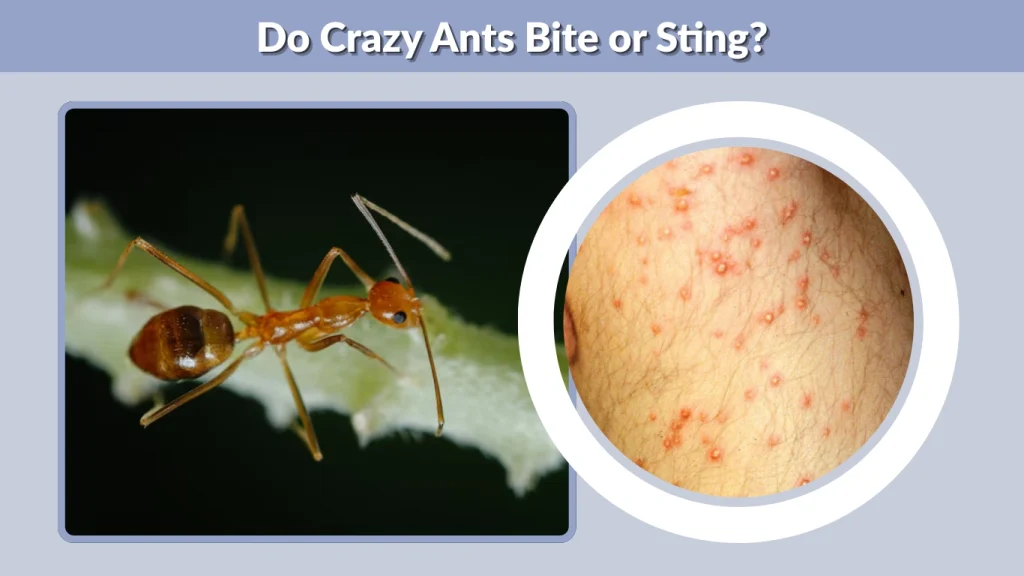
Crazy ants can bite, but they are not aggressive and rarely cause serious reactions. Their bites usually feel like mild pinches and may produce small red marks or brief itching. They do not possess strong stingers like fire ants, making them far less painful.
The main concern with crazy ants is not injury but contamination and nuisance. Because they move rapidly through trash, drains, and decaying matter, they can spread bacteria onto food and kitchen surfaces.
Are Crazy Ants Dangerous to Humans?
Crazy ants are not considered medically dangerous. However, large infestations can severely affect living conditions. They contaminate food, overrun sleeping and cooking areas, and in some cases damage electronics. In sensitive individuals, repeated contact may cause mild skin irritation.
Crazy Ants and Electronics Damage
One unusual trait of crazy ants is their attraction to electrical equipment. They are often found inside circuit boxes, outlets, air conditioners, computers, and routers. When ants are electrocuted, they release alarm pheromones that attract even more ants, leading to swarms that can short-circuit devices.
Crazy Ants With Wings – What It Means
Crazy ant colonies periodically produce winged reproductive ants called swarmers. These ants leave the nest to mate and start new colonies. Indoors, they are commonly seen near windows, lights, and ceilings.
The presence of winged crazy ants usually means a mature colony exists nearby. Swarming often increases during warm, humid seasons or after rainfall.
Why Crazy Ants Are So Difficult to Control
Crazy ants are extremely difficult to eliminate because of their colony structure. Instead of having a single nest, they form interconnected supercolonies containing many queens. When disturbed, colonies “bud,” creating new nests nearby.
Traditional sprays often make infestations worse by causing colonies to split and spread. Because nests can exist both indoors and outdoors, partial treatments rarely provide lasting results.
How to Get Rid of Crazy Ants

Successful control depends on targeting colonies, not just visible ants. This usually requires a combination of sanitation, baiting, and ongoing management.
Immediate Control Steps
Start by reducing food and water sources. Clean surfaces daily, store food in sealed containers, and wipe spills immediately. Remove pet food at night and empty trash frequently.
Seal cracks around doors, windows, pipes, and foundations. Trim vegetation touching buildings and reduce moisture around the structure.
Natural and Home Remedies
Natural methods such as vinegar, lemon juice, peppermint oil, and diatomaceous earth can help disrupt trails and reduce visible numbers. However, these remedies rarely eliminate large crazy ant populations because they do not reach queens and hidden nests.
They are best used as short-term support methods alongside baiting programs.
Best Baits and Professional Treatments
Baits are the most effective solution. Crazy ants feed on both sweets and proteins, so a combination of sugar-based and protein-based baits is often needed. Workers carry bait back to queens, slowly weakening the colony.
Because infestations are often widespread, professional pest control is frequently required. Specialists can locate outdoor nesting zones and apply targeted treatments that homeowners cannot easily perform.
How to Prevent Crazy Ants From Coming Back
Long-term prevention focuses on habitat modification. Keep kitchens and dining areas clean, repair plumbing leaks, and improve ventilation in damp areas. Outdoors, remove debris, mulch piles, and fallen branches near buildings.
Regularly inspect foundations, windows, and utility entry points. Because crazy ants can quickly recolonize areas, ongoing monitoring is essential even after successful treatment.
Crazy Ant Lifecycle and Colony Structure
Crazy ants develop through egg, larva, pupa, and adult stages. Queens lay hundreds of eggs, allowing populations to grow rapidly. Workers live for several months and constantly expand foraging areas.
Supercolonies may contain millions of individuals spread across large territories. This structure explains why infestations often feel overwhelming and difficult to suppress.
Crazy Ants vs Other Household Ants
Crazy ants differ from carpenter ants, which damage wood, and fire ants, which sting aggressively. Compared to ghost ants and little black ants, crazy ants are faster, more chaotic, and far more likely to invade electronics.
Understanding these differences helps homeowners avoid ineffective treatments and choose appropriate control strategies.
