

The yellow crazy ant is one of the most aggressive and destructive invasive ant species in the world. Known for its fast, erratic movement and massive supercolonies, this ant has spread across tropical and subtropical regions, damaging ecosystems, agriculture, and even homes. Unlike many common household ants, yellow crazy ants do not just invade kitchens—they overwhelm entire environments, killing native insects, harming wildlife, and disrupting natural balance. Understanding their identification, behavior, and biology is the first step toward effective control.
What Is a Yellow Crazy Ant?
The yellow crazy ant, scientifically known as Anoplolepis gracilipes, is a long-legged, fast-moving ant species believed to have originated in Africa. Today, it is found across Southeast Asia, the Pacific Islands, northern Australia, parts of the Indian Ocean, and many tropical regions worldwide.
It is considered one of the world’s worst invasive ants because of its ability to form enormous supercolonies with multiple queens. These colonies can spread rapidly, dominate food sources, and completely displace native ant species. Once established, yellow crazy ants are extremely difficult to eliminate, often requiring long-term, coordinated control programs.
Identification of Yellow Crazy Ants

Yellow crazy ants are often mistaken for other light-colored or fast-moving ants, but several features help distinguish them:
- Light yellow to yellow-brown body color
- Medium size (about 4–5 mm long)
- Very long legs and antennae compared to body size
- Erratic, “crazy” running pattern when disturbed
- Soft-bodied appearance
- Weak or almost unnoticeable odor when crushed
- Do not have the dark body of black crazy ants or the tiny size of ghost ants
These physical traits, combined with their restless movement, make yellow crazy ants stand out once you know what to look for.
Yellow Crazy Ant Size and Appearance
Worker ants
Worker yellow crazy ants are slender, long-legged, and usually pale yellow to light brown. Their bodies are smooth and shiny, and their unusually long antennae give them a spider-like look when moving. Workers are the ants most commonly seen trailing on walls, plants, and food sources.
Queens and males
Queens are larger than workers and darker in color, often light brown to amber. Unlike many ant species, yellow crazy ant colonies can contain many queens, which allows colonies to expand rapidly. Males are slimmer, winged during mating periods, and rarely seen by homeowners.
Eggs, larvae, and pupae
Eggs are tiny, white, and oval. Larvae are soft, legless, and grub-like, while pupae resemble small white ants wrapped in a thin casing. These stages are hidden deep inside nests, making colonies difficult to detect and destroy.
Yellow Crazy Ant Habitat and Distribution

Yellow crazy ants thrive in warm, humid climates. They are most common in tropical and subtropical regions, including islands, coastal areas, rainforests, farms, and urban environments.
They can nest in a wide variety of locations such as soil, leaf litter, rotting wood, under rocks, inside wall voids, beneath appliances, in electrical equipment, and even in tree canopies. Outdoors, they often build shallow, widespread nests rather than a single central mound. Indoors, they prefer warm, protected spaces near moisture or food.
Their flexibility in nesting sites is one reason they spread so successfully and survive in both natural ecosystems and human environments.
Behavior and Colony Structure
Yellow crazy ants are highly social and extremely aggressive toward other insects. Their colonies do not rely on a single queen. Instead, they form massive supercolonies with dozens or even hundreds of queens working together.
Key behavioral traits include:
- Formation of interconnected supercolonies over huge areas
- Aggressive attacks on native insects and animals
- Constant foraging activity across large territories
- Strong relationships with aphids and scale insects for honeydew
- Rapid colony expansion and relocation
This social structure allows them to overwhelm native species, protect each other from threats, and recover quickly even after partial colony destruction.
What Do Yellow Crazy Ants Eat?

Yellow crazy ants are omnivores, meaning they eat both plant-based and animal-based foods. Their diet changes depending on availability, but sugar sources are especially important.
They feed on nectar, fruit juices, household sweets, grease, dead insects, and small live prey. One of their most important food sources is honeydew, a sugary liquid produced by aphids, scale insects, and mealybugs. Yellow crazy ants actively protect these pests, spreading them to new plants in exchange for constant honeydew supplies.
This behavior not only supports massive ant populations but also increases plant damage in gardens, farms, and forests.
Life Cycle of Yellow Crazy Ants
Yellow crazy ants go through four stages of development: egg, larva, pupa, and adult. The queen lays eggs continuously under favorable conditions. These eggs hatch into larvae, which are fed and cared for by worker ants.
After molting several times, larvae enter the pupal stage, where they transform into adult ants. Depending on temperature and food availability, the full life cycle can take several weeks. Because colonies contain many queens, reproduction happens year-round in warm climates, allowing populations to grow explosively.
Why Yellow Crazy Ants Are Dangerous
Yellow crazy ants are not just a nuisance—they are a serious environmental and economic threat. In areas where they become established, they often wipe out native ant species and drastically reduce insect diversity. This disruption spreads upward through the food chain, affecting birds, reptiles, and mammals that depend on insects for survival.
They are also known to attack small animals. In heavily infested regions, yellow crazy ants have caused blindness and death in birds and reptiles by spraying formic acid into their eyes. On farms, they protect sap-sucking pests, leading to severe crop damage. Their massive numbers allow them to invade buildings, electrical systems, and greenhouses, creating both structural and financial problems.
Do Yellow Crazy Ants Bite or Sting?
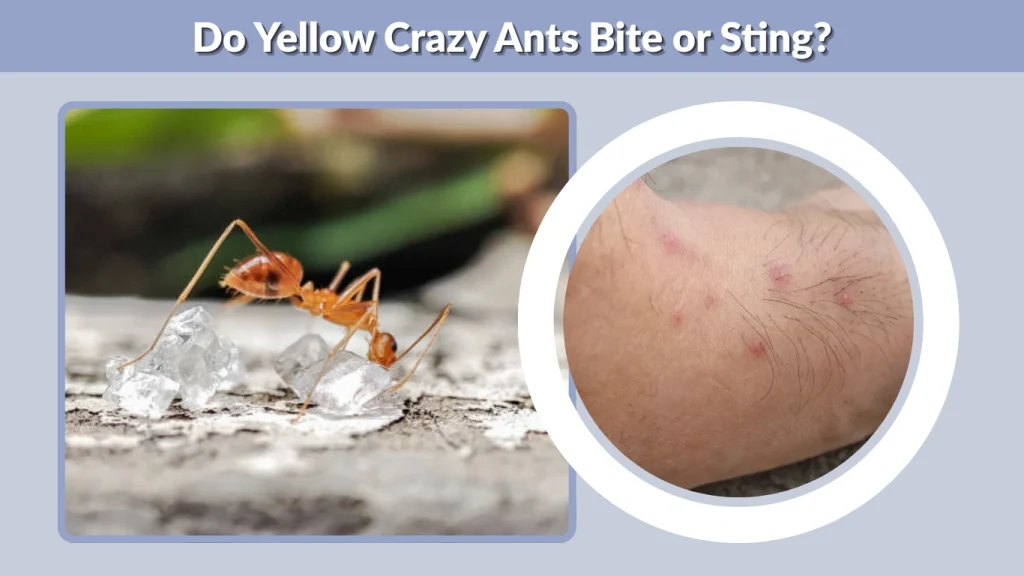
Yellow crazy ants do not have a traditional stinger like fire ants, but they can bite. More importantly, they spray formic acid from the tip of their abdomen. When threatened, they often bite the skin and then spray formic acid into the wound, causing a burning sensation.
For most people, this results in mild irritation, redness, or itching. However, repeated exposure can cause more intense discomfort, especially on sensitive skin or around the eyes. Pets and small animals may suffer stronger reactions, particularly when surrounded by large numbers of ants.
Signs of a Yellow Crazy Ant Infestation
Recognizing an infestation early is critical, because yellow crazy ants spread very quickly. Common warning signs include:
- Large numbers of fast-moving yellow ants on walls, plants, and ground surfaces
- Trails that seem disorganized and spread in many directions
- Ants emerging from electrical outlets, appliances, and wall cracks
- Heavy aphid or scale insect activity on garden plants
- Sudden disappearance of native ants
- Ants swarming pet food, fruit, or sugary spills
Unlike many ants that form narrow trails, yellow crazy ants often create wide, chaotic movement patterns, especially when disturbed.
Yellow Crazy Ants in Homes and Gardens
Inside homes, yellow crazy ants invade kitchens, bathrooms, wall voids, and electronics. They are attracted to moisture, warmth, and sweet or greasy foods. Infestations can become severe, with thousands of ants appearing seemingly overnight.
Outdoors, they nest under mulch, stones, flowerpots, tree bark, and leaf litter. In gardens, their protection of aphids and scale insects leads to yellowing leaves, mold growth, and weakened plants. In agricultural areas, their presence is linked to major crop losses and soil ecosystem disruption.
How to Get Rid of Yellow Crazy Ants

Eliminating yellow crazy ants is far more difficult than controlling ordinary household ants. Spraying visible ants may kill workers, but it rarely affects queens or the deeper colony network. In some cases, spraying actually causes colonies to split and spread.
Successful control usually requires a long-term baiting strategy that targets both workers and queens. Baits must be slow-acting so ants can carry poison back to the nest and share it throughout the colony. Repeated treatments over weeks or months are often necessary.
Yellow Crazy Ant Control Methods
The most effective control programs usually combine several approaches:
- Use protein- and sugar-based baits to match changing food preferences
- Apply insect growth regulators to stop queens and larvae from developing
- Treat outdoor nesting zones, not just indoor trails
- Reduce aphids and scale insects to cut off honeydew supplies
- Work with professional pest control services for large infestations
Because yellow crazy ants form supercolonies, controlling one nest is not enough. The entire surrounding area must be managed.
Natural and Eco-Friendly Control Options
Eco-friendly strategies focus on habitat management rather than instant elimination. Reducing moisture, trimming vegetation away from structures, removing debris, and controlling honeydew-producing insects can significantly weaken colonies.
Diatomaceous earth, botanical insecticides, and boric-acid-based baits may help in small infestations. However, natural methods work best as part of a broader prevention and monitoring plan rather than as a sole solution.
How to Prevent Yellow Crazy Ant Infestations
Prevention is far easier than eradication. Homes and gardens can be protected by sealing cracks, fixing leaks, storing food in airtight containers, and keeping compost and mulch away from building foundations.
Inspect potted plants, firewood, and soil before bringing them indoors. In outdoor spaces, managing aphids and maintaining clean, dry conditions can greatly reduce the chances of colony establishment.
Yellow Crazy Ant vs Other Crazy Ants
Yellow crazy ants are often confused with other “crazy ant” species. Tawny crazy ants are darker and more common in parts of the United States, while black crazy ants are smaller and more cold-tolerant. Yellow crazy ants are more destructive to ecosystems, form larger supercolonies, and are especially dominant in tropical regions.
A comparison table can later highlight differences in color, size, habitat, aggressiveness, and invasion risk.
Interesting Facts About Yellow Crazy Ants
Yellow crazy ants have formed supercolonies stretching across entire islands. On Christmas Island, their invasion caused massive declines in native crab populations, reshaping the forest floor ecosystem. Their success comes from adaptability, cooperative colony structure, and their ability to exploit both natural and human environments.
