
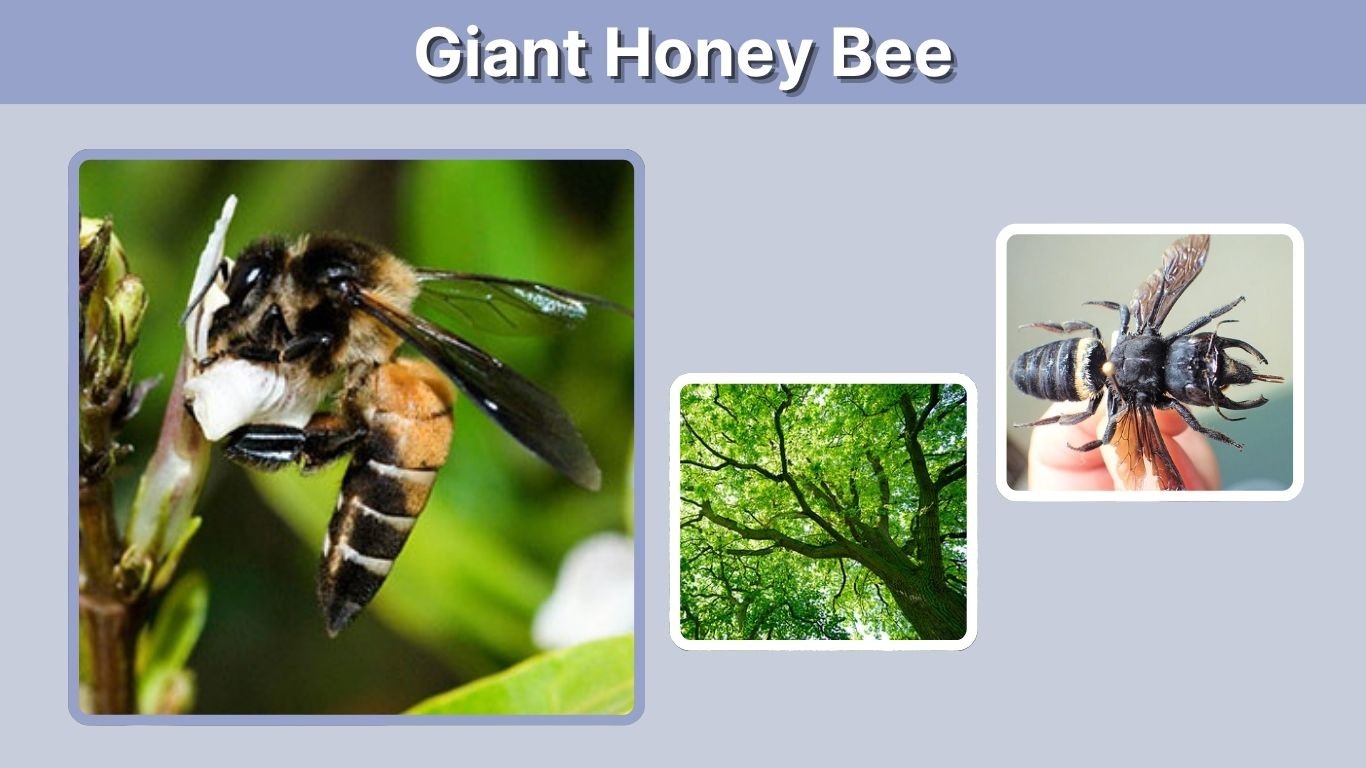
The giant honey bee (Apis dorsata) is one of the world’s largest and most impressive honey-producing bees. Native to South and Southeast Asia, it constructs enormous exposed combs beneath tree branches, cliffs, and buildings. Unlike cavity-nesting honey bees, giant honey bees surround their open nest with layers of workers that protect the comb from weather and predators. These wild, migratory bees are valuable forest and crop pollinators, but colonies can deliver dangerous mass-stinging attacks when people approach or disturb their nests.
Giant Honey Bee Identification and Species
Giant honey bees belong to the genus Apis and the subgenus Megapis. Their large bodies, exposed single-comb nests, seasonal migration, and coordinated defensive behavior distinguish them from European and Asian hive bees. However, several related species and similarly named insects are frequently confused with Apis dorsata.
Giant Honey Bee Identification
- Scientific name: Apis dorsata
- Family: Apidae
- Worker size: Approximately 17–20 millimeters long
- Body: Broad and powerfully built
- Thorax: Dark and covered with brownish hairs
- Abdomen: Golden, dark brown, black, and pale bands
- Wings: Long, transparent, and strong
- Nest type: One large, exposed vertical comb
- Behavior: Usually calm when foraging but highly defensive near its nest
Workers are considerably larger than Apis cerana, the regular Asian honey bee. Giant honey bees can also forage after sunset when sufficient moonlight is available.
Giant Honey Bee Species
The classification of giant honey bees remains under study. A recent morphological revision supports three major species:
- Giant honey bee (Apis dorsata): Found across mainland South and Southeast Asia.
- Himalayan giant honey bee (Apis laboriosa): A high-elevation species of the Himalayas and nearby mountain ranges.
- Indonesian giant honey bee (Apis binghami): Associated particularly with Sulawesi and neighboring islands.
The Philippine giant honey bee is often called Apis breviligula. A 2024 revision classified it as Apis binghami breviligula, although other scientific treatments continue to recognize it as a separate species. Giant honey bee taxonomy is therefore not completely settled. Frontiers in Bee Science explains the current classification debate.
Giant Honey Bee Nest and Colony
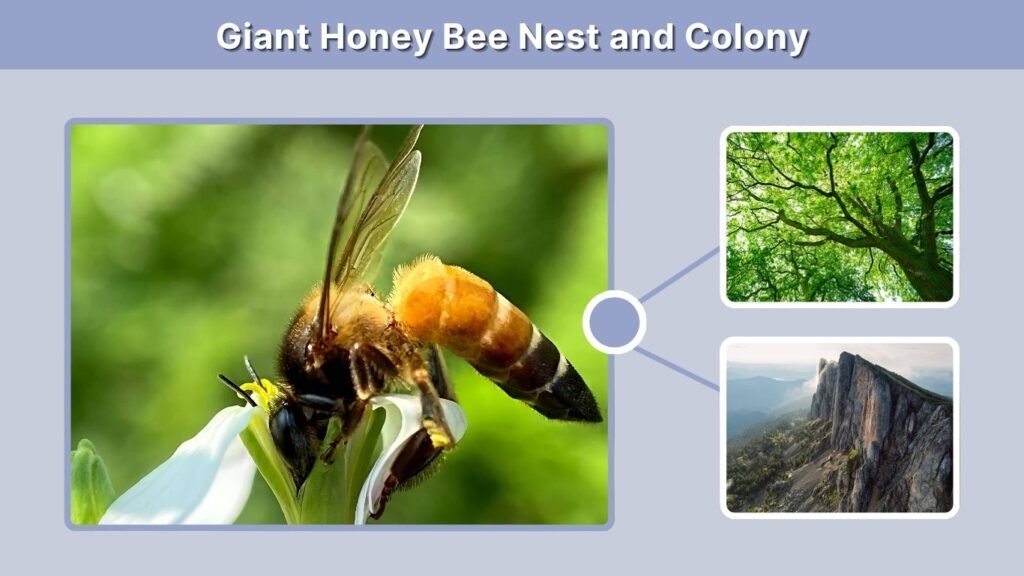
Giant honey bees do not build enclosed, multi-comb hives like European honey bees. Their entire colony lives on a single exposed comb protected by a dense curtain of workers. This unusual design allows the bees to establish colonies in forests where suitable tree cavities might be unavailable.
What Does a Giant Honey Bee Nest Look Like?
A nest consists of one vertical wax comb hanging beneath a sturdy support. Large combs can exceed one meter in width and contain tens of thousands of bees. They may be attached to:
- High tree branches
- Cliff overhangs
- Rock ledges
- Tall towers
- Bridges
- Roofs and building ledges
Honey is stored near the top of the comb, followed by pollen and brood cells. The lower edge forms an active area where workers land, depart, communicate, and perform dances that direct other foragers toward food.
Several colonies may nest in the same tree. Some traditional “bee trees” support dozens of separate combs, each containing an independent colony. The FAO reports that giant honey bee nests may occur individually or in large aggregations.
Giant Honey Bee Queen
Every established colony normally contains one reproductive queen. She has an elongated abdomen and remains inside the dense worker curtain, where she lays eggs in the brood area.
The queen is supported by thousands of female workers responsible for building comb, collecting food, feeding larvae, cooling the nest, and defending the colony. Male drones appear when environmental conditions favor reproduction. A queen is difficult to see without dangerously disturbing the exposed nest.
Seasonal Migration
Apis dorsata colonies frequently migrate as flowering conditions and rainfall patterns change. They abandon their comb, travel to another productive area, and construct a new nest. Some colonies return to the same nesting trees in later seasons, even though individual workers have short lifespans.
In Bangladesh, thousands of giant honey bee colonies migrate into the Sundarbans as mangrove trees begin flowering. Similar movements occur throughout India, Thailand, Cambodia, Malaysia, Indonesia, and Vietnam.
Shimmering and Colony Defense
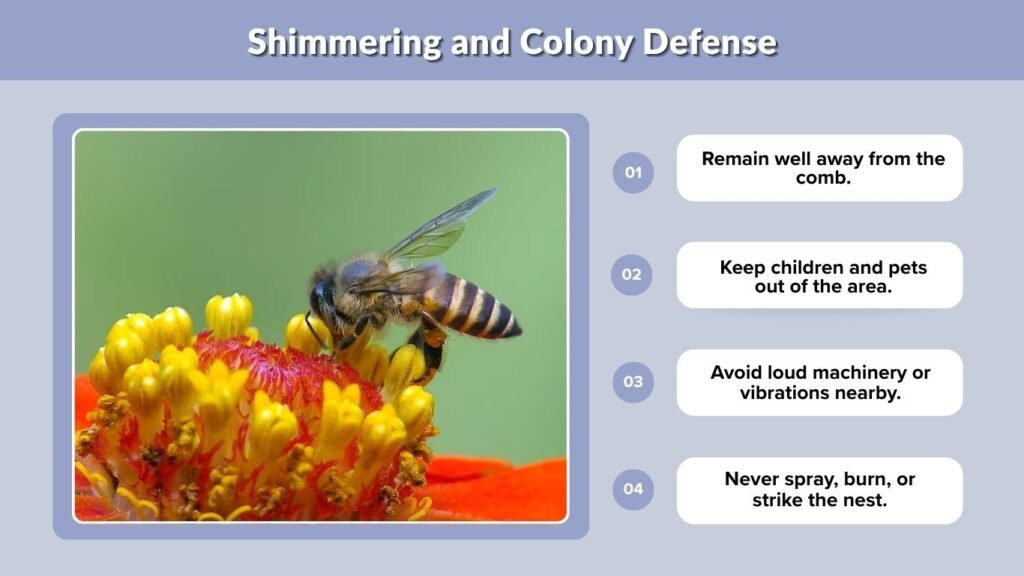
An exposed nest is vulnerable to hornets, birds, mammals, and other predators. Giant honey bees compensate with coordinated colony defenses. Thousands of workers cover the comb in several layers, forming a living barrier between the brood and the surrounding environment.
Why Do Giant Honey Bees Make Waves?
When a hornet or other predator approaches, workers may raise and lower their abdomens in rapid sequence. This creates a visible wave across the colony called “shimmering.”
Small waves warn a predator, while larger synchronized waves can confuse or drive it away. The response may spread across the comb in a fraction of a second. Shimmering provides a first line of defense that does not require workers to leave the nest or physically contact the attacker.
Researchers have documented shimmering as an organized defensive behavior against predatory wasps and other threats. It can escalate into mass flight and stinging if the intruder continues approaching.
Are Giant Honey Bees Dangerous?
Foraging workers are generally not aggressive toward people who leave them alone. The danger arises near their nest. Vibrations, climbing, cutting branches, throwing objects, using machinery, or attempting to remove honey may provoke a mass attack.
Defending workers can pursue an intruder for a considerable distance. Numerous stings may cause severe pain, swelling, allergic reactions, or life-threatening envenomation. Anyone who discovers a colony should:
- Remain well away from the comb.
- Keep children and pets out of the area.
- Avoid loud machinery or vibrations nearby.
- Never spray, burn, or strike the nest.
- Contact local wildlife or pest-management professionals.
Difficulty breathing, throat swelling, dizziness, faintness, or widespread hives following a sting requires immediate emergency medical care.
Giant Honey Bee Honey
Wild Apis dorsata colonies can store substantial quantities of honey. Rural communities across Asia have collected this honey for generations using ropes, ladders, smoke, and traditional climbing techniques. Honey hunting can provide food and income, but unsustainable harvesting may destroy brood and prevent colonies from returning.
Can Giant Honey Bees Be Kept in Hives?
Giant honey bees are wild, exposed-nesting, migratory insects. They generally do not remain in conventional hive boxes and have not been domesticated like Apis mellifera or Apis cerana.
Modern conservation programs encourage honey hunters to remove only the honey-rich portion of the comb while leaving the brood area intact. Harvesting at suitable times and protecting traditional bee trees can reduce colony losses.
Himalayan Giant Honey Bee Honey
The Himalayan giant honey bee, Apis laboriosa, is the world’s largest living honey bee. Workers average slightly over 3 centimeters long and build large combs beneath steep Himalayan cliff overhangs. University of Florida IFAS describes its high-altitude habitat and exceptional size.
Some spring honey produced by these bees contains grayanotoxins collected from certain rhododendron flowers. This product is commonly called “mad honey.” It may cause:
- Nausea and vomiting
- Dizziness or confusion
- Excessive sweating
- Low blood pressure
- An abnormally slow heartbeat
- Fainting
Not all Himalayan honey contains dangerous toxin levels, but potency can be unpredictable. “Mad honey” should not be treated as a proven medicine, and consuming unregulated products can result in poisoning.
Distribution and Similar Giant Bees
Apis dorsata occurs from the Indian subcontinent and southern China through mainland Southeast Asia, Malaysia, and Indonesia. Singapore supports native giant honey bees in forests, densely planted parks, and some urban locations. They usually place their comb beneath sloping branches of tall trees, according to Singapore’s National Parks Board.
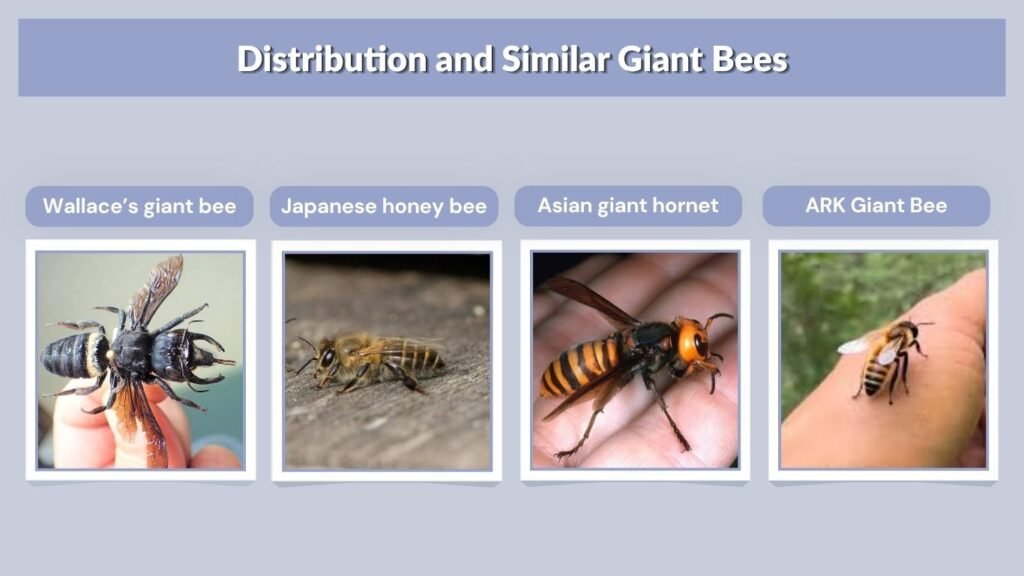
Giant honey bees are not native or established in the UK or USA. Other insects are sometimes mistaken for them:
- Wallace’s giant bee: Megachile pluto, a huge solitary leafcutter bee—not a honey bee.
- Japanese honey bee: Apis cerana japonica, a smaller cavity-nesting species.
- Asian giant hornet: Vespa mandarinia, a predatory wasp rather than a bee.
- ARK Giant Bee: A fictional tamable creature in the video game ARK: Survival Evolved, not Apis dorsata.
FAQs
How big is a giant honey bee?
An Apis dorsata worker is generally around 17–20 millimeters long. The Himalayan species, Apis laboriosa, can grow to approximately 3 centimeters.
Do giant honey bees sting?
Yes. Workers possess functional stingers and may attack collectively when their exposed nest is threatened.
How many bees live in a giant honey bee nest?
A large nest can support tens of thousands of workers. Exceptional colonies may contain approximately 60,000 to 100,000 bees.
Is the giant honey bee extinct?
No. Apis dorsata and other living giant honey bee species still occur across Asia. Wallace’s giant bee was once feared extinct but was rediscovered in 2019.
Can people buy Himalayan giant honey bee honey?
It is sold by some retailers, but authenticity and toxin concentration may be uncertain. Products advertised as “mad honey” can cause serious poisoning, even in relatively small amounts.
