
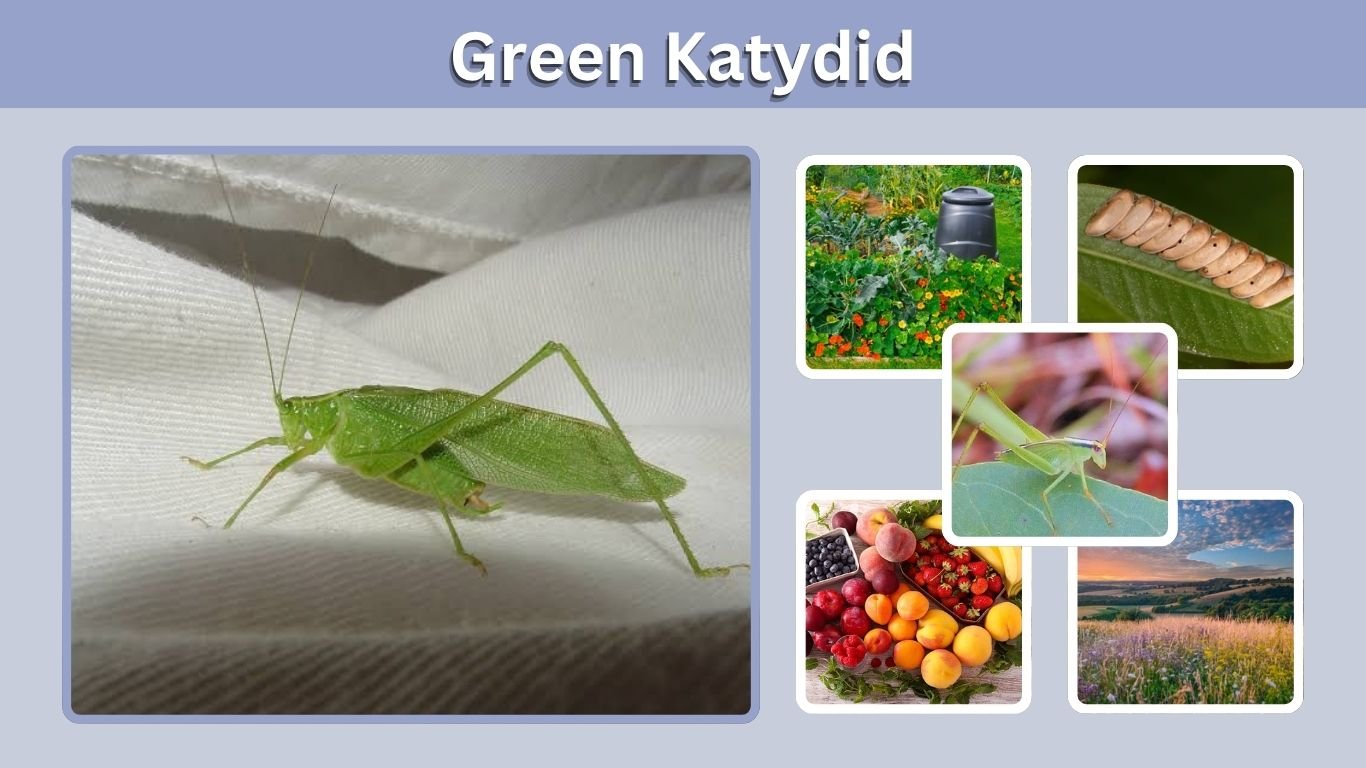
The green katydid is a leaf-like insect known for its bright green body, extremely long antennae, powerful hind legs, and distinctive nighttime calls. Katydids belong to the family Tettigoniidae and are close relatives of crickets rather than true grasshoppers. Their remarkable camouflage allows them to disappear among leaves, shrubs, and garden plants. Although they may look unusual or intimidating, most green katydids are harmless to people. This guide covers identification, diet, habitat, sound, life cycle, bite behavior, and other fascinating green katydid facts.
What Is a Green Katydid?
Green katydids are members of a large family containing thousands of species worldwide. Many species have flattened green wings that closely resemble leaves, helping them avoid birds and other predators. They are especially active during warm evenings and nights, when males often produce loud calls to attract females.
Green Katydid Identification
You can usually recognize a green katydid by these characteristics:
- Bright green or lime-green body
- Very long, threadlike antennae
- Six legs with enlarged hind legs
- Leaf-shaped front wings
- Body usually about 1–3 inches long, depending on species
- Large compound eyes
- Chewing mouthparts
- Female may have a long, blade-like ovipositor
- Some species have spines, horns, or pointed wings
The antennae are particularly useful for identification. They are usually longer than the insect’s entire body.
Green Katydid Scientific Classification
Green katydids belong to the order Orthoptera and family Tettigoniidae. However, “green katydid” is a general description rather than the scientific name of one species.
Different green species occur around the world, including true katydids, bush katydids, coneheads, angle-wing katydids, and false leaf katydids.
Big and Small Green Katydids
Size differs considerably among species. Small green katydids may measure less than an inch, while large or giant species can reach several inches when their wings and legs are included.
Large tropical species often possess particularly broad wings that resemble leaves. Smaller species may have slender bodies and are sometimes mistaken for young grasshoppers or crickets.
Where Do Green Katydids Live?
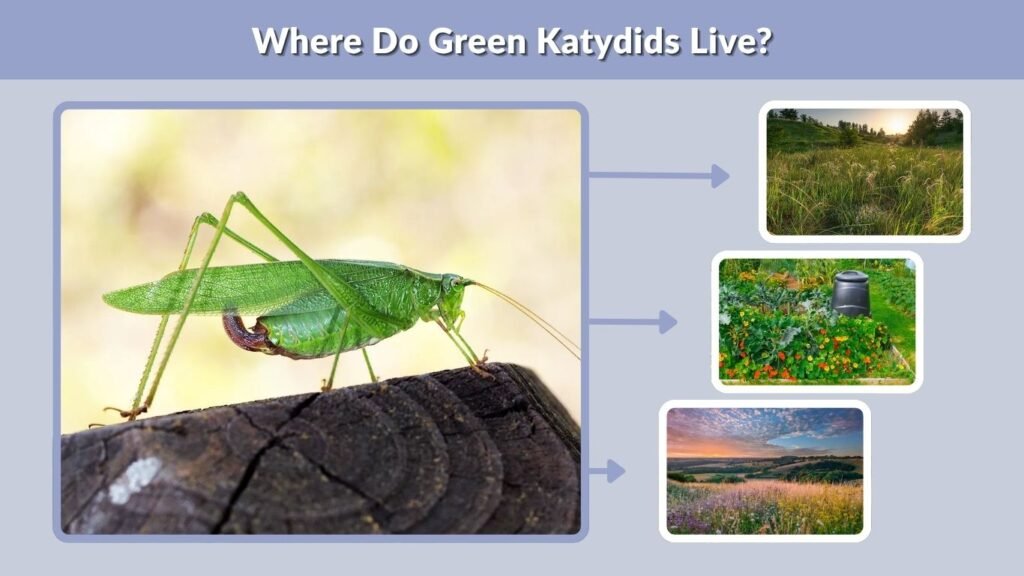
Green katydids occur in many warm and temperate regions worldwide. They commonly inhabit trees, shrubs, gardens, grasslands, forest edges, and agricultural areas. Their green coloration provides excellent camouflage among living vegetation. During the day, they frequently remain motionless beneath leaves before becoming considerably more active after sunset.
Common Green Katydid Habitats
Green katydids can commonly be found around:
- Trees and shrubs
- Tall grasses
- Flower gardens
- Vegetable gardens
- Forest edges
- Meadows
- Orchards
- Agricultural fields
- Parks and woodland vegetation
Many species spend most of their lives above ground rather than on bare soil.
Green Katydids in North America
Green katydids occur throughout many parts of the United States and Canada. They may be encountered in Texas, Florida, California, Ohio, New York, Oregon, North Carolina, Arkansas, Tennessee, and other regions.
The exact species present varies with climate and habitat. Warm areas generally support a greater diversity of katydids.
Green Katydids Around the World
Katydids also occur in Australia, New Zealand, Asia, Africa, Europe, and tropical regions. Tropical forests contain some of the most spectacular green leaf-mimicking species.
Some resemble damaged leaves, complete with fake veins, brown spots, and uneven edges that make their camouflage extremely convincing.
What Do Green Katydids Eat?
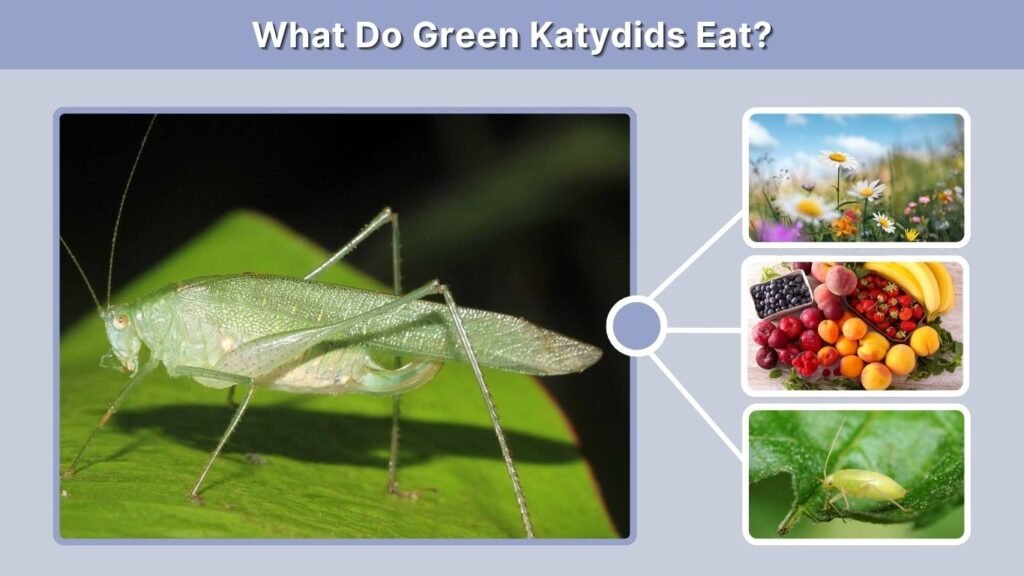
Most green katydids are omnivorous or primarily plant-eating insects. They use strong chewing mouthparts to consume leaves, flowers, fruit, seeds, and other plant material. However, some species are opportunistic predators and may eat smaller insects when available.
Green Katydid Diet
Common foods can include:
- Fresh leaves
- Flowers
- Flower petals
- Fruits
- Seeds
- Pollen
- Tender stems
- Aphids
- Caterpillars
- Small insects
- Insect eggs
Diet varies among species, so not every green katydid eats exactly the same foods.
Do Green Katydids Damage Plants?
A few katydids may chew holes along the edges or surfaces of leaves. In most gardens, their feeding causes only minor cosmetic damage.
Large populations can occasionally damage crops or ornamental plants, but katydids are generally not considered as destructive as grasshoppers, locusts, or some caterpillar species.
Are Green Katydids Predators?
Some species are surprisingly effective predators. Predatory katydids use their legs and strong jaws to capture insects.
They may eat caterpillars, moths, flies, aphids, and other small arthropods. Because of this, certain katydids can provide some natural pest control while also feeding on plants.
Green Katydid Sound and Behavior
One of the most recognizable features of katydids is their sound. Male katydids produce calls primarily to attract females and communicate with other individuals. These sounds are especially noticeable during warm summer and early autumn nights, when several males calling together can create a continuous chorus.
What Does a Green Katydid Sound Like?
The sound varies depending on the species. Some produce repeated clicks, while others make buzzing, rattling, ticking, or raspy calls.
The familiar name “katydid” comes from calls of certain species that people interpreted as sounding similar to the words “katy-did” or “katy-didn’t.”
How Do Green Katydids Make Noise?
Katydids do not produce their calls with their mouths. Males usually create sound through stridulation, rubbing specialized structures on their forewings together.
One wing contains a file-like structure while another has a scraper. Rapid movement produces vibrations that create the characteristic call.
Why Are Katydids Loud at Night?
Katydids are mainly nocturnal, meaning much of their activity occurs after sunset. Calling at night allows males to communicate when they are most active.
Temperature can also influence calling speed. Many species call faster during warmer conditions and slow down as nighttime temperatures decrease.
Green Katydid Nymph and Life Cycle
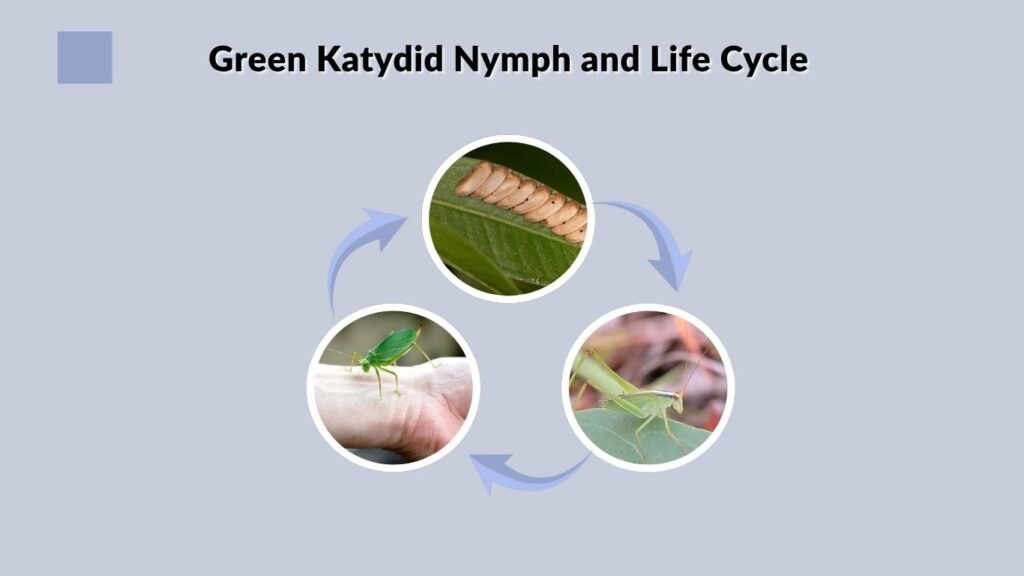
Katydids undergo incomplete metamorphosis, so they do not have a caterpillar or pupal stage. Their development progresses from egg to nymph and finally to adult. Young green katydids already resemble miniature versions of adults but lack fully developed wings and reproductive structures.
Green Katydid Life Cycle
The basic stages are:
- Egg: Females deposit eggs in plants, bark, soil, or other suitable locations.
- Young nymph: The newly hatched katydid resembles a tiny wingless adult.
- Growing nymph: It molts several times while gradually becoming larger.
- Late-stage nymph: Developing wing pads become more noticeable.
- Adult: Wings and reproductive organs become fully developed.
What Does a Baby Green Katydid Look Like?
A baby green katydid usually has a small, slender green body and very long antennae. Its wings are absent or appear only as tiny pads.
Some nymphs look surprisingly different from adults. Certain species develop unusual patterns or colors while young, which can make identification difficult.
Female Green Katydid Ovipositor
Adult female katydids commonly possess a noticeable structure extending from the rear of the abdomen called an ovipositor.
It may resemble a curved blade or sword. Despite its intimidating appearance, it is not a stinger. Females use the ovipositor to place eggs into soil, plant tissue, bark, or other suitable material.
Green Katydid vs. Grasshopper
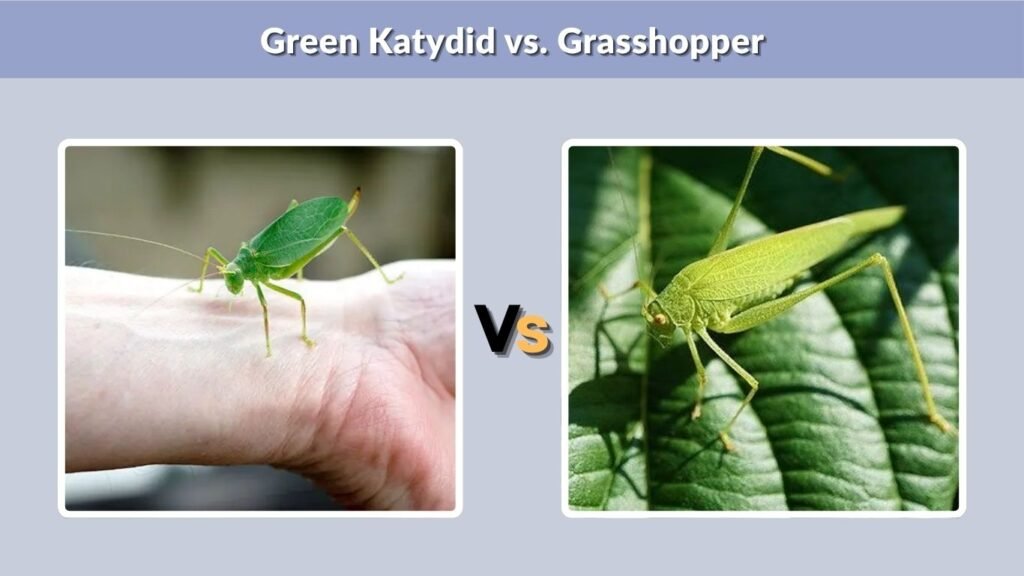
Green katydids and grasshoppers belong to the same insect order, but they can usually be separated by several obvious characteristics. The most useful feature is antenna length. Katydids have extremely long antennae, while grasshopper antennae are generally much shorter.
Main Differences
Key differences include:
- Antennae: Katydids have very long antennae; grasshoppers have shorter ones.
- Body: Katydids often have a more leaf-like appearance.
- Activity: Many katydids are nocturnal; grasshoppers are commonly active during daylight.
- Sound: Katydids often rub their wings together; grasshoppers may use their legs and wings.
- Diet: Katydids may be omnivorous; many grasshoppers primarily eat plants.
- Egg laying: Female katydids may have a clearly visible blade-shaped ovipositor.
Do Green Katydids Bite?
Green katydids are not dangerous insects and do not seek people out to bite. However, larger individuals have powerful chewing mouthparts and may nip defensively if they are grabbed, squeezed, or handled roughly. Such bites are generally associated with self-defense rather than aggression.
What Does a Green Katydid Bite Feel Like?
A large katydid can sometimes produce a noticeable pinch. The area may feel temporarily sore or become slightly red.
Katydids do not have venomous fangs and do not inject venom into people. Most encounters require no treatment beyond ordinary cleaning if the skin has been broken.
Are Green Katydids Poisonous?
Green katydids are generally not considered poisonous or venomous to humans. They also do not possess stingers.
Their best defense is camouflage. If discovered, a katydid may jump, fly, kick with its hind legs, or attempt to bite when physically restrained.
Are Green Katydids Harmful to Pets?
A katydid encountered outdoors is unlikely to pose a serious threat to cats or dogs. Pets may occasionally chase or eat them.
It is still better to prevent pets from consuming large numbers of wild insects because insects may have contacted pesticides or other environmental chemicals.
Interesting Green Katydid Facts
Green katydids have evolved impressive adaptations that allow them to survive among vegetation. Their camouflage, hearing, jumping ability, and complex communication make them much more sophisticated insects than their simple leaf-like appearance might suggest.
Fascinating Facts
- Katydids are more closely related to crickets than grasshoppers.
- Their antennae can be longer than their entire bodies.
- Many species imitate leaves almost perfectly.
- Males produce mating calls by rubbing their wings together.
- Katydid ears are located on their front legs.
- Some species eat both plants and insects.
- Females often possess a sword-like ovipositor.
- Most species are most active at night.
- Green coloration helps conceal them from predators.
- Some tropical species imitate damaged or diseased leaves.
FAQs
1. Is a green katydid a grasshopper?
No. Katydids and grasshoppers are related because both belong to the order Orthoptera, but they belong to different groups. Katydids generally have much longer antennae, are often more active at night, and frequently have wings that strongly resemble leaves.
2. Can a green katydid bite humans?
Yes, a large green katydid can occasionally nip if it is handled or squeezed. However, katydids do not normally attack people. Their bite is primarily defensive, and they do not have venomous fangs or a stinger.
3. What do green katydids eat?
Green katydids commonly eat leaves, flowers, seeds, fruit, and tender plant material. Some species are omnivorous and also capture aphids, caterpillars, insect eggs, and other small insects. Their exact diet depends on the species and available food.
4. Why do green katydids make noise at night?
Male katydids call at night mainly to attract females and communicate with other males. They produce these sounds by rubbing specialized parts of their forewings together. Different species make clicking, buzzing, rattling, or repetitive rhythmic calls.
5. Are green katydids good to have around?
Usually, yes. Most green katydids cause only limited plant damage, while some also eat smaller insects. They are an important part of local food webs and provide food for birds, reptiles, amphibians, spiders, and other predators.
