
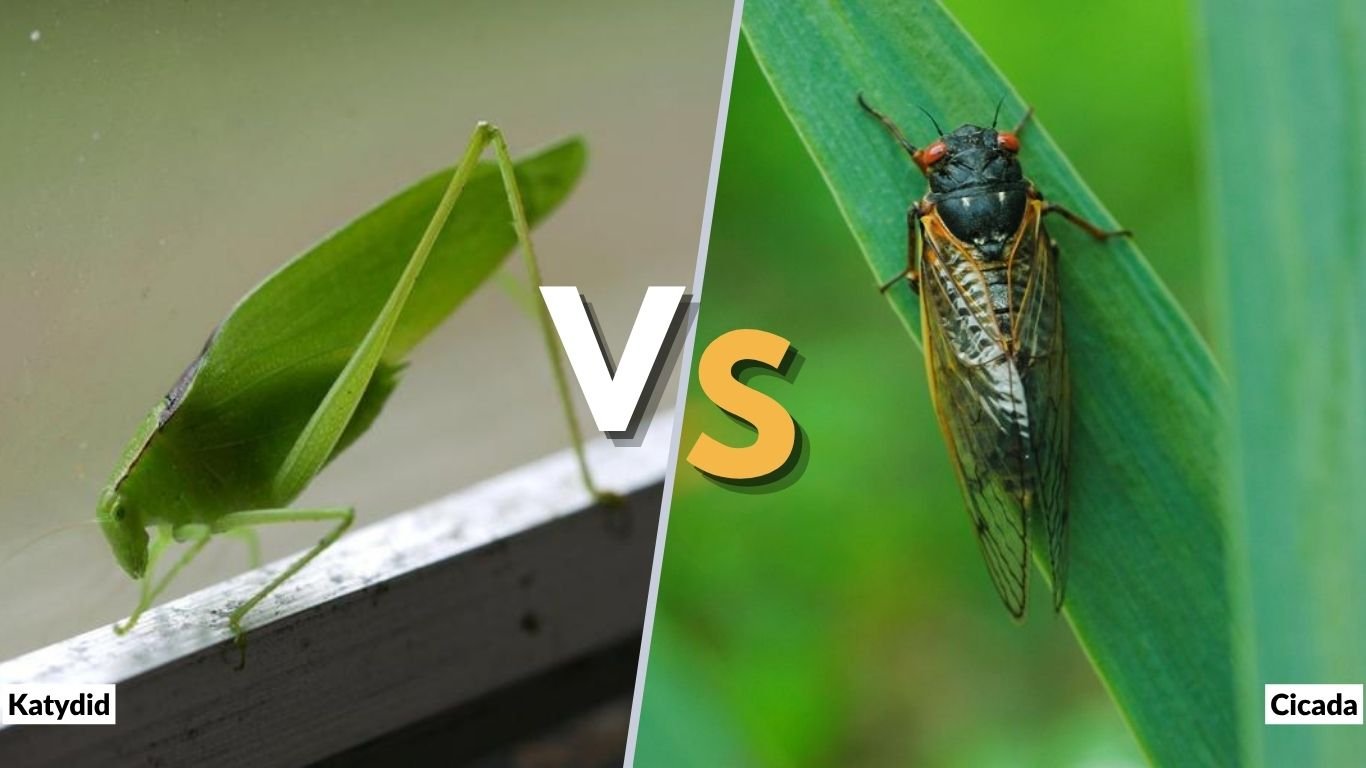
Katydids and cicadas are both famous for their loud summer sounds, but they are very different insects. Katydids belong to the family Tettigoniidae and are closely related to crickets and grasshoppers, while cicadas belong to the superfamily Cicadoidea. They also differ in body shape, antenna length, feeding habits, life cycle, and the way they produce sound. Learning the main differences between a katydid vs cicada makes it much easier to identify which insect is calling from trees, shrubs, or grass.
Katydid vs Cicada: Key Differences
At first glance, katydids and cicadas may seem similar because both can be green, live around vegetation, and produce noticeable calls. However, their anatomy and behavior clearly separate them. Katydids are long-legged jumping insects with extremely long antennae, while cicadas are heavier-bodied insects with broad transparent wings and short antennae.
Main Differences
- Family: Katydids belong to Tettigoniidae; cicadas belong to Cicadoidea.
- Antennae: Katydids have very long antennae; cicadas have short antennae.
- Body: Katydids are slender; cicadas are broad and robust.
- Hind legs: Katydids have powerful jumping legs.
- Wings: Katydid wings often resemble leaves; cicadas usually have transparent wings.
- Sound: Katydids rub their wings together; cicadas use special organs called tymbals.
- Activity: Many katydids call at night, while many cicadas are most vocal during the day.
- Diet: Katydids chew plant material; cicadas drink plant fluids.
- Life cycle: Cicada nymphs can spend years underground.
- Camouflage: Katydids often closely resemble leaves or vegetation.
Is a Katydid a Cicada?
No. A katydid is not a cicada. They belong to different insect groups and evolved very different structures for feeding and sound production.
Katydids belong to the order Orthoptera, which also contains grasshoppers and crickets. Cicadas belong to the order Hemiptera, which includes true bugs. Their similarities mainly come from sharing similar habitats and producing loud seasonal sounds.
Which Is Easier to Identify?
Katydids can usually be recognized by their long antennae and large jumping legs. Many also have green wings shaped like leaves.
Cicadas are easier to recognize by their thick bodies, large eyes, and transparent wings held roof-like over the abdomen. Their short antennae are especially useful for separating them from katydids.
Katydid vs Cicada Appearance
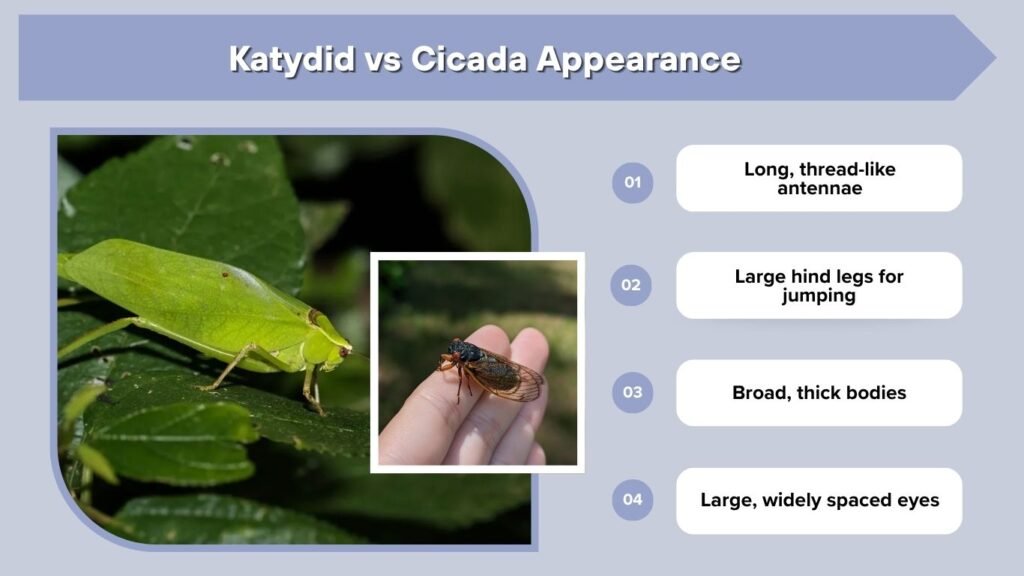
Appearance is one of the easiest ways to distinguish these insects when you can see them clearly. Katydids are typically built for jumping and hiding among leaves, whereas cicadas have bodies adapted for climbing trees, flying, and feeding on plant fluids. Their wings, legs, heads, and antennae are noticeably different.
What Does a Katydid Look Like?
Katydids commonly have:
- Long, thread-like antennae
- Large hind legs for jumping
- Green or brown coloration
- Leaf-shaped wings
- Narrow or elongated bodies
- Chewing mouthparts
- Wings often marked with leaf-like veins
Some katydids are so well camouflaged that they can be difficult to detect even when sitting directly on a leaf.
What Does a Cicada Look Like?
Cicadas typically have:
- Broad, thick bodies
- Large, widely spaced eyes
- Short antennae
- Clear or translucent wings
- Prominent wing veins
- Strong legs for gripping bark
- Piercing-sucking mouthparts
Most cicadas look less like leaves than katydids, although their brown, green, or black coloration can still help them blend into tree bark and vegetation.
Katydid vs Cicada Size
Both groups vary greatly in size. Many common katydids range from roughly 1 to 3 inches long, depending on species. Cicadas can also reach similar body lengths, although their broad bodies and large wings often make them appear heavier.
Size alone is not a reliable identification method. Antennae, legs, wing shape, and sound provide better clues.
Katydid vs Cicada Sound
Sound is the reason many people confuse katydids with cicadas. Both insects can create loud repetitive calls during warm weather. However, they produce their noises using completely different body parts, and their songs often differ in rhythm, timing, and overall quality.
Katydid Sound
Katydid calls may sound like:
- Repeated clicks
- Chirps
- Buzzing
- Rattling
- Scraping
- Rhythmic “katy-did” patterns
Male katydids usually create sound by rubbing specialized parts of their forewings together. This process is called stridulation.
Their calls are often especially noticeable during evening and nighttime hours.
Cicada Sound
Cicadas can produce:
- Loud buzzing
- Pulsing drones
- Metallic rattles
- Whining sounds
- Repetitive vibrating calls
Male cicadas produce sound using specialized abdominal organs called tymbals. Muscles rapidly deform these structures, creating repeated clicks that combine into a loud call.
Large groups of cicadas can become extremely noisy.
Katydid vs Cicada Sound at Night
If you hear repetitive chirping after dark, a katydid is often a likely source. Many katydids are strongly nocturnal and call from trees, shrubs, and tall vegetation.
Cicadas are generally more associated with daytime and warm evening calling, although activity depends on species and local conditions. Listening to both the rhythm and time of day can help narrow down the identification.
Katydid vs Cicada Diet
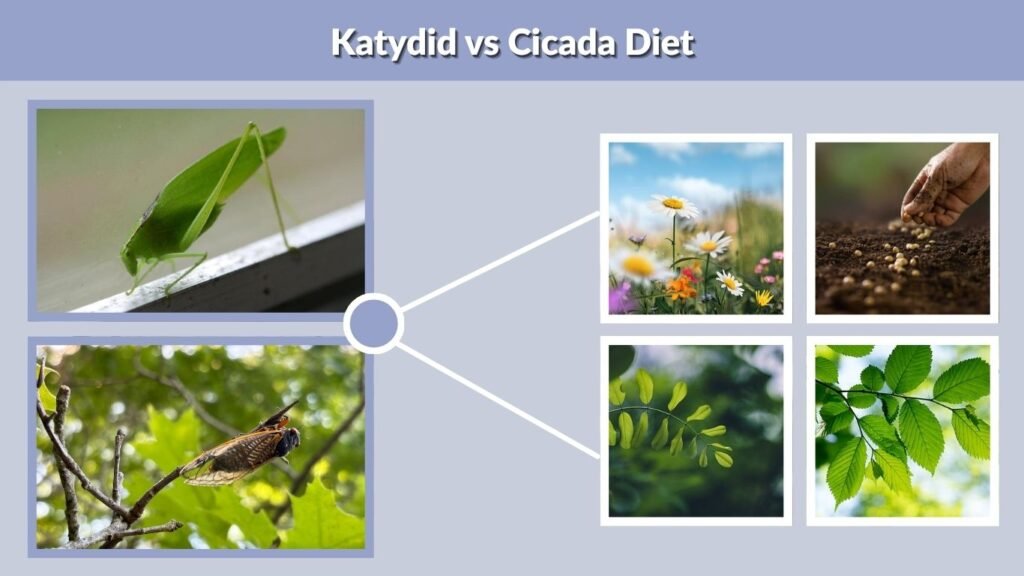
Katydids and cicadas also feed very differently. Katydids have chewing mouthparts and can physically remove pieces of leaves, flowers, and other material. Cicadas have piercing-sucking mouthparts and feed primarily by drawing fluids from woody plants. These feeding adaptations reflect their completely different evolutionary histories.
What Do Katydids Eat?
Katydids may eat:
- Leaves
- Grasses
- Flowers
- Fruits
- Seeds
- Tender plant stems
- Aphids
- Caterpillars
- Small insects
Many species are herbivorous, but some are omnivorous or predatory.
What Do Cicadas Eat?
Cicadas primarily obtain nutrients from fluids inside plants. Nymphs live underground and feed from plant roots, while adults generally feed from woody stems and branches.
Their mouthparts do not chew holes in leaves like those of a katydid. Instead, they pierce plant tissue and draw out liquid.
Can Katydids Eat Cicadas?
Large predatory katydids may occasionally attack other insects, but cicadas are not a standard food for most katydids.
Smaller cicadas or vulnerable individuals could potentially become opportunistic prey for a large predatory species. However, the majority of katydids mainly consume plants or much smaller arthropods.
Katydid vs Cicada Life Cycle
Both insects undergo incomplete metamorphosis, meaning there is no pupal stage. Their eggs hatch into nymphs that eventually become adults. The major difference is where the nymphs live. Katydid nymphs usually remain above ground, while cicada nymphs spend most of their development underground.
Katydid Life Cycle
Katydids generally develop through:
- Egg
- Young nymph
- Several nymphal molts
- Adult
The nymphs resemble small wingless adults. With each molt, their wings and reproductive structures become more developed.
Some species overwinter as eggs before hatching during favorable weather.
Cicada Life Cycle
Cicadas typically develop through:
- Egg
- Newly hatched nymph
- Underground nymphal stages
- Final nymph emerging from soil
- Adult
Cicada nymphs feed underground for months or years depending on species. Periodical cicadas are especially famous for remaining underground for 13 or 17 years.
Cicada Shell vs Katydid Molt
Empty cicada shells are commonly found attached to tree trunks and other vertical surfaces. These are the shed exoskeletons left behind when mature nymphs emerge and molt into adults.
Katydids also molt, but their shed skins are usually less noticeable because they often remain hidden among vegetation.
Katydid vs Cicada Habitat and Behavior
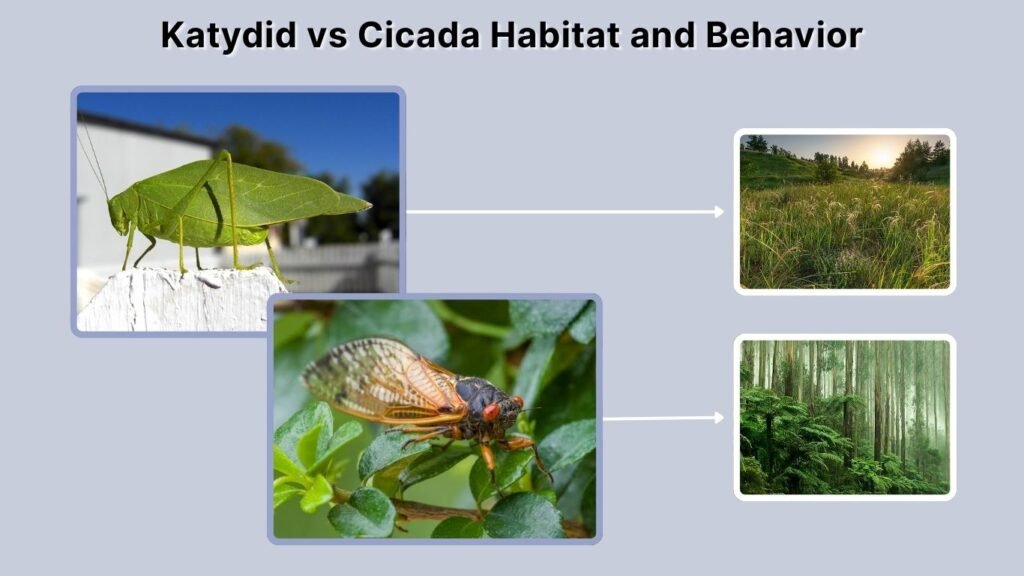
Both insects live around vegetation, but they use their habitats differently. Katydids usually remain among leaves, grasses, and shrubs where their camouflage provides protection. Cicadas spend much of their lives underground before adults emerge and move into trees. Their lifestyles therefore overlap mainly during the adult stage.
Where Katydids Live
Katydids commonly inhabit:
- Trees
- Shrubs
- Meadows
- Tall grasses
- Gardens
- Forest edges
- Tropical forests
Many spend daylight hours hiding among vegetation before becoming more active at night.
Where Cicadas Live
Adult cicadas are strongly associated with trees and woody vegetation. Their underground nymphs live around plant roots.
After emerging, adults climb trees, shed their final nymphal skin, expand their wings, and begin their short above-ground reproductive period.
Cicada vs Locust vs Katydid
Cicadas, locusts, and katydids are often confused because all can occur in large numbers and produce noticeable sounds. However, locusts are actually certain grasshopper species that can develop swarming behavior, while katydids belong to a different Orthopteran family and cicadas belong to Hemiptera.
Quick Comparison
- Katydid: Long antennae, leaf-like body, usually nocturnal caller.
- Cicada: Short antennae, transparent wings, loud buzzing call.
- Locust: Short antennae, powerful jumping legs, grasshopper body.
- Cricket: Long antennae, often ground-dwelling, chirping sound.
The antennae provide one of the simplest clues: katydids and crickets have long antennae, while locusts and cicadas have much shorter ones.
FAQs
What is the main difference between a katydid and a cicada?
Katydids are long-horned insects related to crickets and grasshoppers, while cicadas are true bugs with piercing-sucking mouthparts. Katydids have long antennae and powerful jumping legs, whereas cicadas have short antennae, broad bodies, and transparent wings.
Is a katydid the same thing as a cicada?
No. Katydids belong to the family Tettigoniidae in the order Orthoptera. Cicadas belong to Cicadoidea in the order Hemiptera. They may live in similar environments and produce loud sounds, but they are biologically different insects.
Which is louder, a katydid or a cicada?
Both can be loud, but cicadas are especially famous for producing extremely intense buzzing calls. Large groups can create a powerful continuous sound. Katydids usually make more distinct chirping, clicking, scraping, or rhythmic calls, particularly at night.
How can you tell a katydid sound from a cicada sound?
Katydids commonly produce repetitive clicks, chirps, or rasping calls, often after dark. Cicadas usually create louder buzzing, droning, or pulsing sounds. Katydids rub their wings together, whereas cicadas produce their calls with specialized abdominal organs called tymbals.
Do katydids and cicadas come out at the same time?
They can overlap during warm summer months, although activity patterns differ. Many cicadas call mainly during daylight and warm evenings, while numerous katydid species become most active after sunset. Local species, temperature, and season influence exactly when each insect appears.
