
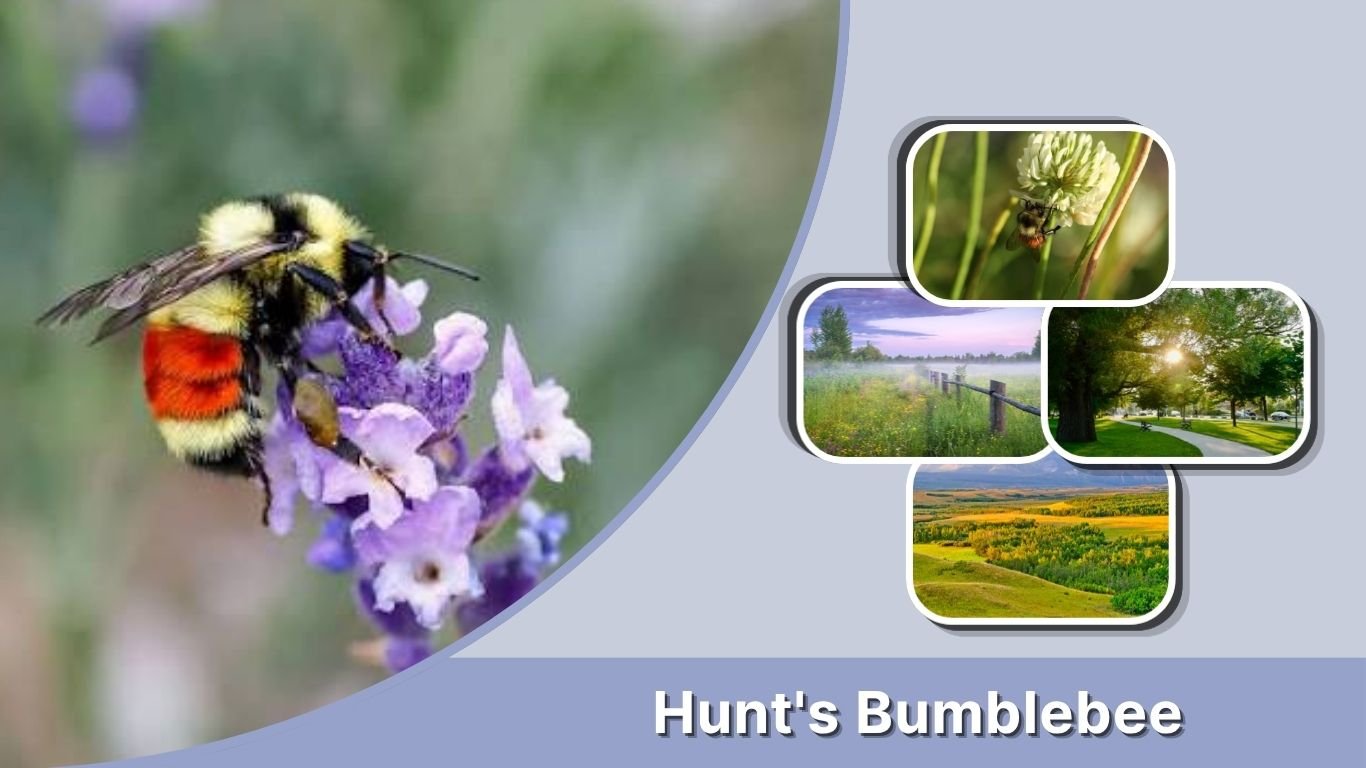
Hunt’s bumblebee (Bombus huntii) is a colorful native bumblebee found mainly across western North America. Its combination of yellow, black, and bright orange-red hairs makes it one of the easier bumblebees to notice on summer flowers. This social bee forms seasonal colonies, usually nests underground, and gathers pollen and nectar from many different plants. Hunt’s bumblebee is also an important wild pollinator in grasslands, gardens, farms, and mountain landscapes. Here is how to identify it, where it lives, what it eats, and how its colony develops.
What Is Hunt’s Bumblebee?
Hunt’s bumblebee is a medium-sized species belonging to the family Apidae and genus Bombus. Its scientific name is Bombus huntii. It is primarily associated with western North America and can remain common in suitable habitats. NatureServe currently ranks the species G5, indicating that it is considered globally secure.
Hunt’s Bumblebee Identification
Important identification features include:
- Dense, fuzzy body
- Yellow hairs on the face
- Yellow hair toward the front of the thorax
- Black band between the wing bases
- Yellow first abdominal segment
- Bright orange or reddish middle abdominal segments
- Yellow band behind the orange area
- Dark tip of the abdomen
- Dark legs and translucent wings
The striking orange middle of the abdomen is one of the best features for recognizing this species.
Scientific Classification
Hunt’s bumblebee is classified as:
- Kingdom: Animalia
- Order: Hymenoptera
- Family: Apidae
- Genus: Bombus
- Species: Bombus huntii
It is also placed within the bumblebee subgenus Pyrobombus.
What Does Hunt’s Bumblebee Look Like?
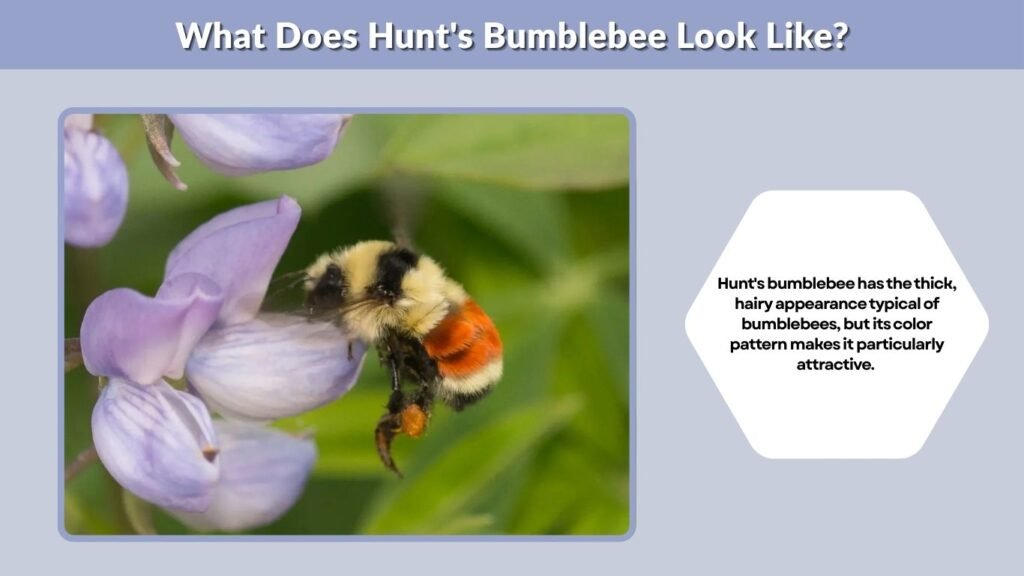
Hunt’s bumblebee has the thick, hairy appearance typical of bumblebees, but its color pattern makes it particularly attractive. Yellow hairs cover much of the front of the body, followed by black and conspicuous orange-red abdominal bands. Queens, workers, and males may show some differences in size and coloration.
Hunt’s Bumblebee Size
Hunt’s bumblebee is generally considered a medium-sized bumblebee. Workers are often around 11–14 mm long, while queens can be noticeably larger. Individual size varies because nutrition during larval development can influence adult body size.
A large queen seen flying close to the ground in spring may therefore look considerably bigger than workers encountered later in summer.
Hunt’s Bumblebee vs Similar Bumblebees
Bombus centralis can closely resemble Hunt’s bumblebee.
One useful difference involves abdominal coloration. In female Hunt’s bumblebees, the second abdominal segment is orange and the fourth is yellow. Female Bombus centralis generally show a different arrangement, with the second segment yellow and the fourth orange.
Color alone is not always enough for difficult specimens, so location and additional anatomical features may also be necessary.
Where Does Hunt’s Bumblebee Live?
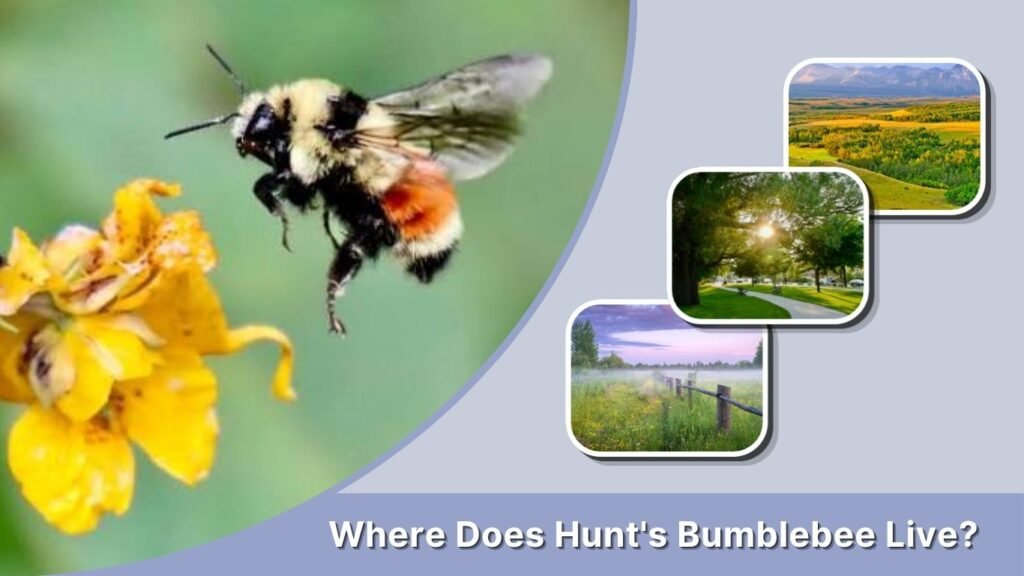
Hunt’s bumblebee has a broad western North American distribution. Its range extends from southern Canada through much of the western United States and south into Mexico. It can occupy environments ranging from dry landscapes to mountain meadows, making it adaptable compared with some more habitat-restricted bumblebees.
Hunt’s Bumblebee Range
The species occurs in areas including:
- Alberta
- British Columbia
- Saskatchewan
- Manitoba
- Washington
- Oregon
- California
- Idaho
- Montana
- Wyoming
- Colorado
- Utah
- Nevada
- Arizona
- New Mexico
- North Dakota
- South Dakota
- Nebraska
- Parts of Texas
- Mexico
Its distribution extends eastward into portions of the Great Plains.
Preferred Habitat
Hunt’s bumblebees can occupy:
- Prairie
- Meadows
- Shrublands
- High-desert scrub
- Mountain valleys
- Riparian areas
- Agricultural landscapes
- Gardens
- Parks
- Developed areas with abundant flowers
In the Pacific Northwest, surveys have frequently recorded the species in shrublands, developed areas, and riparian habitats.
Where Does Hunt’s Bumblebee Nest?
Hunt’s bumblebee is primarily a ground-nesting species. Queens generally search for existing cavities rather than excavating a large underground tunnel themselves.
Potential nest sites include abandoned rodent burrows, cavities under vegetation, spaces beneath grass, and other protected underground locations.
Hunt’s Bumblebee Diet and Pollination
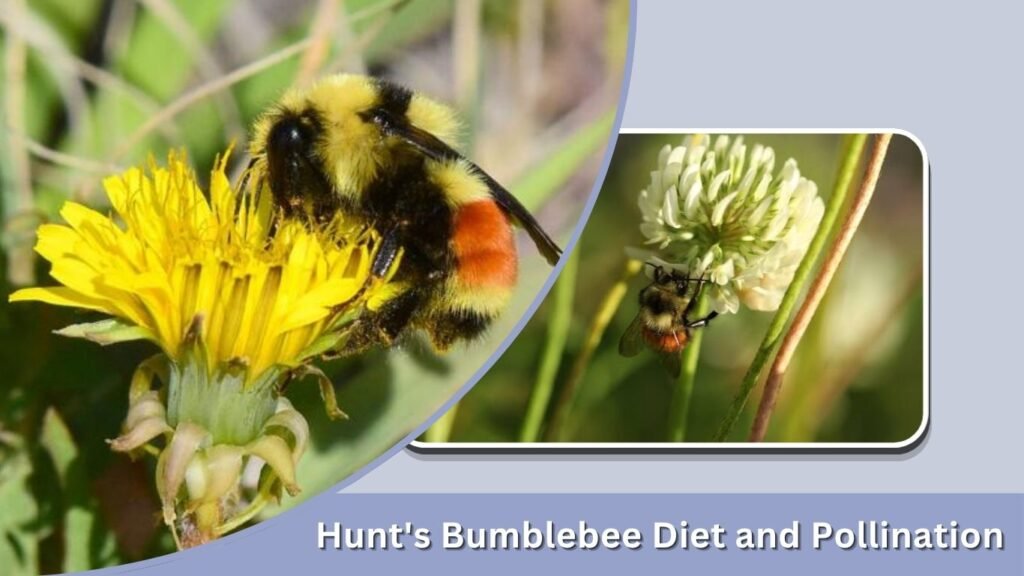
Hunt’s bumblebees are generalist flower visitors. Rather than relying on one plant species, they collect pollen and nectar from many flowering plants throughout their active season. This flexibility helps colonies survive across a broad range of western environments.
What Does Hunt’s Bumblebee Eat?
Adults and larvae depend primarily on:
- Flower nectar
- Pollen
- Small stores of nectar in the nest
- Pollen provisions collected for developing larvae
Hunt’s bumblebees have been recorded visiting many plant groups, including members of the sunflower family and legumes.
Flowers Hunt’s Bumblebees Visit
They may frequently visit flowers such as:
- Lupines
- Catmint
- Sunflowers
- Thistles
- Clovers
- Asters
- Goldenrods
- Native legumes
- Teasel
- Other nectar-rich wildflowers
Providing multiple flower species with overlapping bloom periods helps create dependable food throughout the season.
Importance as Pollinators
As workers move between blossoms, pollen attaches to their hairy bodies and is transferred to other flowers.
Bumblebees can also perform buzz pollination, using rapid vibrations to release pollen from certain flowers. This makes bumblebees valuable pollinators in both natural ecosystems and agricultural settings.
Hunt’s Bumblebee Life Cycle
Hunt’s bumblebees form annual social colonies. A colony does not normally survive through several years like a honey bee hive. Instead, a fertilized queen survives winter and establishes a completely new colony when conditions become favorable.
Annual Colony Cycle
The life cycle generally follows these stages:
- A fertilized queen emerges after overwintering.
- She feeds heavily on spring flowers.
- The queen searches for a suitable underground nest.
- She lays eggs and cares for the first larvae.
- Female workers emerge and begin foraging.
- The colony grows through summer.
- New queens and males are produced later in the season.
- Males mate with young queens.
- Old queens, males, and workers eventually die.
- Newly fertilized queens overwinter and restart the cycle.
Hunt’s Bumblebee Queen
Queens are particularly important during early spring because each surviving queen represents the potential beginning of an entire colony.
Before workers appear, the queen must perform every major job herself, including gathering food, warming brood, defending the nest, and raising the first generation.
Once workers emerge, the queen spends more time laying eggs.
Does Hunt’s Bumblebee Sting?
Female Hunt’s bumblebees, including queens and workers, have stingers and can sting defensively. However, they generally concentrate on gathering food and do not seek out people to attack.
Sting and Behavior
Keep these points in mind:
- Female workers can sting.
- Queens can also sting.
- Male bumblebees cannot sting.
- Stings are usually defensive.
- Disturbing a nest increases the chance of being stung.
- A trapped or handled bee may defend itself.
Unlike honey bees, bumblebees do not have the same strongly barbed stinger mechanism and can potentially sting more than once.
Is Hunt’s Bumblebee Endangered?
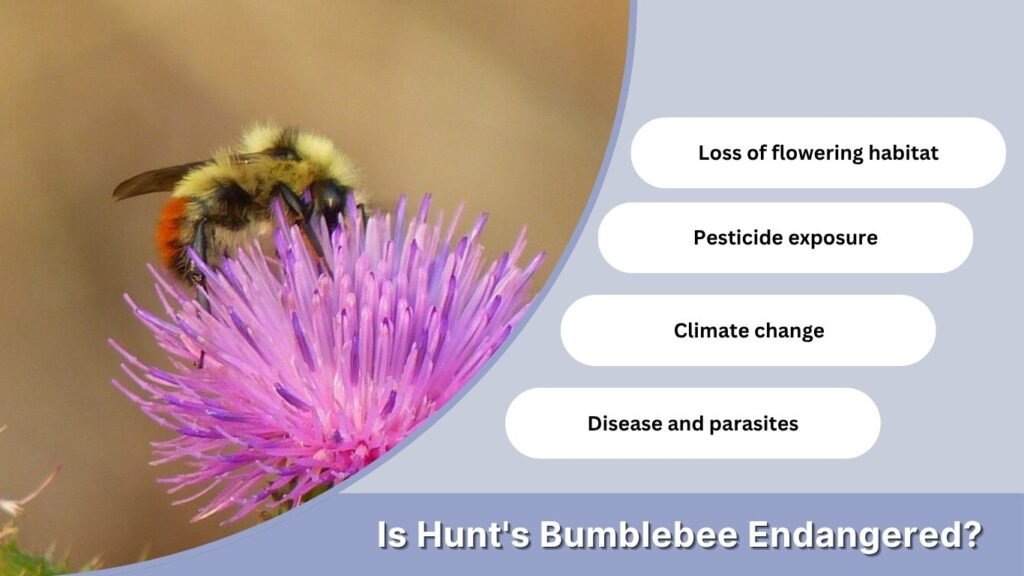
Hunt’s bumblebee is not currently considered an endangered species across its overall range. NatureServe ranks Bombus huntii as G5 (Secure) and describes its short- and long-term trends as relatively stable.
The Pacific Northwest Bumble Bee Atlas also lists Hunt’s bumblebee as Least Concern and describes it as common and stable across its range.
Potential Threats
Like other native bumblebees, it can still be affected by:
- Loss of flowering habitat
- Pesticide exposure
- Climate change
- Disease and parasites
- Reduced nesting habitat
- Loss of native plant diversity
- Intensive land management
Protecting diverse flowering landscapes benefits Hunt’s bumblebee along with many less common native bee species.
FAQs
1. What is the scientific name of Hunt’s bumblebee?
The scientific name is Bombus huntii. It is a native North American bumblebee belonging to the family Apidae.
2. How do you identify Hunt’s bumblebee?
Look for yellow hairs on the face, black between the wings, and a distinctive combination of yellow and bright orange-red abdominal bands.
3. Where is Hunt’s bumblebee found?
It occurs mainly across western North America, from southern Canada through the western United States and into parts of Mexico.
4. Is Hunt’s bumblebee endangered?
No. It is currently considered globally secure by NatureServe and is listed as Least Concern in the Pacific Northwest Bumble Bee Atlas assessment.
5. Where does Hunt’s bumblebee nest?
Hunt’s bumblebee usually nests underground, often using existing protected cavities such as abandoned rodent burrows or spaces beneath vegetation.
