
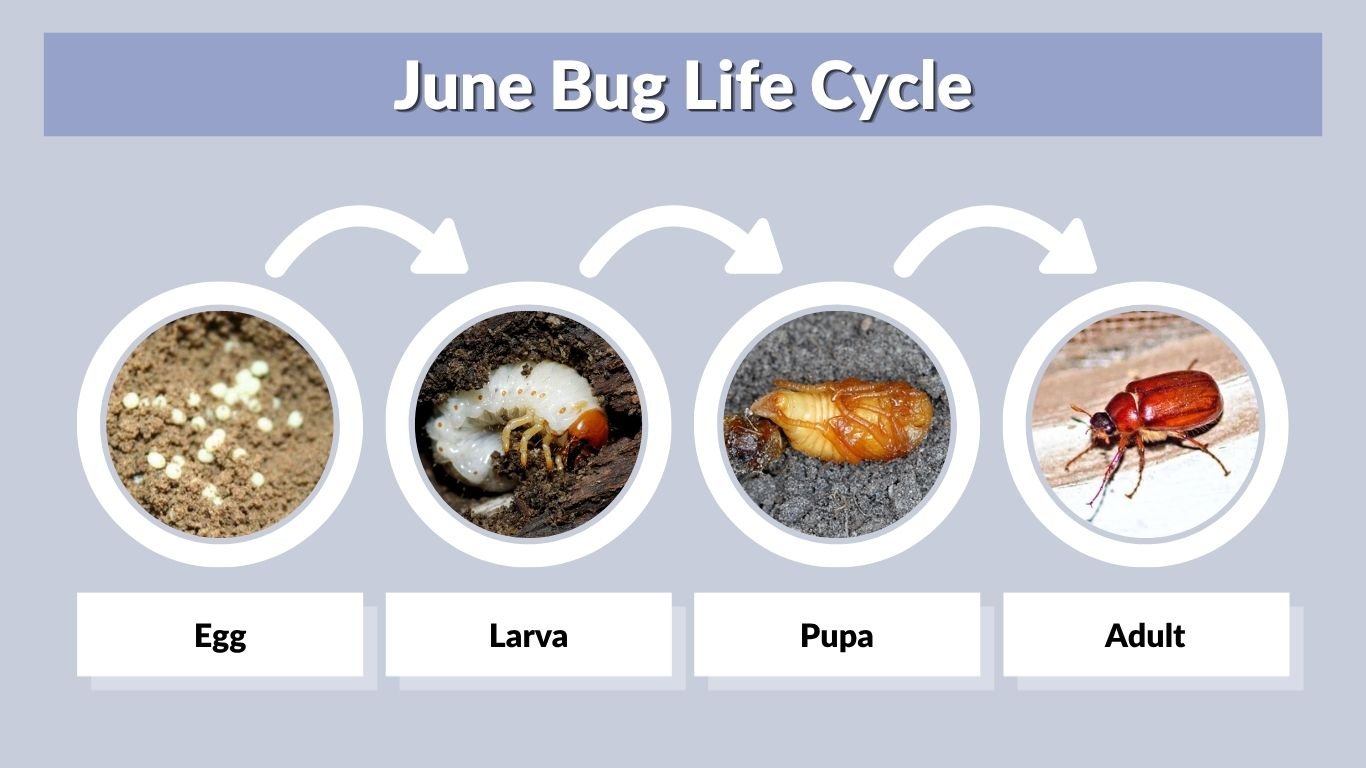
June bugs are common scarab beetles frequently seen flying around outdoor lights during warm spring and summer evenings. However, the familiar adult beetle represents only a short part of its life. June bugs spend most of their development underground as white, C-shaped larvae known as grubs. Their complete life cycle includes four main stages: egg, larva, pupa, and adult. Depending on the species and local climate, the entire process may take one to three years. Understanding each stage can help homeowners recognize June bug activity and identify possible lawn or garden damage.
Understanding the June Bug Life Cycle
June bugs undergo complete metamorphosis, meaning their immature stages look very different from the adult beetles. Their life begins as an egg buried in soil. The egg hatches into a white grub that feeds and grows underground before changing into a pupa. An adult beetle eventually develops inside the pupa and emerges to reproduce.
| Life-cycle stage | Typical location | Main activity |
|---|---|---|
| Egg | Moist soil | Embryonic development |
| Larva or white grub | Below the soil surface | Feeding on roots and growing |
| Pupa | Underground soil chamber | Transformation into an adult |
| Adult | Above ground and on plants | Feeding, mating, and laying eggs |
The timing varies among species. Some June beetles complete one generation each year, while many Phyllophaga species require two or three years to mature. University of Minnesota Extension notes that certain May and June beetle grubs can remain underground through several growing seasons.
Stage 1: June Bug Eggs
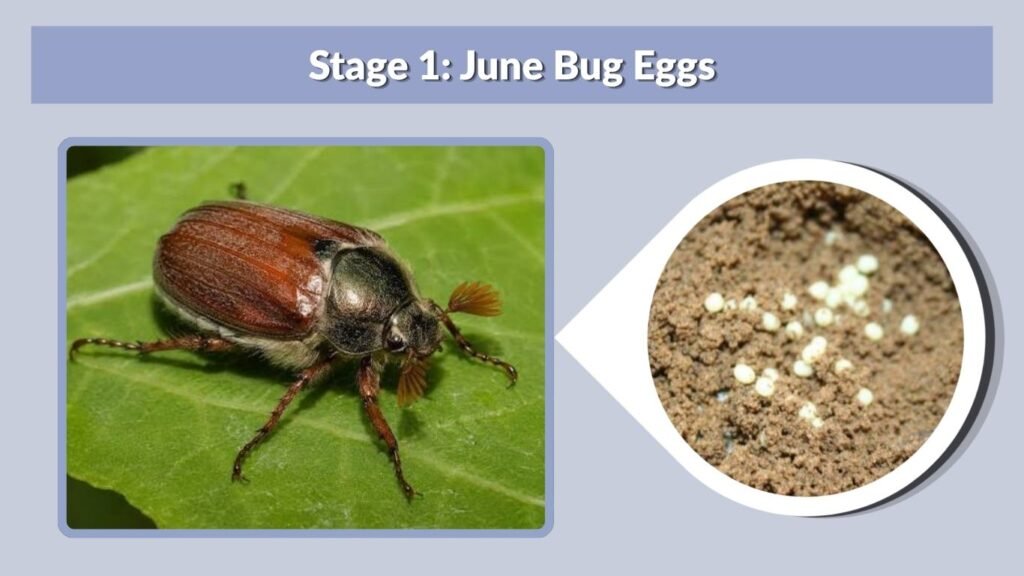
The June bug life cycle begins when an adult female lays eggs in the soil. Egg-laying generally occurs during late spring or summer, shortly after adults emerge, mate, and begin feeding.
Where Do June Bugs Lay Their Eggs?
Female June bugs usually select moist, grassy soil because it provides suitable conditions for the eggs and plenty of roots for newly hatched larvae. Lawns, pastures, fields, gardens, and areas with grassy weeds are common egg-laying locations.
The female burrows several inches into the ground and deposits her eggs in small groups. She may return to the surface to feed before entering the soil again and laying more eggs.
Well-watered lawns can be particularly attractive because moist soil is easier for females to enter and helps prevent eggs from drying out.
What Do June Bug Eggs Look Like?
June bug eggs are small, pale, and usually round or slightly oval. They may begin as pearly white eggs and increase slightly in size as they absorb moisture from the surrounding soil.
Because the eggs are buried underground, homeowners rarely see them. Finding adult June bugs during summer does not necessarily mean their eggs will be visible near the surface.
How Long Does the Egg Stage Last?
June bug eggs commonly hatch after a few weeks, although temperature, moisture, and species affect the exact timing. Eggs generally develop faster in warm, adequately moist soil.
Extremely dry conditions can reduce egg survival. Once development is complete, a tiny white grub emerges and immediately begins searching for plant roots.
Stage 2: June Bug Larvae or White Grubs
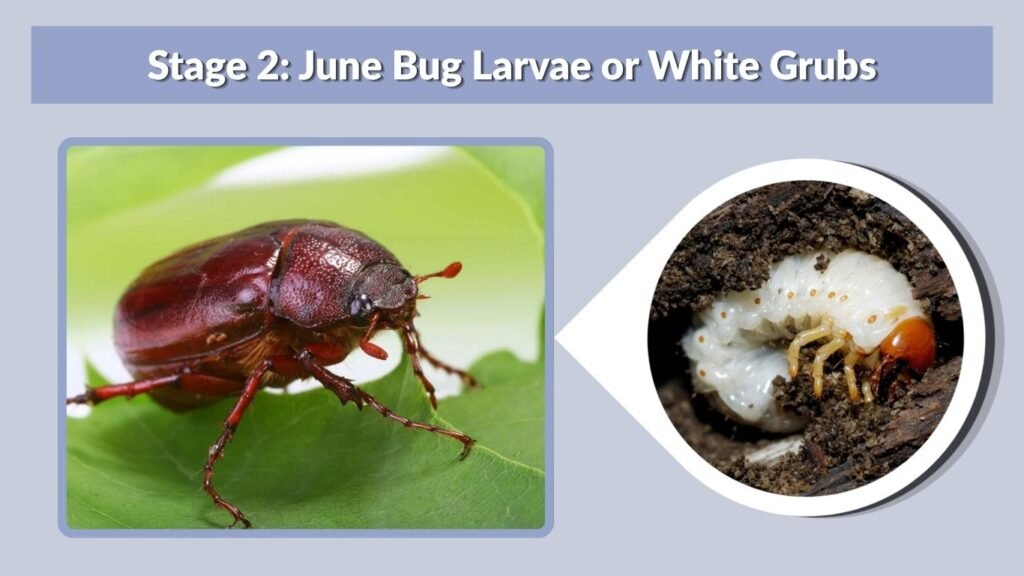
The larval stage is the longest and potentially most damaging part of the June bug life cycle. June bug larvae are called white grubs because of their pale bodies and curved appearance.
What Do June Bug Larvae Look Like?
June bug grubs have creamy-white bodies, brown or orange heads, six small legs near the front of the body, and dark material visible near the rear. When uncovered, they usually curl into a recognizable C shape.
Young grubs are very small, but they increase in size after each molt. Mature June bug larvae may become noticeably larger and thicker than Japanese beetle or masked chafer grubs.
Correct identification can sometimes require examining the arrangement of hairs beneath the rear end, known as the raster pattern.
What Do June Bug Grubs Eat?
June bug grubs feed mainly on underground plant material, including:
- Grass roots
- Weed roots
- Crop roots
- Young plant roots
- Decaying organic matter
Newly hatched grubs begin feeding near the soil surface, where tender roots are abundant. As they grow, they can consume larger roots and become more capable of damaging lawns, pastures, and crops.
Heavy root feeding may cause grass to yellow, wilt, or turn brown. Severely damaged turf may pull away from the ground like loose carpet because the root system has been destroyed.
The Three Larval Instars
June bug larvae normally pass through three developmental periods called instars. The grub molts between each instar, shedding its old outer covering as it grows.
First Instar
The first instar begins immediately after the egg hatches. These young grubs are small and feed on fine roots and organic material near the surface.
Their feeding usually causes little visible damage because their bodies and mouthparts are still small.
Second Instar
After molting, the grub enters its second instar. It becomes larger, eats more roots, and moves more actively through the soil.
Damage may become noticeable if many second-instar grubs are concentrated beneath the same area of turf.
Third Instar
The third instar is the largest larval stage. These mature grubs have strong mouthparts and can consume substantial amounts of plant material.
In species with a multi-year life cycle, third-instar larvae may remain underground for an extended period. University of Minnesota Extension explains that mature Phyllophaga grubs can return to the upper soil layer during their third spring before forming pupal cells later in the season.
How June Bug Grubs Survive Winter
As temperatures fall, June bug grubs move deeper into the soil. Below the frost line, they become less active and remain protected from extreme cold.
They do not normally feed heavily during winter. Instead, development slows until the soil warms again in spring.
When warmer temperatures return, the grubs move closer to the surface and resume feeding on roots. This seasonal movement may occur more than once in species that need two or three years to mature.
The depth at which they overwinter depends on the climate, soil type, moisture level, and severity of the cold.
Stage 3: The June Bug Pupa
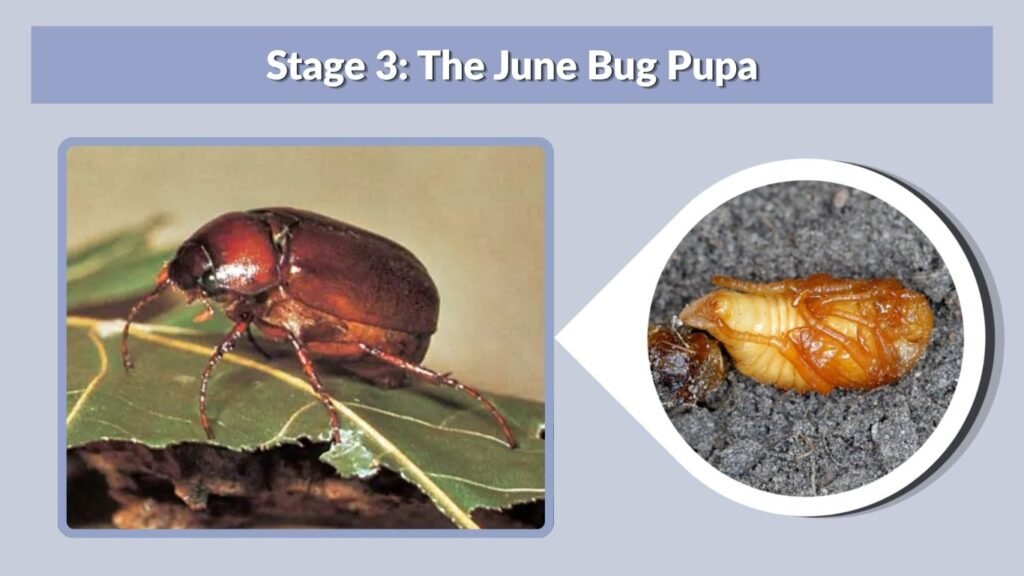
After completing its larval growth, a mature June bug grub prepares to become a pupa. It stops feeding and creates a small chamber in the soil.
How Does Pupation Begin?
The grub compacts soil around its body to form an oval pupal cell. Inside this protected chamber, it sheds its larval skin and becomes a soft-bodied pupa.
The pupa initially appears pale or creamy but gradually darkens as adult features develop.
What Happens Inside the Pupa?
The pupal stage is a period of dramatic transformation. The grub’s body is reorganized into the adult beetle’s form.
During this stage, the insect develops:
- Hardened wing covers
- Functional wings
- Adult legs and claws
- Compound eyes
- Antennae
- Reproductive organs
- Adult chewing mouthparts
The pupa does not feed or actively travel. It survives using energy stored during the larval stage.
University of Minnesota Extension reports that mature larvae create underground pupal cells and molt into pupae before adult beetles develop.
How Long Does the Pupal Stage Last?
The pupal period often lasts several weeks, although temperature and species influence its length. Warm soil generally speeds development, while cooler temperatures may delay it.
In some multi-year June beetle species, adults form during late summer or fall but remain underground inside their pupal cells throughout winter. They emerge above ground the following spring.
Stage 4: Adult June Bugs
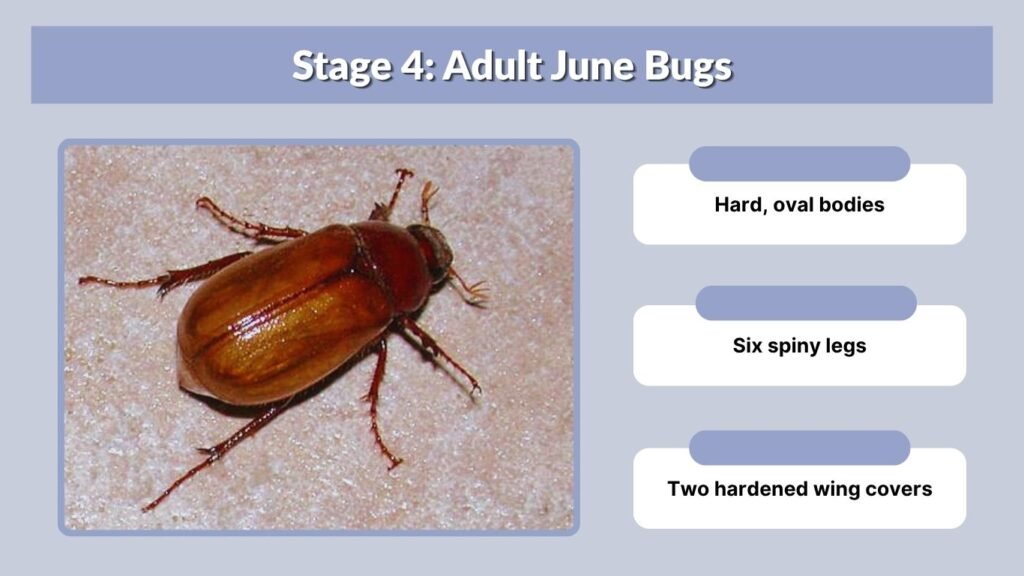
The adult stage is the most visible part of the June bug life cycle. Adult beetles emerge from the soil when temperatures become warm, commonly during May, June, or early summer.
The name “June bug” comes from the seasonal appearance of these beetles, although emergence can occur earlier or later depending on location and species.
What Do Adult June Bugs Look Like?
Many common June bugs are reddish-brown, dark brown, or nearly black. Other species, such as green June beetles, have shiny green or bronze bodies.
Adults usually have:
- Hard, oval bodies
- Six spiny legs
- Clubbed antennae
- Two hardened wing covers
- Functional flying wings
- Chewing mouthparts
University of Minnesota Extension describes May and June beetles as reddish-brown or black insects that are commonly active during May and June and strongly attracted to lights.
What Do Adult June Bugs Eat?
Adult June bugs feed mainly on plant material, including tree leaves, flowers, fruit, and tender vegetation. Some species cause noticeable leaf damage when large groups gather on the same plants.
Green June beetles are especially attracted to soft, ripe, damaged, or fermenting fruits.
Most adults feed after sunset. During the day, they may hide in vegetation, beneath debris, or in shaded locations.
Mating and Reproduction
Adult June bugs emerge primarily to feed, mate, and reproduce. Males fly in search of females, often during warm evenings.
After mating, females enter the soil and deposit their eggs. They may repeat this process several times before dying.
Once the eggs hatch, a new generation of underground grubs begins, completing the cycle.
How Long Do June Bugs Live?
The total June bug lifespan varies greatly by species. Some species complete their development in approximately one year, while others need two or three years.
The larval stage accounts for most of this lifespan. Adult June bugs generally survive for only several weeks or a few months, depending on weather, food availability, predators, and species.
A typical multi-year cycle may follow this pattern:
- Eggs hatch during summer.
- Young grubs feed until cold weather.
- Grubs overwinter deep underground.
- Feeding resumes during spring.
- The process may repeat during another year.
- Mature grubs pupate underground.
- Adults develop and eventually emerge.
- Adults mate and lay eggs.
Because overlapping generations may be present, a yard can contain young grubs, mature grubs, pupae, and adult beetles during different parts of the year.
When Are June Bugs Most Active?
Adult June bugs are most active on warm evenings in late spring and summer. They are strongly attracted to porch lights, streetlights, and illuminated windows.
Grubs are usually most active near the surface during spring and late summer when the soil is warm and roots are available. They move deeper during extremely hot, dry, or cold conditions.
The exact calendar differs by region. Adult beetles may appear earlier in warmer southern areas and later in cooler northern climates.
FAQs
How Many Stages Are in the June Bug Life Cycle?
June bugs have four main life-cycle stages: egg, larva, pupa, and adult. The larval stage includes three growth periods called instars. The insect molts between each instar before becoming a pupa and eventually developing into an adult beetle.
How Long Do June Bugs Stay Underground?
June bugs may remain underground for most of their lives. Depending on the species, the grub stage can last one to three years. Pupae and newly developed adults also remain underground temporarily before the adults emerge during warm weather.
What Month Do June Bug Eggs Hatch?
June bug eggs commonly hatch during summer, usually several weeks after females lay them. Exact timing depends on the species, region, soil moisture, and temperature. Warm, moist soil generally supports faster egg development and better survival.
Do June Bugs Die After Laying Eggs?
Female June bugs usually die sometime after completing their egg-laying period. Adult life is relatively short and is focused on feeding, mating, and reproduction. The eggs remain underground and begin the next generation after the adults disappear.
Do June Bugs Return Every Year?
Adult June bugs appear every year in many regions, but they are not necessarily the same individuals. Different generations may overlap because some species spend several years as grubs. Adults emerge seasonally once they have completed larval and pupal development.
