
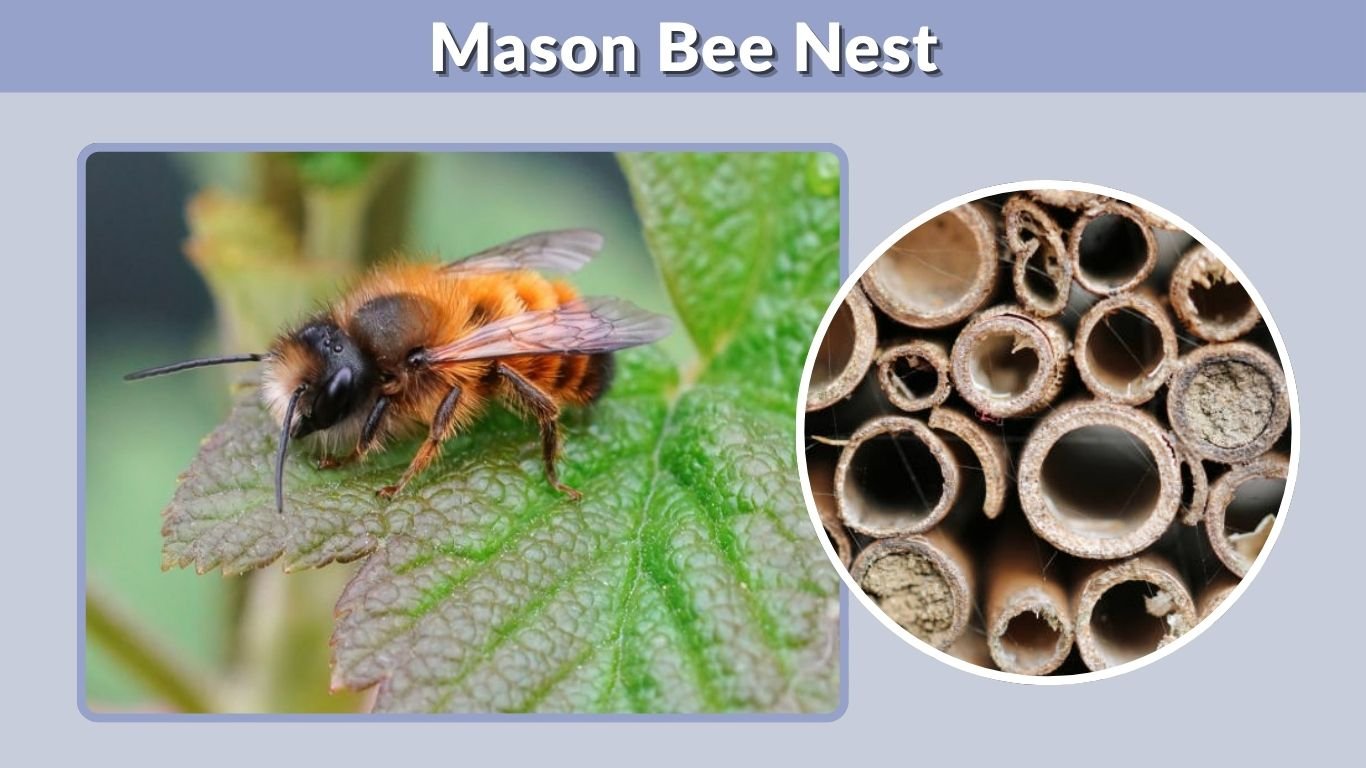
A mason bee nest is very different from the large communal hive built by honey bees. Mason bees, primarily species in the genus Osmia, are solitary bees that usually nest inside existing narrow cavities such as hollow plant stems, beetle holes, cracks, and artificial nesting tubes. Each female independently collects pollen, lays eggs, and builds mud partitions between her offspring. Gardeners can support these valuable spring pollinators by providing properly designed nesting tubes or reusable nesting blocks placed in a sheltered location near flowers and suitable mud.
What Does a Mason Bee Nest Look Like?
Mason bees do not build hanging honeycomb nests or wax hives. Instead, females search for narrow tunnels that are already present and convert them into a series of individual brood chambers.
Natural nests may be hidden inside hollow stems, holes created by wood-boring insects, cracks in structures, or similar protected cavities. Mason bees are solitary, although many females may willingly nest close together when suitable holes are concentrated in one location.
Mason Bee Nest Identification
A typical nest has:
- A narrow tubular cavity
- One entrance
- Several brood cells arranged in a row
- Pollen and nectar stored in each cell
- One egg placed with each food provision
- Mud walls separating individual cells
- A final mud plug sealing the entrance
A row of tubes with several entrances capped by dried mud is therefore a strong sign that mason bees are using a bee house.
How Do Mason Bees Make Their Nests?
The name “mason bee” comes from the female’s habit of working with mud much like a mason uses mortar.
After selecting a tunnel, she repeatedly visits flowers to collect pollen and nectar. She places this food toward the back of the cavity, lays an egg on the provision, and then builds a mud partition. She repeats the process until the tunnel contains a row of brood cells and finally seals the entrance with mud.
Inside a Mason Bee Nest
The arrangement generally follows this pattern:
- The female chooses an empty tunnel.
- She brings in pollen and nectar.
- An egg is laid on the food supply.
- She constructs a mud wall.
- Another cell is provisioned.
- Additional eggs and partitions are added.
- The entrance receives a final mud seal.
Each tunnel may therefore contain several developing mason bees, even though only one female constructed and provisioned it.
Where Do Mason Bees Nest Naturally?
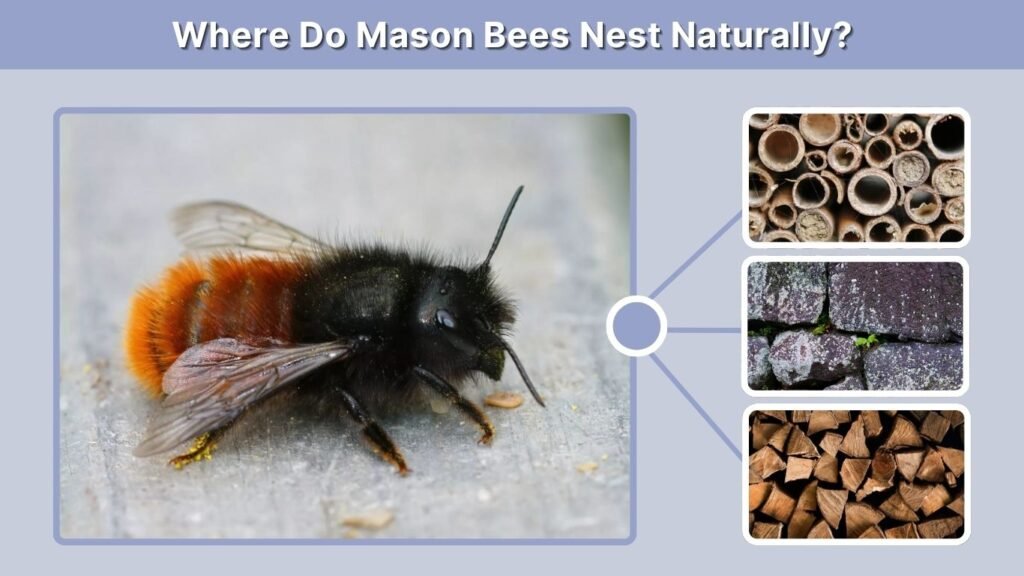
Mason bees are generally cavity nesters rather than excavators. They do not normally drill their own tunnels into sound wood.
Instead, they take advantage of suitable existing spaces.
Natural Mason Bee Nest Sites
Common locations include:
- Hollow plant stems
- Beetle holes in dead wood
- Small cracks and crevices
- Firewood piles
- Gaps in wood
- Other narrow protected cavities
Penn State notes that mason bees naturally use hollow reeds and plant stems, cavities left by boring beetles, firewood piles, and similar spaces.
Do Mason Bees Nest in the Ground?
Most mason bees commonly kept for orchard and garden pollination, including the Blue Orchard Bee (Osmia lignaria), are cavity-nesting bees rather than ground nesters.
If numerous bees are excavating individual holes directly into bare soil, they may instead be mining bees, digger bees, or another group of solitary ground-nesting bees.
Mason Bee Nesting Tubes
Artificial nesting tubes imitate the hollow stems and insect tunnels mason bees naturally occupy. Proper tube dimensions and materials are important because poor designs can trap moisture and encourage parasites, mites, or mold.
Best Mason Bee Nesting Tube Size
For many mason bees, Utah State University recommends:
- Hole diameter: About 1/4–3/8 inch
- Tunnel depth: About 5–6 inches
- One closed end
- Breathable material
- Removable or cleanable design
For Blue Orchard Bees specifically, Oregon State University recommends cardboard tubes with removable paper liners about 5/16 inch in diameter and 6 inches long.
Providing sufficient tunnel depth is important. Very short tunnels may result in a greater proportion of male offspring rather than a balanced mixture of males and females.
Mason Bee Nesting Blocks and Trays
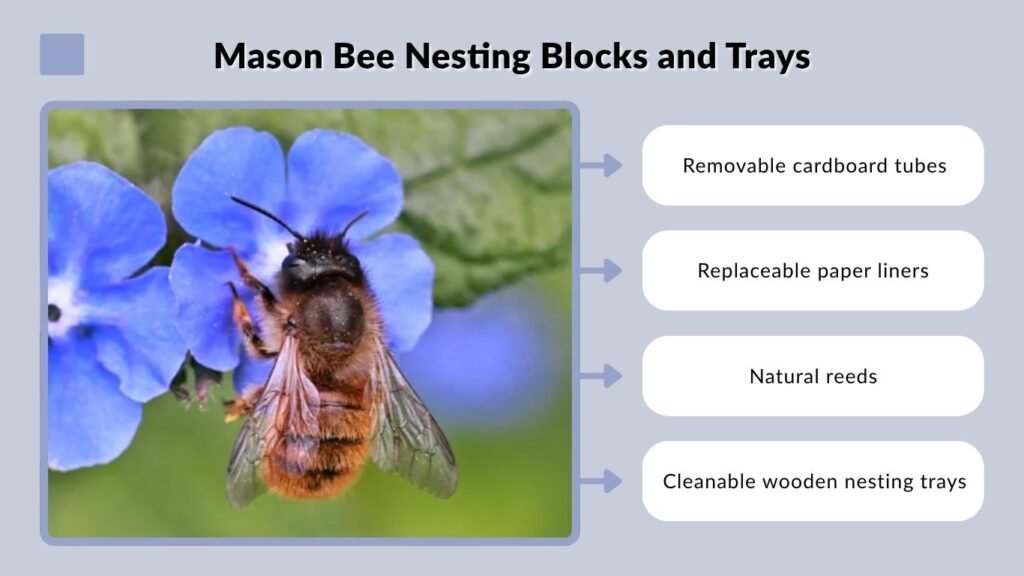
Nesting blocks can also provide suitable cavities, but designs that can be opened and thoroughly cleaned are preferable to permanently drilled solid blocks.
Reusable wooden trays contain grooves that form enclosed tunnels when stacked together. After the nesting season, the trays can be separated so cocoons can be inspected and the nesting material cleaned.
Which Nesting Material Is Best?
Good options include:
- Removable cardboard tubes
- Replaceable paper liners
- Natural reeds
- Cleanable wooden nesting trays
- Laminated blocks that open for cleaning
Oregon State University advises against older designs using permanently drilled wood, bamboo, or plastic tubes when they cannot be opened and cleaned. Moisture, parasites, and mold can accumulate from year to year.
Utah State likewise recommends breathable, removable nesting materials and cautions against plastic tubes because they can retain moisture and promote fungal problems.
How to Make a DIY Mason Bee Nest
A mason bee house does not need to be complicated. The most important features are suitable tunnel dimensions, protection from rain, proper positioning, and nesting material that can be replaced or cleaned.
Simple DIY Mason Bee Nest
For a basic setup:
- Build or obtain a weather-resistant outer shelter.
- Add removable paper tubes, reeds, or cleanable trays.
- Keep one end of every tunnel closed.
- Make most tunnels approximately 5–6 inches deep.
- Provide several suitable diameters around 1/4–3/8 inch.
- Add an overhanging roof.
- Keep the nesting material dry.
- Mount the structure firmly so it does not swing.
Avoid filling a bee hotel with decorative pine cones, loose bark, moss, and similar materials. They generally do not provide appropriate mason bee tunnels and can shelter spiders, mites, earwigs, and other organisms.
Where Should You Put a Mason Bee Nest Box?
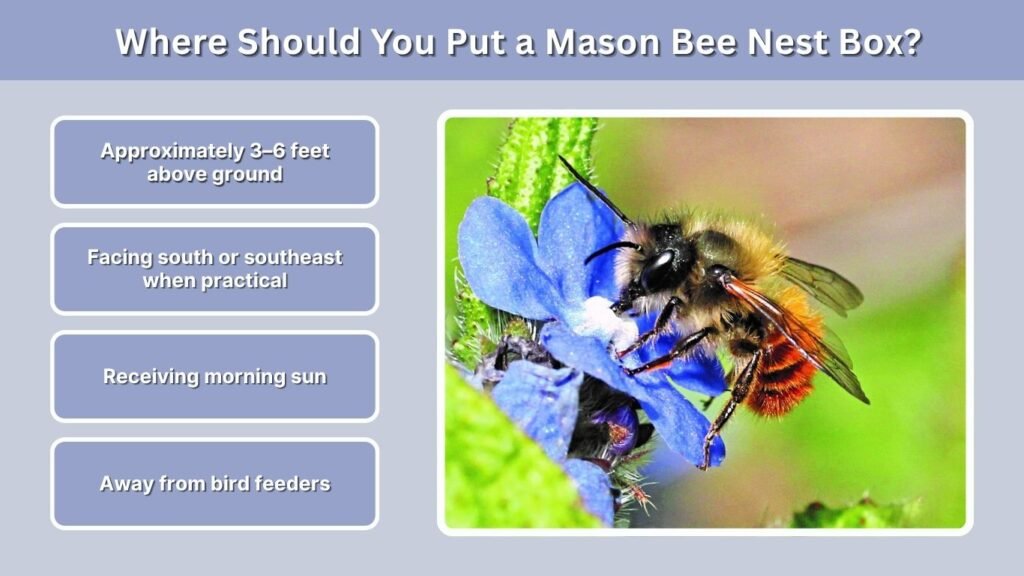
Location can determine whether a nest box is actually used.
Mason bees need warmth in the morning, protection from heavy rain and wind, nearby flowers, and access to moist clay-rich mud for constructing their cell partitions.
Best Nest Box Placement
For Blue Orchard Bees, Oregon State recommends:
- Approximately 3–6 feet above ground
- Facing south or southeast when practical
- Receiving morning sun
- Protected from intense afternoon sun
- Sheltered from rain and strong wind
- Away from bird feeders
- Close to flowering plants
Mason bees typically forage much closer to their nests than honey bees. Oregon State reports that around 200–300 feet from the nest is a normal foraging distance, making nearby flowering plants particularly important.
When Do Mason Bees Start Nesting?
Mason bees are particularly associated with spring.
Exact timing depends on species, climate, and local flowering periods. Blue Orchard Bees emerge around the time early fruit trees bloom.
Mason Bee Nesting Season
Penn State reports that in the Mid-Atlantic region, orchard mason bees may remain active for approximately six to eight weeks, roughly from mid-April through mid-June.
Males generally emerge first. Females emerge shortly afterward, mate, and begin looking for suitable nesting cavities.
After completing their nests, the adult generation eventually dies. Their offspring continue developing safely inside the sealed cavities.
What Happens to Mason Bees Inside the Nest?
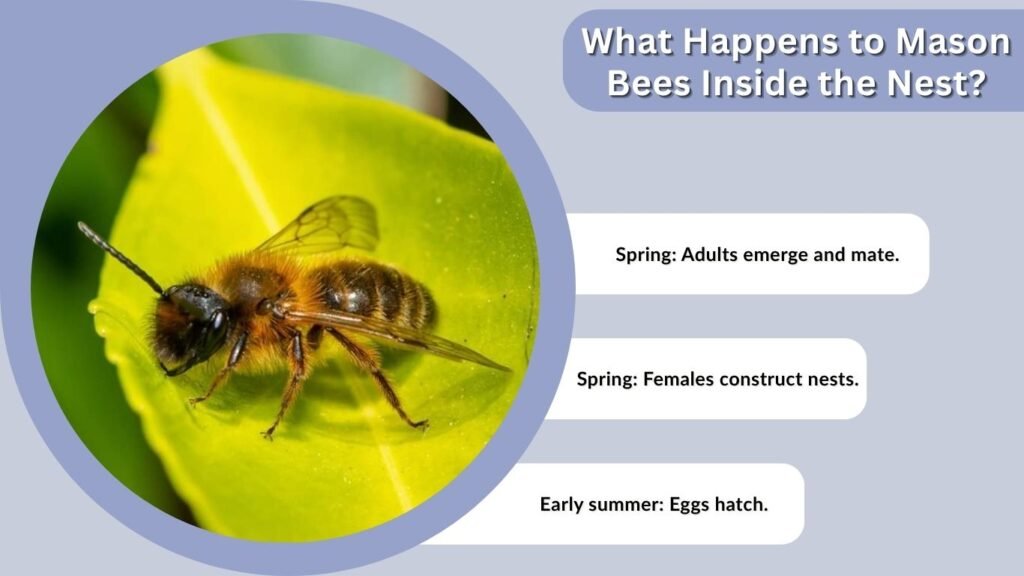
The egg hatches and the larva consumes the stored pollen and nectar left by its mother.
It then spins a cocoon and eventually pupates. By late summer, the new bee may already have transformed into an adult, but it remains protected inside its cocoon through winter.
Winter Inside the Nest
The basic cycle is:
- Spring: Adults emerge and mate.
- Spring: Females construct nests.
- Early summer: Eggs hatch.
- Summer: Larvae eat pollen provisions.
- Late summer: Development into adults occurs.
- Winter: Adults remain dormant inside cocoons.
- Following spring: New adults emerge.
Mason bees generally have one generation per year.
Do Mason Bees Nest in Walls?
They sometimes use existing cracks or holes in structures because those spaces resemble their natural nesting cavities.
Unlike carpenter bees, mason bees generally do not chew extensive tunnels through structural wood.
Should You Remove a Mason Bee Nest?
Usually, removal is unnecessary.
Mason bees are solitary pollinators and are not normally aggressive around their nests. When they occupy an inconvenient structural opening, wait until the nesting cycle is complete when practical, then repair or seal the opening before the next nesting season.
Providing a suitable alternative bee house nearby may encourage future nesting in a more convenient location.
Do Mason Bees Reuse Their Nests?
Mason bees may return to favorable nesting locations in future years, and newly emerged females may use tunnels near the place where they developed.
However, repeatedly leaving the same dirty artificial tubes in place can increase parasites, pollen mites, and disease problems.
Keep Artificial Nests Clean
Good management includes:
- Using removable nesting material
- Replacing disposable liners
- Cleaning reusable trays appropriately
- Removing damaged or moldy materials
- Protecting nests from excessive moisture
- Providing clean nesting cavities each season
This is one reason modern removable tubes and opening wooden trays are preferable to permanently sealed blocks.
FAQs
What does a mason bee nest look like?
It usually looks like a narrow cavity divided into several chambers by mud partitions. Once completed, the entrance is sealed with a visible mud plug.
How many mason bees live in one nest?
Mason bees are solitary, so a single female normally provisions a tunnel herself. That tunnel may contain several individual brood cells, each holding one developing bee.
What size holes do mason bees need?
Many mason bees prefer holes approximately 1/4–3/8 inch in diameter and 5–6 inches deep. Blue Orchard Bees commonly use approximately 5/16-inch-wide, 6-inch-long tubes.
When do mason bees start nesting?
They generally begin during spring as suitable flowers become available. Timing varies by climate and species, with males usually emerging shortly before females.
Do mason bees make nests in the ground?
Typical Osmia mason bees use existing cavities such as hollow stems, beetle holes, and artificial tubes rather than excavating underground burrows. Bees actively digging holes in soil are more likely to belong to another group of solitary bees.
