
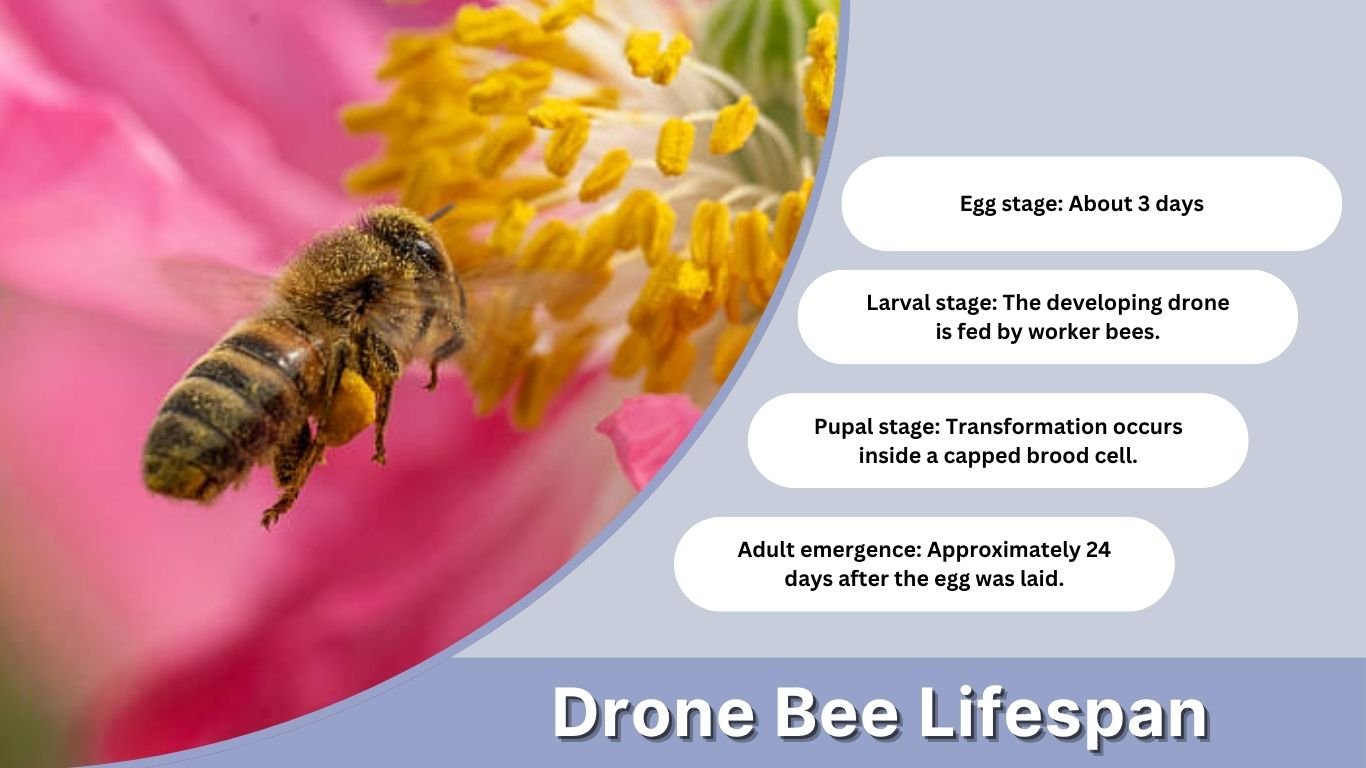
A drone bee typically lives for about one to two months, although its actual lifespan depends heavily on mating success, season, food availability, and colony conditions. Drones are the male members of a honey bee colony, and their primary biological role is to mate with virgin queens. A drone that successfully mates dies immediately afterward, while drones that never mate may survive for several weeks. In temperate regions, surviving drones are commonly expelled from the hive before winter as workers conserve valuable food stores.
How Long Do Drone Bees Live?
The average lifespan of a drone honey bee is generally around several weeks to roughly two months during the active season. Unlike worker bees, drones do not spend their lives collecting nectar, pollen, or defending the colony. Their survival is instead strongly connected to reproduction and seasonal colony needs.
Average Drone Bee Lifespan
A useful general estimate is:
- Typical adult lifespan: Several weeks to about 2 months
- Development from egg to adult: About 24 days
- If successful in mating: Dies immediately afterward
- If it does not mate: May remain alive for several weeks
- Autumn fate: Often expelled from the colony
- Winter survival: Usually uncommon in temperate colonies
University of Georgia Extension gives a typical drone lifespan of about two months and notes that drones are normally forced from colonies during fall and winter.
Drone Bee Life Cycle
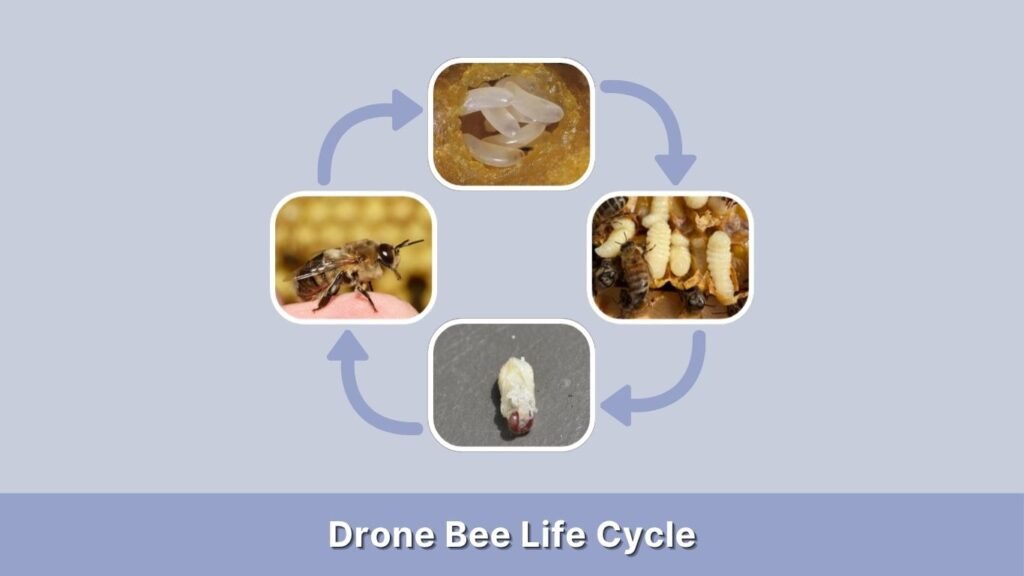
A drone’s lifespan actually begins before it emerges as an adult. Like queens and workers, drones undergo complete metamorphosis through egg, larval, pupal, and adult stages.
However, drones develop more slowly than either workers or queens.
From Egg to Adult Drone
The development process includes:
- Egg stage: About 3 days
- Larval stage: The developing drone is fed by worker bees.
- Pupal stage: Transformation occurs inside a capped brood cell.
- Adult emergence: Approximately 24 days after the egg was laid.
Workers require roughly 21 days to develop, while queens require only about 16 days. Drone development therefore takes the longest of the three honey bee castes.
Why Are Drone Cells Larger?
Drones are larger and broader than worker bees, so they develop inside larger cells.
Capped drone brood has a rounded, raised appearance compared with the relatively flat cappings covering worker brood.
Beekeepers often describe drone brood as having a bumpy appearance because the developing males require additional space.
Why Do Drone Bees Have Such a Short Lifespan?
Drone life revolves around reproduction. They do not maintain the hive like workers and do not reproduce continuously like the queen.
Their main function is to fly out of the colony and attempt to mate with a virgin queen.
What Do Drone Bees Do?
Drones primarily:
- Mature sexually after emerging
- Eat food available in the colony
- Leave the hive on mating flights
- Gather in drone congregation areas
- Search for virgin queens
- Compete with other drones for mating opportunities
Missouri Extension describes mating as the principal function of drones. They lack the worker’s pollen baskets, wax-producing role, and defensive stinger.
Why Does a Drone Bee Die After Mating?
Successful mating dramatically shortens a drone’s lifespan.
During aerial mating, the drone transfers sperm to the queen using his reproductive organ. After mating, part of this reproductive structure is torn from his body.
The injury is fatal, and the drone dies soon afterward.
Can a Drone Mate More Than Once?
No. A drone that successfully mates does not survive to mate with another queen.
However, the queen mates with multiple drones during her mating flights. The sperm from these males is stored in her spermatheca and can later be used to fertilize eggs for years.
Penn State explains that honey bees use haplodiploid sex determination: fertilized eggs develop into females, while unfertilized eggs become male drones.
What Happens to Drones That Never Mate?
Most drones never successfully mate with a queen.
Those unsuccessful males may continue living within or around the colony for weeks, making repeated mating flights during suitable weather.
Their fate changes when the productive season ends.
Why Are Drones Kicked Out of the Hive?
Maintaining drones requires food, yet drones contribute little to colony survival during winter.
When flowers become scarce and temperatures fall, workers begin conserving honey. They may stop feeding drones and physically force them out of the hive.
Missouri Extension notes that drones appear during spring but are forced from colonies in fall.
Outside the hive, expelled drones eventually die from cold, starvation, or exposure.
Do Drone Bees Survive Winter?
In temperate climates, most do not.
Honey bee colonies survive winter using stored honey. Workers cluster together around the queen and generate enough heat to survive cold conditions.
Supporting hundreds of non-foraging drones during this period would waste valuable food.
When Might Drones Stay in a Hive?
Occasionally, drones may remain longer when:
- Climate conditions are mild
- Nectar remains available
- The colony has abundant food
- The colony is queenless or undergoing reproductive changes
- Local seasonal conditions permit continued drone production
However, a large drone population during winter is not normal for most healthy colonies in cold climates.
Drone Bee Lifespan vs Worker Bee
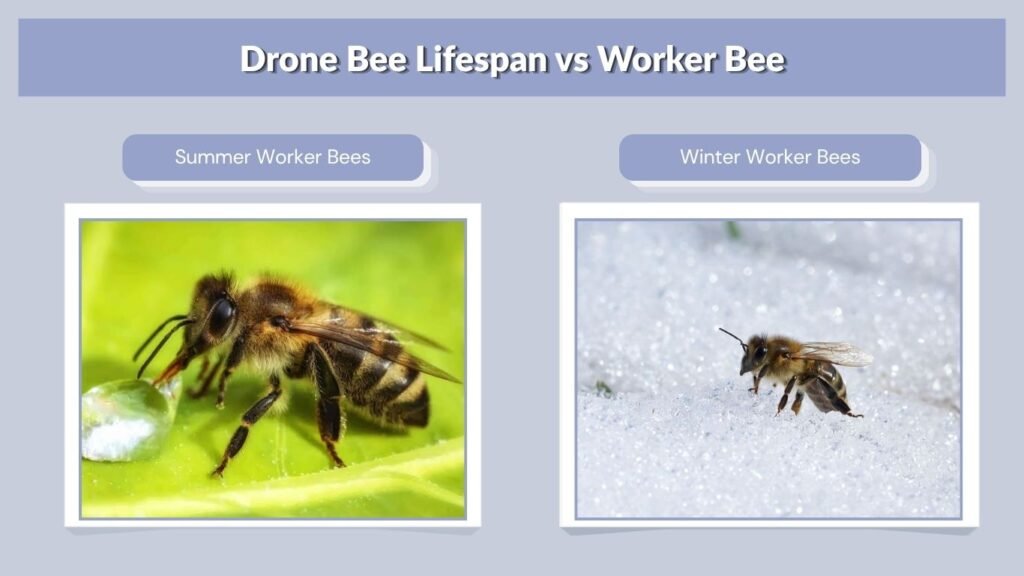
Drone and worker lifespans are difficult to compare directly because workers themselves have dramatically different lifespans depending on the season.
Summer Worker Bees
Summer workers typically live around five to six weeks.
Their lives are short largely because foraging is physically demanding. A worker may fly repeatedly between the colony and thousands of flowers while collecting nectar, pollen, water, and propolis.
Winter Worker Bees
Winter workers can live around four to six months because they do much less intensive outdoor foraging.
Their primary job is keeping the winter colony alive until spring.
Therefore, winter workers may substantially outlive drones.
Drone Bee Lifespan vs Queen Bee
The queen has by far the greatest potential lifespan of the three honey bee castes.
Queen Bee Lifespan
Queens commonly survive for several years under favorable conditions. Penn State notes that queens can live seven years or more, although reproductive performance often begins declining after the first year or two.
Beekeepers may therefore replace a queen before she reaches her natural maximum lifespan.
Queen, Worker and Drone Lifespan Comparison
| Honey Bee | Typical Lifespan |
| Drone | Several weeks to about 2 months |
| Summer worker | About 5–6 weeks |
| Winter worker | Around 4–6 months |
| Queen | Several years; exceptional queens can exceed 7 years |
These figures are general ranges rather than fixed expiration dates. Weather, disease, nutrition, colony health, predators, and management can shorten any bee’s life.
How Can You Identify a Drone Honey Bee?
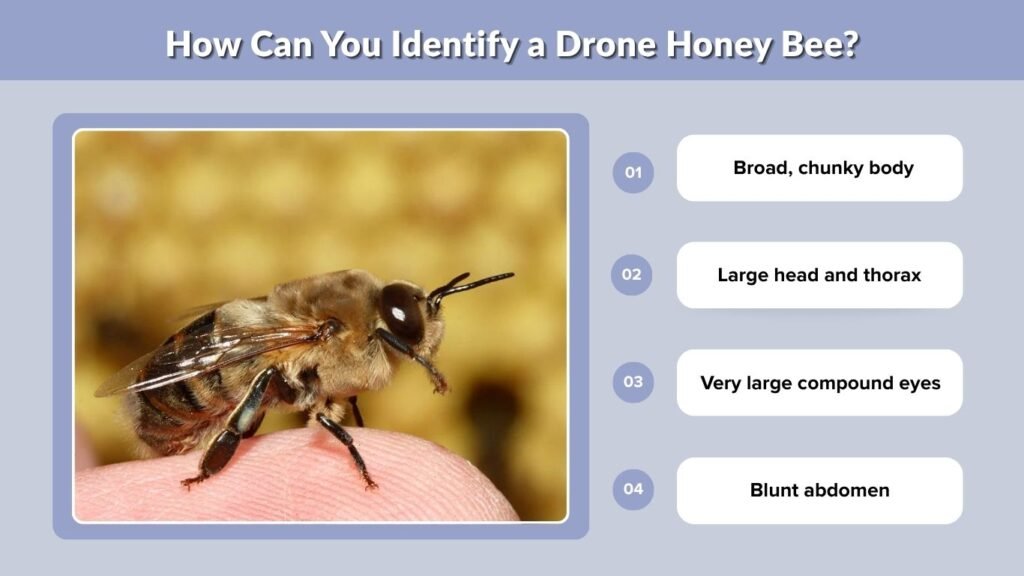
Drones are fairly easy to recognize once you compare them with workers.
Drone Identification
Look for:
- Broad, chunky body
- Large head and thorax
- Very large compound eyes
- Eyes nearly touching on top of the head
- Blunt abdomen
- No pollen baskets
- No stinger
Missouri Extension identifies the large eyes, broad body, and blunt abdomen as characteristic drone features.
Their huge eyes help them locate virgin queens while flying.
Are Drone Bees Male or Female?
Every normal drone honey bee is male.
Honey bees use a genetic system called haplodiploidy.
How Drone Bees Are Produced
The queen controls whether an egg is fertilized when laying it.
- Unfertilized egg → male drone
- Fertilized egg → female worker or queen
Drones therefore receive their chromosomes only from their mother and have 16 chromosomes, whereas female honey bees have two sets totaling 32.
Do Drone Bees Sting?
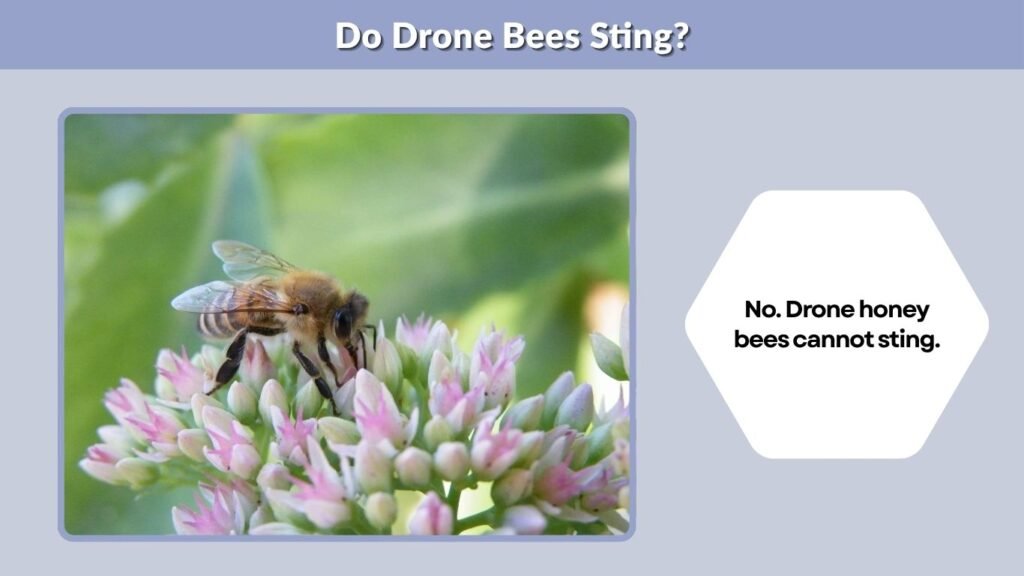
No. Drone honey bees cannot sting.
A bee’s stinger is derived from the ovipositor, a female reproductive structure. Male drones therefore lack a functional stinger.
Even though drones are larger than workers and may appear intimidating, they cannot sting people.
Workers, by contrast, are females equipped with barbed stingers used primarily for defending the colony.
What Is the Maximum Lifespan of a Drone Bee?
There is no single reliable maximum age that applies to every drone.
Most references describe adult drones as relatively short-lived, often surviving only several weeks or around two months. Mating immediately ends the life of successful drones, while seasonal eviction usually prevents unmated drones from surviving into winter.
Consequently, claims assigning one exact maximum lifespan to every drone should be treated cautiously.
FAQs
What is the average lifespan of a drone bee?
A drone commonly lives for several weeks to around two months. Its life may be much shorter if it successfully mates with a queen.
Why do drone bees die after mating?
The drone’s reproductive organ is severely damaged during successful mating, causing injuries that result in its death shortly afterward.
Do drone bees live longer than workers?
They may live longer than some summer workers, but winter workers can survive several months and therefore usually outlive drones.
Can drone bees survive winter?
Most drones in temperate climates are expelled from colonies before winter because workers need to conserve stored food.
How long do queen, worker and drone honey bees live?
Drones generally survive several weeks to about two months, summer workers around five to six weeks, winter workers several months, and queens potentially several years.
