
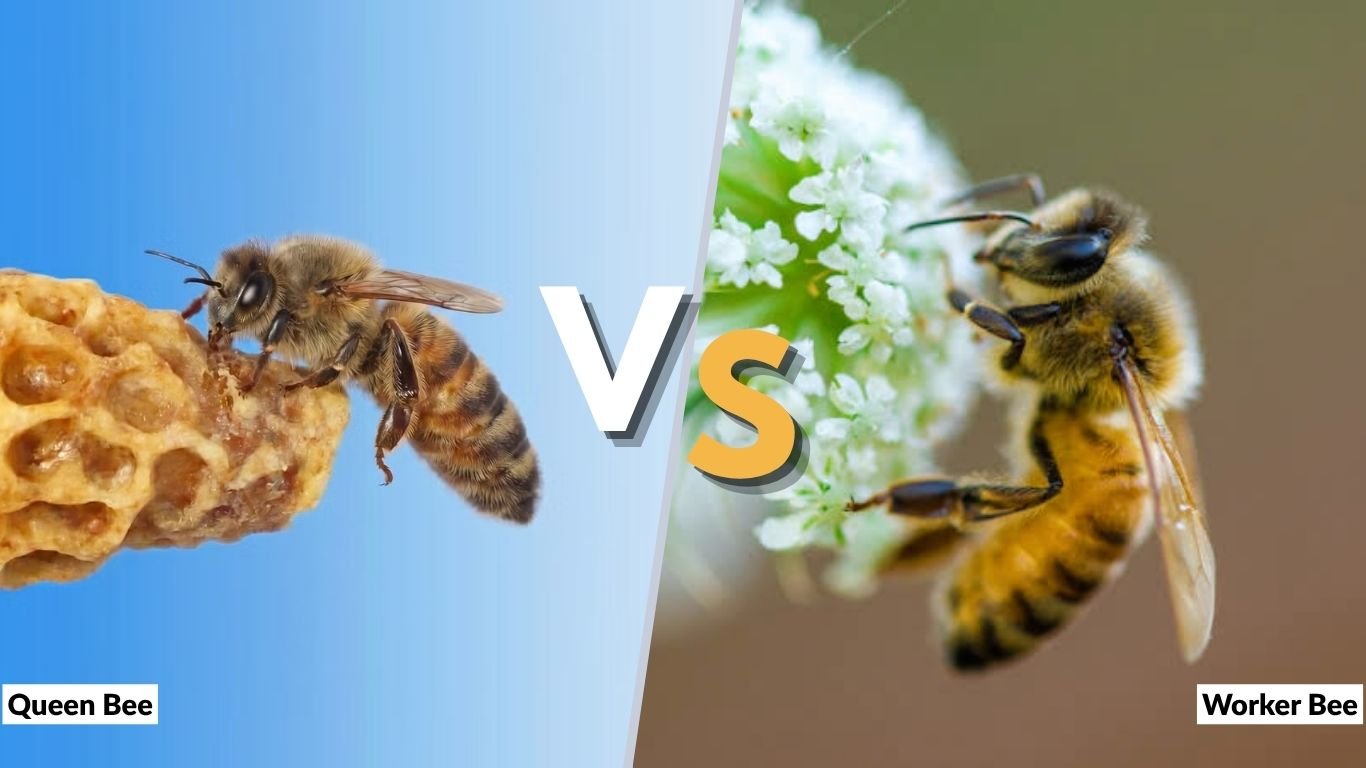
The main difference between a queen bee and a worker bee is their role in the colony. Both are female, but the queen specializes in reproduction, while workers gather food, raise young, build comb, and defend the nest.
In honey bees, queens generally have longer abdomens and live much longer than summer workers. Drones are different again: they are males whose main reproductive role is mating with queens.
These comparisons primarily describe honey bees. Bumblebees and carpenter bees have different social arrangements, so their queens and workers need separate explanations.
Queen Bee vs Worker Bee vs Drone: Quick Comparison
A honey bee colony normally contains one laying queen, thousands of workers, and a seasonally varying number of drones.
| Feature | Queen bee | Worker bee | Drone |
| Sex | Female | Female | Male |
| Body shape | Long, enlarged abdomen | Smaller, compact body | Stocky body with a blunt abdomen |
| Main role | Reproduction and chemical communication | Foraging, brood care, comb building, defense | Mating with queens |
| Egg laying | Fertilized and unfertilized eggs | Usually none; some workers lay unfertilized eggs | Cannot lay eggs |
| Egg-to-adult development | About 16 days | About 21 days | About 24 days |
| Stinger | Present, with reduced barbs | Present, strongly barbed | Absent |
These differences reflect specialized anatomy and development, not separate species. Queens, workers, and drones within a honey bee colony belong to the same species.
Queen Bee vs Worker Bee Size
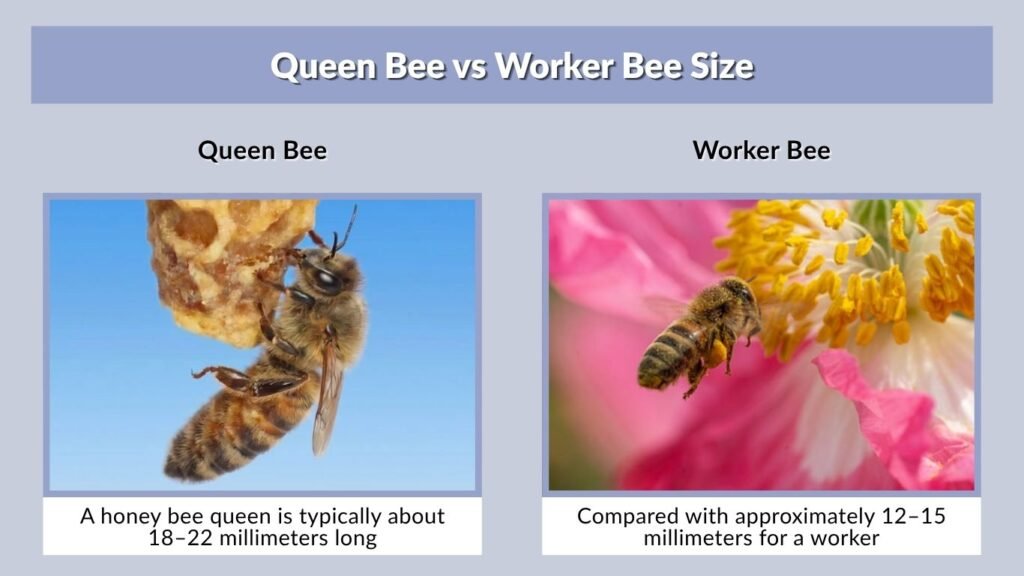
A honey bee queen is typically about 18–22 millimeters long, compared with approximately 12–15 millimeters for a worker. Individual size varies, so measurements are a guide rather than an identification rule.
The queen’s most noticeable feature is her elongated abdomen. In a mature laying queen, it extends well beyond the tips of her folded wings.
Workers have shorter abdomens and specialized structures for their everyday tasks, including pollen baskets on their hind legs.
Drones can look impressively large, but their broad bodies and enormous eyes distinguish them from queens. Their eyes meet at the top of the head.
Color alone is unreliable. A queen is not necessarily brighter, darker, or more golden than her workers. Virgin queens also have slimmer abdomens than established laying queens, making them harder to recognize.
What Does a Queen Bee Do?
The queen’s main job is laying eggs that sustain the colony’s population. A healthy honey bee queen can produce around 2,000 eggs daily during favorable peak-season conditions, although output changes with resources and season.
She also produces pheromones—chemical signals that influence colony organization and reproductive behavior.
Despite her title, the queen does not direct every worker like a human ruler. Colony activity depends on communication among many bees and their responses to local conditions.
Workers feed and attend the queen, allowing her to concentrate on reproduction. An established honey bee queen does not routinely forage for nectar and pollen.
What Do Worker Bees Do?
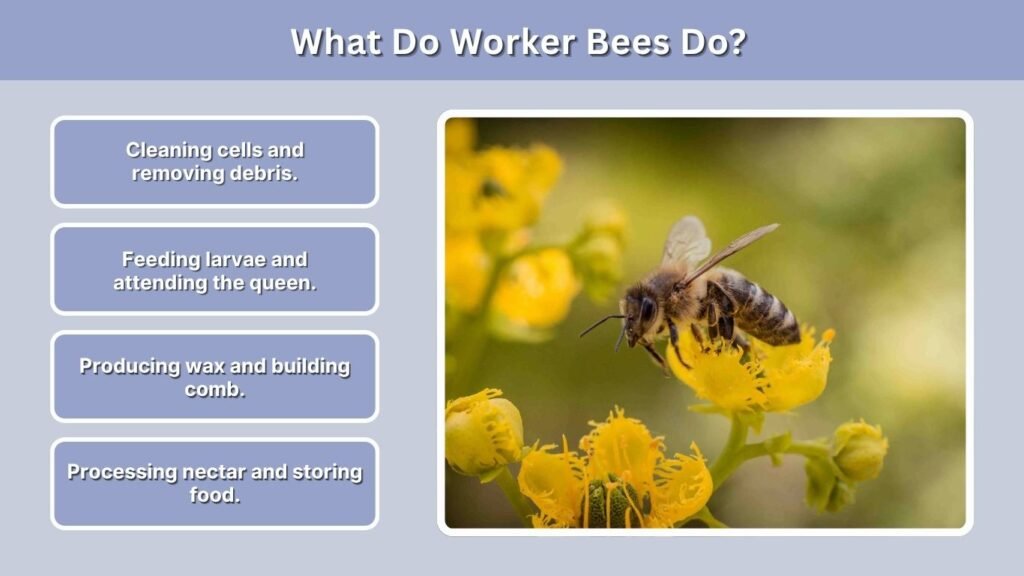
Workers perform most of the tasks that keep a honey bee colony functioning.
Their responsibilities include:
- Cleaning cells and removing debris.
- Feeding larvae and attending the queen.
- Producing wax and building comb.
- Processing nectar and storing food.
- Regulating nest temperature and defending the entrance.
- Collecting nectar, pollen, water, and plant resins.
Younger workers generally perform more tasks inside the hive, while older workers often become foragers. However, this division is flexible: workers can change activities when the colony needs change.
A queen cannot maintain a colony without this workforce, just as workers normally need a productive queen to replace their population.
Queen Bee Lifespan vs Worker Bee Lifespan
Honey bee queens generally live much longer than summer workers, but season makes a major difference.
A queen may live for several years, with some surviving five years or longer. Actual average lifespan varies among populations and management systems.
Summer workers commonly live around four to six weeks. Winter workers can survive for several months, helping the colony remain alive until spring.
The difference is not simply that workers “work themselves to death.” Queen and worker physiology differ, and foraging exposes workers to weather, predators, and other hazards. Nutrition, reproductive biology, and environmental risks all contribute to longevity.
Why Does One Larva Become a Queen and Another a Worker?
Queens and workers both normally develop from fertilized eggs. Their different developmental pathways are strongly influenced by larval nutrition and rearing conditions.
Queen-destined larvae receive abundant royal jelly and develop in specialized queen cells. Their reproductive systems become much more developed than those of workers.
Worker-destined larvae follow a different feeding and developmental pattern, producing adults equipped for foraging, nursing, wax production, and other colony tasks.
Royal jelly is important, but describing caste development as a single “magic food” effect oversimplifies the biology.
An adult worker cannot become a queen simply by receiving royal jelly. The major developmental differences are established before adulthood.
Queen Bee Eggs vs Worker Bee Eggs
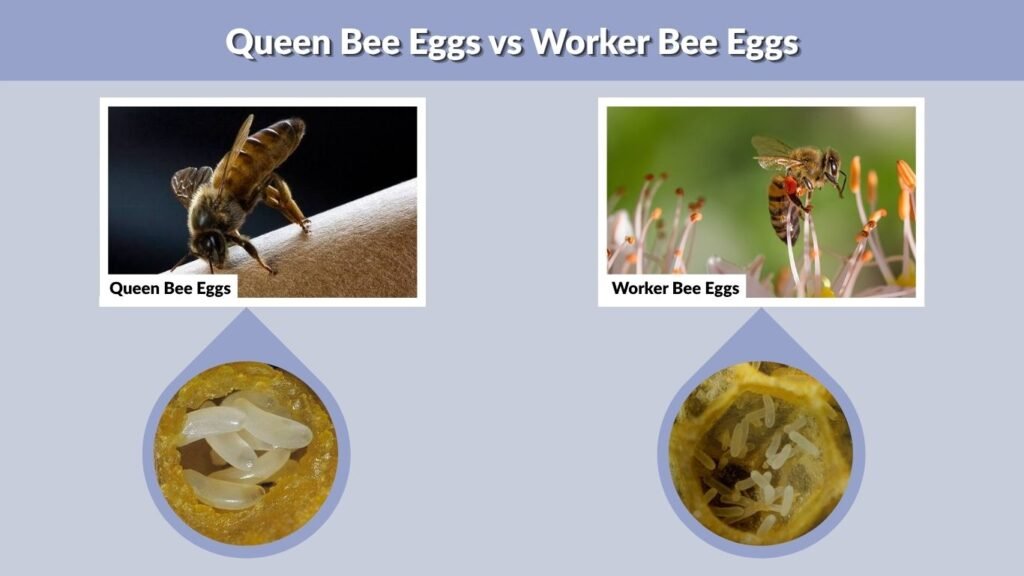
A mated queen can lay fertilized eggs that normally become females and unfertilized eggs that become drones.
Some workers can also lay eggs, especially after prolonged queenlessness. In most honey bee colonies, these worker-laid eggs are unfertilized and develop into males.
Consequently, laying workers do not replace a queen’s ability to produce the female workforce.
Egg arrangement can provide clues: laying workers often leave multiple eggs scattered within cells. However, young queens sometimes deposit extra eggs too. One unusual cell is not enough to identify the egg layer.
Do Queen Bees and Worker Bees Sting?
Both female honey bee castes have stingers, but they use them differently.
Workers defend the colony. Their strongly barbed stingers often become embedded in mammalian skin, causing fatal injury when the bee pulls away.
Queens have stingers with reduced barbs and use them primarily against rival queens. They rarely sting people.
Drones cannot sting because they have no stinger. These distinctions should not be generalized to every bee species: bumblebee workers, for example, can sting repeatedly.
Queen Bumblebee vs Worker Bumblebee
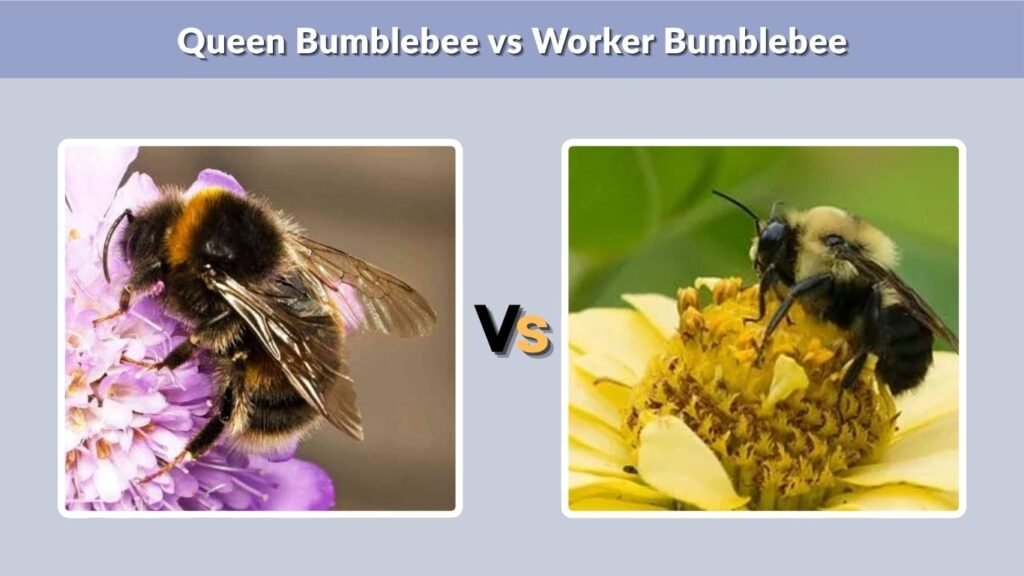
Bumblebee queens and workers are also female, and queens are generally larger. Unlike an established honey bee queen, a bumblebee queen initially gathers food and raises her first workers herself.
Once workers emerge, they increasingly take over foraging and nest care. In the typical temperate annual cycle, new queens overwinter and establish colonies the following season.
For the common eastern bumblebee, Bombus impatiens, reported body lengths are approximately 17–21 millimeters for queens and 8.5–16 millimeters for workers.
Size varies considerably among species and individuals. Compare bees of the same species, and consider season and behavior rather than judging by size alone.
Carpenter Bee Queen vs Worker: Is It the Same?
The honey bee comparison does not transfer neatly to carpenter bees.
Eastern carpenter bees may nest alone or share a nest with other females. In shared nests, a dominant reproductive female may be described as a “queen,” while other females occupy subordinate roles.
However, the dominant female also gathers food and performs nesting work. This differs from the strongly specialized queen-and-worker arrangement of honey bees.
Rather than assuming every large carpenter bee is a queen and every small one a worker, first identify the species and its nesting behavior.
FAQs
1. Are queen bees and worker bees both female?
Yes. Honey bee queens and workers are female, while drones are male. Queens specialize in reproduction; workers perform most colony maintenance tasks.
2. Can a worker bee become a queen?
An adult worker cannot become a queen. However, a very young female larva can develop into a queen when workers provide appropriate nutrition and rearing conditions.
3. Why do queen bees live longer than workers?
Queens have different physiology and receive continuous care. They also avoid the frequent flights, predators, and weather hazards that foraging workers face.
4. Can worker bees lay eggs?
Yes. Some workers lay unfertilized eggs, particularly in queenless colonies. In most honey bee colonies, these eggs become drones rather than female workers.
5. Does the queen bee make honey?
No. Workers collect nectar, process it, and store honey. The queen primarily lays eggs and produces chemical signals that help coordinate colony life.
