
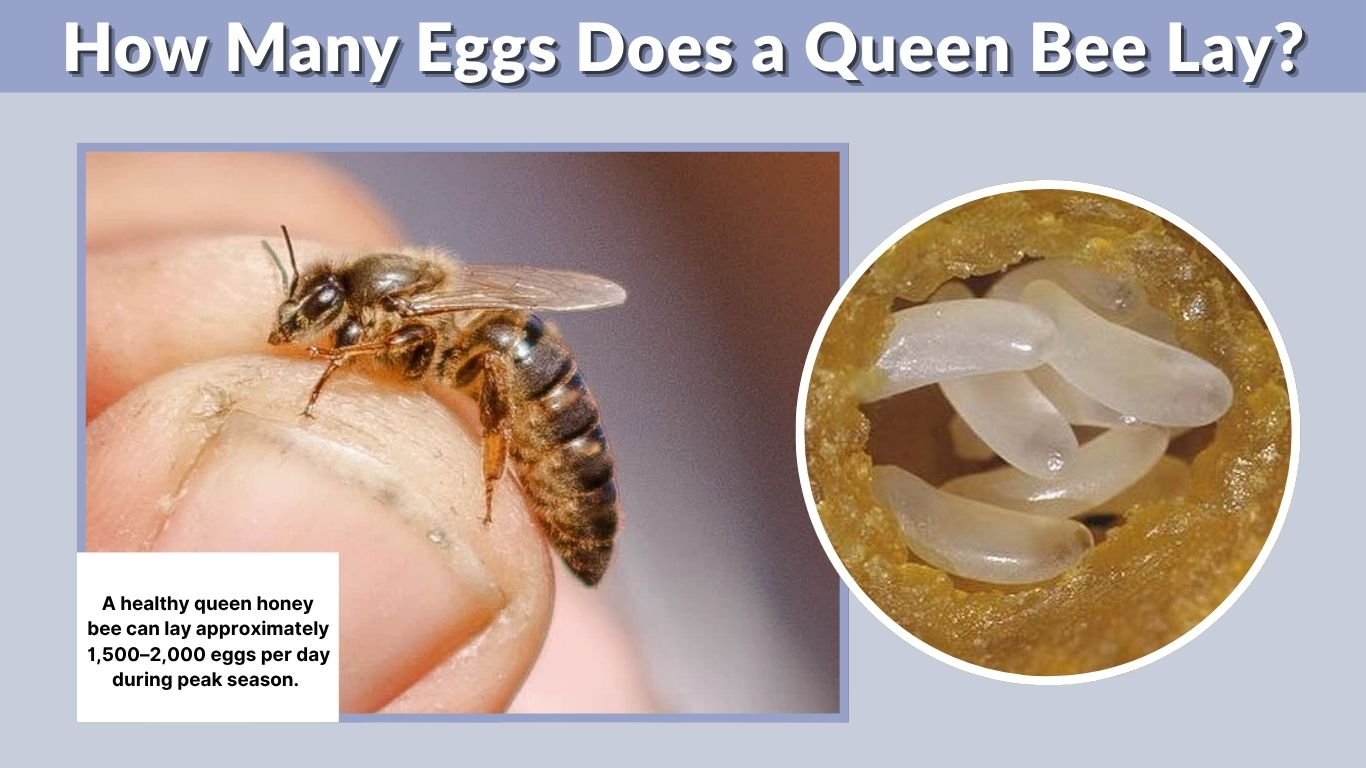
A healthy queen honey bee can lay approximately 1,500–2,000 eggs per day during peak season. Exceptionally productive queens may exceed 2,000 eggs daily, but this is not a rate every queen maintains throughout the year. Egg production changes with the season, food supply, colony strength, and the queen’s condition.
These figures describe honey bees, particularly the western honey bee, Apis mellifera. Other bee species have different reproductive patterns.
To understand queen bee egg laying, it helps to distinguish maximum output from normal seasonal activity—and eggs from the adult bees they eventually become.
How Many Eggs Does a Queen Bee Lay a Day?
During favorable conditions, a productive queen can lay well over a thousand eggs daily, sometimes reaching or exceeding 2,000. However, a queen laying fewer eggs is not necessarily unhealthy.
Her output must match what the colony can support. Every developing larva needs food, and the brood requires care and suitable temperatures. A small colony cannot raise unlimited young simply because its queen has the capacity to produce more eggs.
Workers make high egg production possible. They prepare cells, feed the queen, and care for developing bees.
For beekeepers, the useful question is therefore not just “How many eggs can a queen bee lay?” It is also “Is she producing enough healthy brood for this colony and season?”
How Many Eggs Does a Queen Bee Lay in a Year?
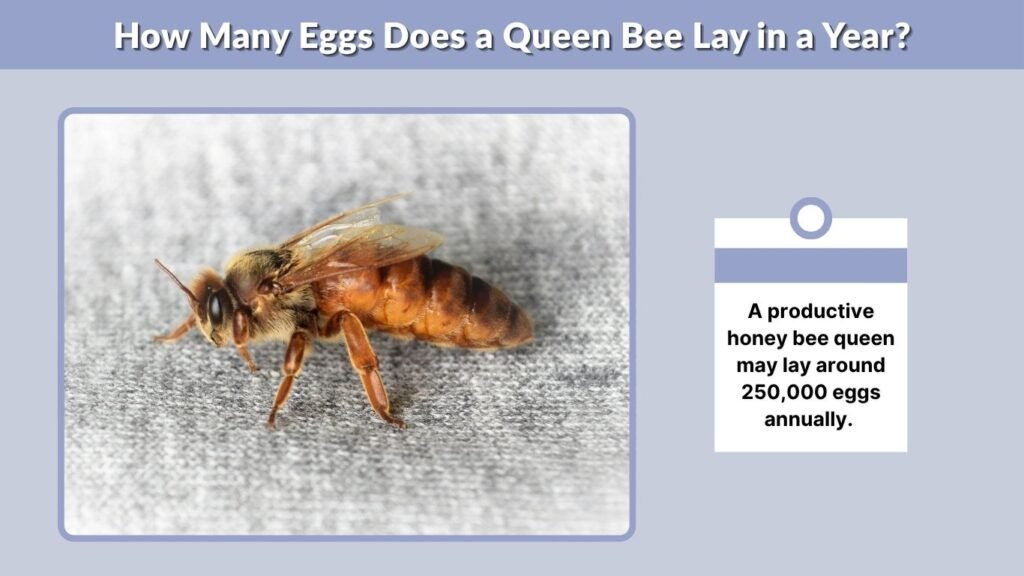
A productive honey bee queen may lay around 250,000 eggs annually. Over several years, some queens may produce more than a million eggs. These are possible totals, not guarantees.
Multiplying a peak daily figure by 365 gives a misleading estimate. Egg laying usually rises and falls, and some colonies experience periods with little or no brood production.
The length of the growing season matters, too. Queens in different climates do not necessarily follow the same annual schedule.
How Does a Queen Bee Lay Eggs?
A queen lays eggs inside individual beeswax cells in the brood nest, where the colony raises young bees.
She normally:
- Examines a suitable cell.
- Positions her abdomen inside it.
- Deposits one egg near the cell’s base.
- Moves to another cell.
Workers clean and prepare these cells. Between laying periods, the queen pauses while attendants feed and groom her.
Although videos may show rapid, repeated laying, she does not produce eggs at an uninterrupted, mechanical pace. Her daily total includes periods of activity and rest.
What Do Queen Bee Eggs Look Like?
Honey bee eggs are tiny, white, and elongated. They resemble miniature grains of rice attached to the bottoms of comb cells.
Freshly laid eggs generally stand upright. As development progresses, they lean toward the cell floor. Most cells containing normally laid eggs hold just one.
Eggs can be difficult to spot, particularly against pale wax. Good lighting and a clear view into the cell make identification easier.
“Queen bee eggs” can mean eggs laid by a queen or eggs destined to become queens. You cannot reliably distinguish a future queen from a future worker by the egg’s appearance alone. Their later rearing conditions help determine their development.
How Do Queen Bee Eggs Get Fertilized?
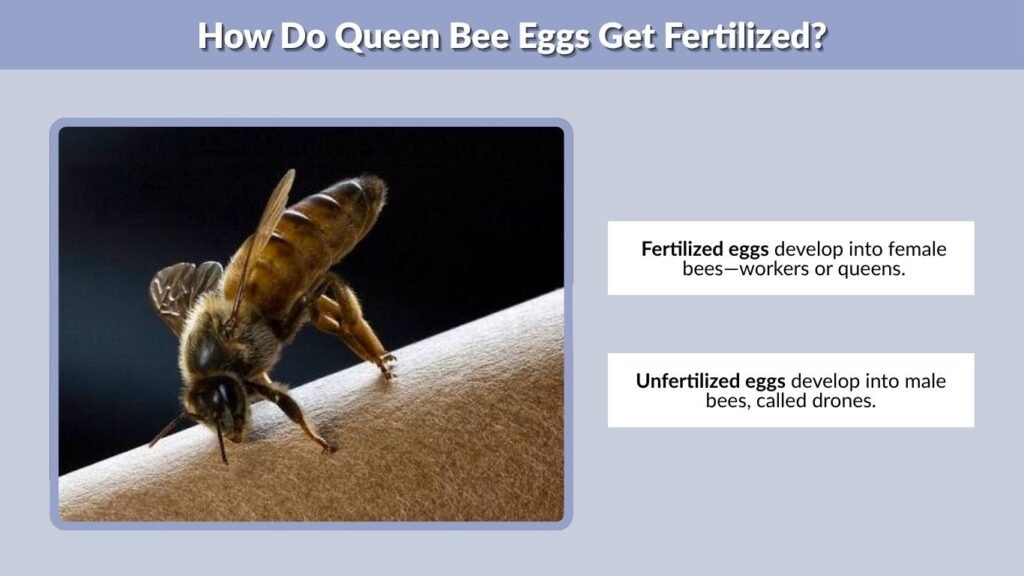
A queen stores sperm obtained during mating in a specialized organ called the spermatheca. She uses this stored sperm to fertilize eggs before laying them.
Under normal circumstances:
- Fertilized eggs develop into female bees—workers or queens.
- Unfertilized eggs develop into male bees, called drones.
The queen does not need to mate each time she produces an egg. Stored sperm supports her ongoing production of female offspring.
Most female larvae become workers. Larvae raised as queens receive specialized care, including abundant royal jelly and development in queen cells.
This also explains why a queen does not lay a visibly different “royal egg.” A future queen begins as a fertilized egg, just as a worker does.
How Long Before a New Queen Bee Lays Eggs?
A newly emerged queen needs time to mature and mate before she can begin normal production of fertilized eggs.
She typically spends approximately five to eight days in the hive before taking mating flights. After successful mating, egg laying often begins within a few days.
Together, these stages can allow first eggs to appear roughly one to two weeks after emergence under favorable conditions. This is an approximate timeline, not a deadline: unsuitable weather can delay mating.
An already-mated replacement queen is different. She has completed mating, but acceptance, release from her introduction cage, and colony conditions can affect when laying resumes.
Before worrying about a new queen not laying eggs, establish whether she arrived as a queen cell, a virgin queen, or a mated adult.
How Long Do the Eggs Take to Hatch?
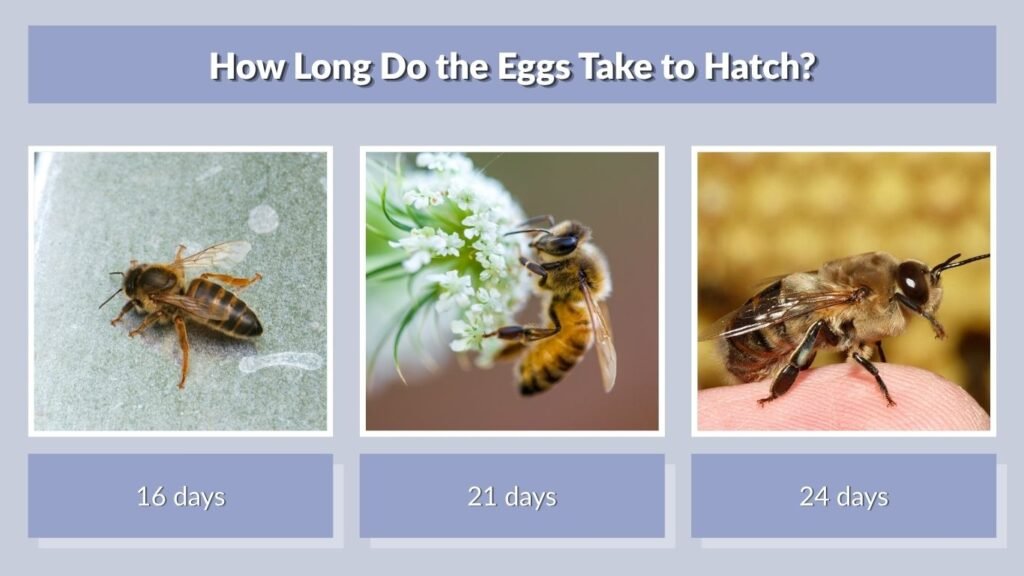
Honey bee eggs generally hatch into larvae after about three days. Adult emergence happens later, following larval growth and pupation.
| Bee type | Approximate time from egg to adult |
| Queen | 16 days |
| Worker | 21 days |
| Drone | 24 days |
These are average development times, with some variation according to conditions.
The distinction matters: an egg hatching after three days does not mean an adult bee appears. Likewise, a queen emerging around day 16 is not immediately ready to produce fertilized eggs.
Is the Queen Bee the Only Bee That Lays Eggs?
The queen is normally the colony’s main egg layer, but some worker honey bees can also lay eggs.
Worker reproduction becomes particularly noticeable when a colony remains queenless. In most honey bee colonies, laying workers produce unfertilized eggs that develop into drones.
These males cannot replace the female workforce. Consequently, worker egg laying does not solve the colony’s need for a successfully mated, productive queen.
Numerous eggs scattered within cells, sometimes attached to cell walls, can indicate laying workers. However, diagnosis should consider the brood pattern and colony history—not one unusual cell.
Why Is a Queen Bee Not Laying Eggs?
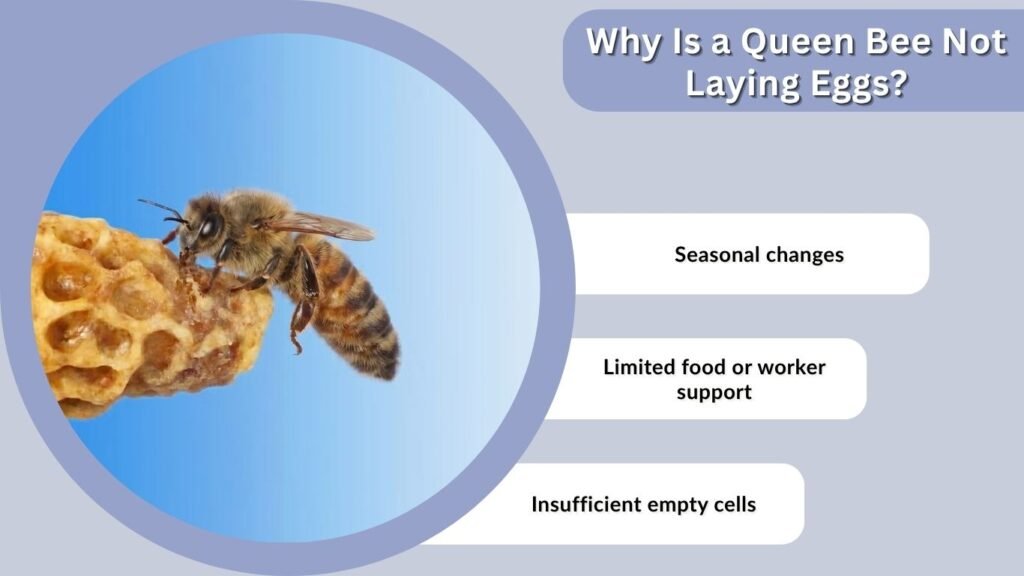
Missing eggs do not automatically mean the queen is dead or failing. Several situations can reduce or interrupt egg production.
Seasonal changes
In temperate climates, laying often decreases as the colony approaches winter. Some colonies have a broodless period; others continue raising small amounts of brood.
Laying may restart during winter, before obvious spring weather arrives. There is no universal month when every queen starts or stops. Local conditions and stored food influence the cycle.
Limited food or worker support
A colony needs sufficient resources and workers to rear young. Reduced support can limit brood production even when the queen is present.
Insufficient empty cells
A brood nest crowded with honey, nectar, or pollen may leave too few suitable cells for laying.
Mating or fertility problems
A queen that mated poorly, or whose stored sperm is no longer functioning adequately, may struggle to produce a female brood. Persistent drone broods in worker-sized cells can be a warning sign.
If an unexpected absence of eggs continues, ask an experienced beekeeper or local extension specialist to assess the colony before replacing its queen.
How Can You Tell Whether a Queen Is Laying Well?
Look for several kinds of evidence together:
- Fresh eggs showing recent laying.
- Young larvae and developing worker broods.
- Brood production appropriate to the season.
- Changes recorded across successive inspections.
Seeing eggs confirms recent laying, but does not prove that the queen is still present at the moment of inspection. Capped brood reflects activity from earlier days.
A patchy brood pattern is worth investigating, but it does not automatically identify a bad queen. Research has shown that colony conditions can influence brood patterns independently of queen quality.
FAQs
Can a queen bee lay eggs without mating?
Yes. An unmated honey bee queen can lay unfertilized eggs, which normally develop into drones. Successful mating is necessary for normal production of female workers.
Can a queen bee lay multiple eggs in one cell?
Yes. A young queen beginning to lay, or a queen with too few available cells, may occasionally deposit extra eggs. Multiple eggs alone do not prove that laying workers are present.
Can a queen bee lay eggs in a drone comb?
Yes. Queens normally lay unfertilized eggs in the larger cells used to rear drones.
Does every egg become an adult bee?
No. Egg production and adult emergence are different measures. Eggs or developing brood may be removed or fail to survive, so counting eggs does not directly predict the number of future adults.
