
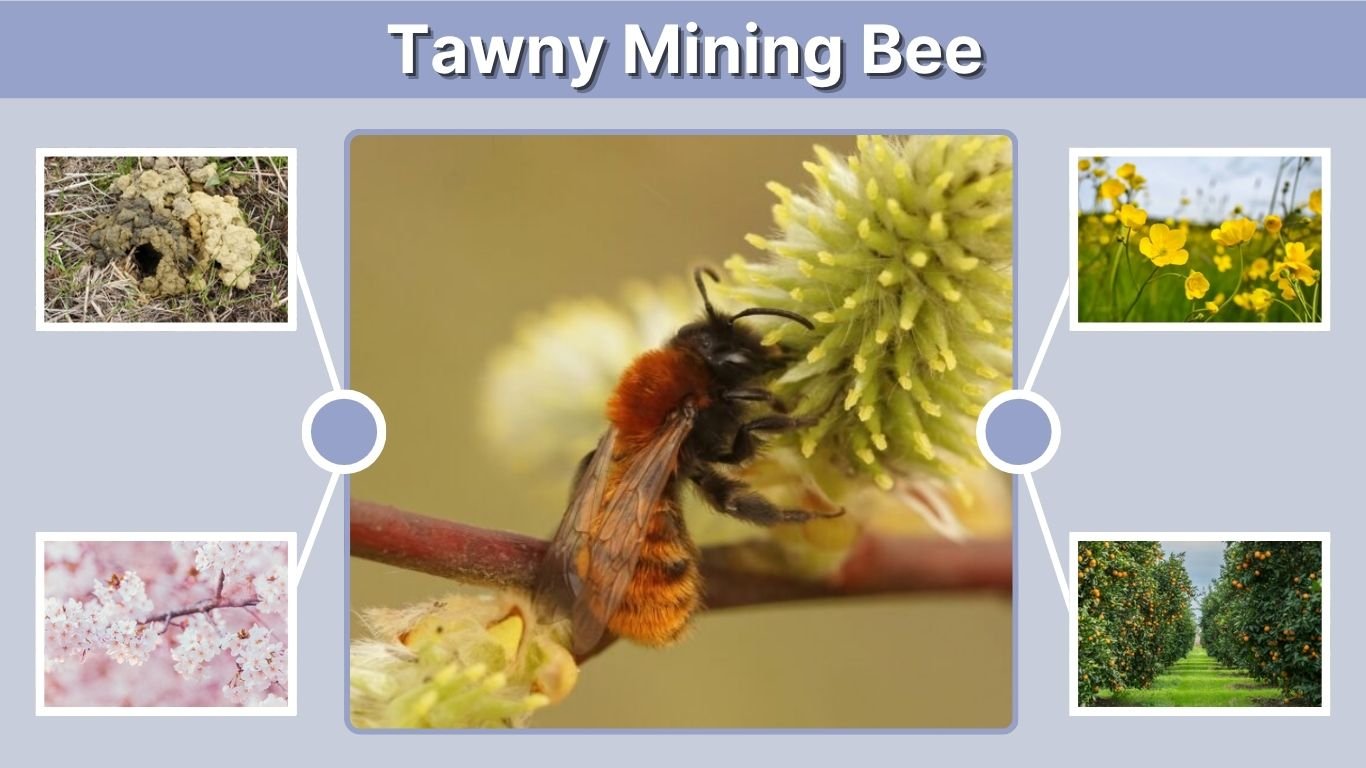
The Tawny Mining Bee (Andrena fulva) is a striking spring-flying solitary bee best known for the female’s dense orange-red coat and black face and legs. It frequently nests in lawns, parks, gardens, orchards, and short grass, where females create small volcano-shaped mounds of excavated soil. Although many nests may occur together, each female maintains her own burrow. Tawny Mining Bees are valuable spring pollinators, are generally non-aggressive, and are widespread across much of England and Wales.
What Does a Tawny Mining Bee Look Like?
The female Tawny Mining Bee is among the easiest British mining bees to recognize. Fresh females have a thick covering of bright reddish-orange hair across the upper thorax and abdomen, contrasting strongly with a black head, black legs, and dark hairs along the underside. Males are noticeably slimmer, less colorful, and more easily confused with other Andrena species.
Tawny Mining Bee Identification
- Scientific name: Andrena fulva
- Family: Andrenidae
- Female length: up to about 12 mm
- Female covered dorsally in dense orange-red hair
- Head and legs mainly black-haired
- Male smaller and slimmer
- Male has duller reddish-brown hair
- Male has noticeable pale or white facial hairs
- Usually active in spring
- Often seen close to lawns and bare soil
Females are approximately honey-bee sized, whereas males are smaller and much less conspicuous.
Male vs Female Tawny Mining Bee
Females have the classic fox-red or gingery appearance that gives the species its common name. The dense orange coat extends over both the thorax and abdomen.
Males are slimmer, with less dense brownish-orange hair. They also have long pale hairs on the face and relatively prominent jaws. Because several male mining bees look similar, identifying males from photographs can be difficult.
Tawny Mining Bee Nest
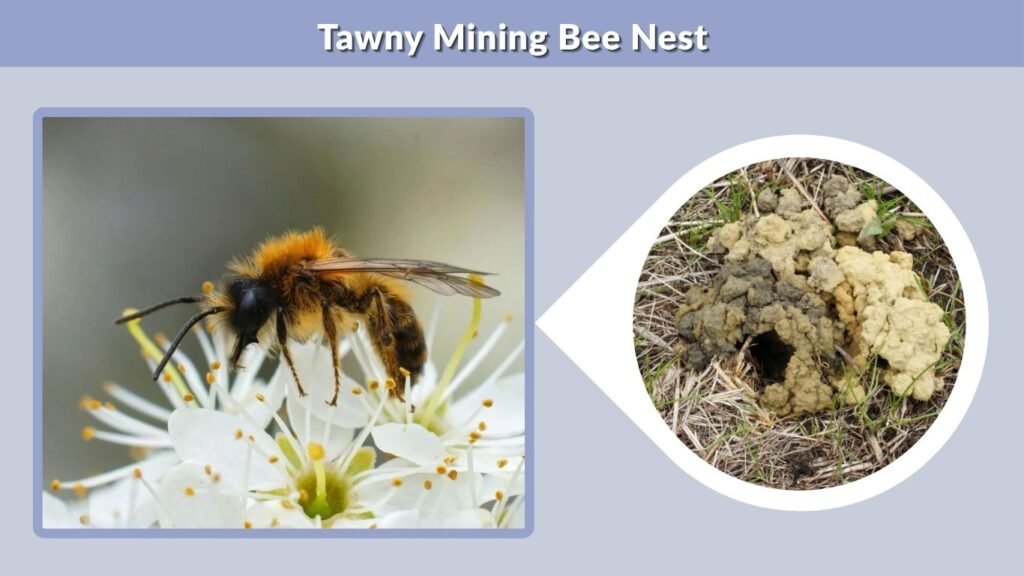
Tawny Mining Bees nest underground rather than in hollow tubes or bee hotels. Each female digs her own burrow, usually in fairly level soil with short or sparse vegetation. The soil removed during excavation accumulates around the entrance, creating the characteristic miniature “volcano” seen in lawns during spring.
What Does the Nest Look Like?
Typical signs include:
- Small round entrance hole
- Loose mound of soil around the opening
- Volcano-shaped appearance
- Short or sparse surrounding grass
- Several entrances relatively close together
- Sunny or relatively warm location
Inside, a main shaft leads to lateral tunnels ending in individual brood cells. BWARS reports that a nest commonly contains around four or five cells and that one female may construct two or three nests.
Why Are There So Many Nests in One Lawn?
Tawny Mining Bees are solitary, but they frequently form nesting aggregations.
This means dozens or even hundreds of females may choose the same suitable patch of ground. They still do not form a social colony: there is no communal queen, worker caste, shared brood chamber, or honey store.
Some nesting aggregations can persist for many years when the soil remains suitable.
Do Tawny Mining Bees Sting?
Female Tawny Mining Bees possess stingers, but they are not considered aggressive insects. They have no social hive to defend, so people can usually walk close to an active nesting area without being attacked.
Can Tawny Mining Bees Sting Humans?
A female could sting if she were squeezed, trapped, or roughly handled, but ordinary activity around a lawn nest presents very little risk.
Males cannot sting.
The safest approach is simply to watch the bees without trying to catch or squeeze them. Large numbers flying close to the ground during spring mating activity may look intimidating, but this behavior does not mean the bees are attacking.
Are Tawny Mining Bees Dangerous?
No. Tawny Mining Bees are generally regarded as beneficial solitary pollinators rather than dangerous pests.
BWARS educational material specifically describes the species as safe around children and pets.
Tawny Mining Bee Life Cycle
Tawny Mining Bees have one generation per year. Adults emerge in spring and are active for a relatively short period. Males generally appear first and search for females. After mating, females excavate nests, collect pollen and nectar, and provision individual underground brood cells for their offspring.
Life Cycle Stages
- Adult emergence: Bees appear in early spring.
- Mating: Males patrol areas where females are emerging.
- Nest excavation: Females dig underground tunnels.
- Provisioning: Each cell receives pollen and nectar.
- Egg: One egg is deposited with the food supply.
- Larva: The developing bee consumes the stored food.
- Pupa: Development continues underground.
- Next spring: A new generation emerges.
Wildlife Trusts notes that the developing offspring remain underground and pass the winter before emerging the following season.
When Are Tawny Mining Bees Active?
The main flight period is approximately late March to mid-June, although exact timing changes with temperature and geographic location.
The species is therefore strongly associated with spring flowers and fruit-tree blossom.
What Do Tawny Mining Bees Eat?
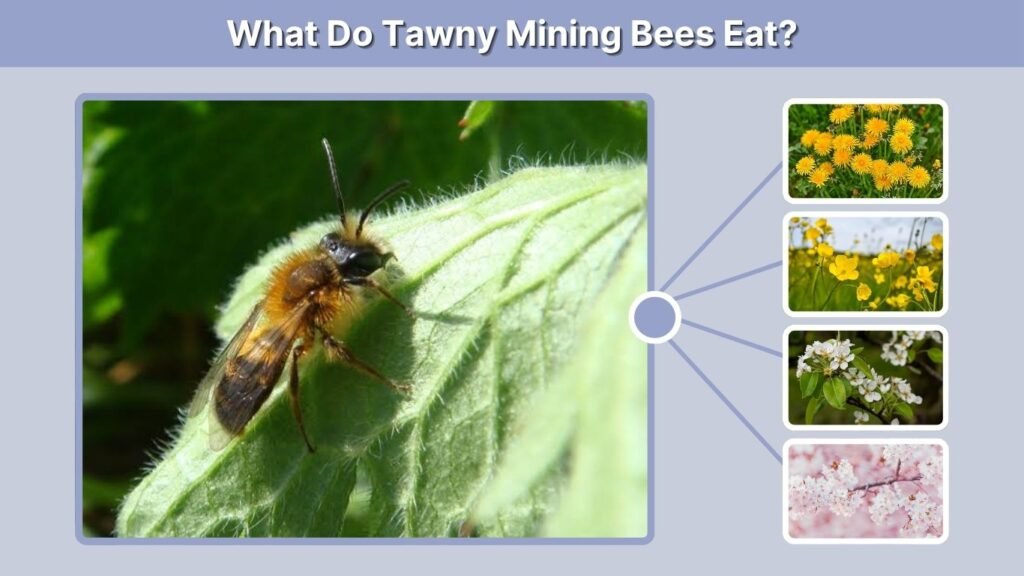
Adult Tawny Mining Bees feed on flower nectar for energy, while females also collect pollen to supply their developing offspring. They are generalist flower visitors rather than specialists restricted to one plant species.
Common Flowers Visited
They may feed on:
- Dandelions
- Buttercups
- Willow
- Hawthorn
- Blackthorn
- Maple
- Apple blossom
- Pear blossom
- Cherry blossom
- Other spring flowers
Their flight period overlaps closely with fruit-tree flowering, making them useful pollinators in gardens and orchards.
Tawny Mining Bee Habitat
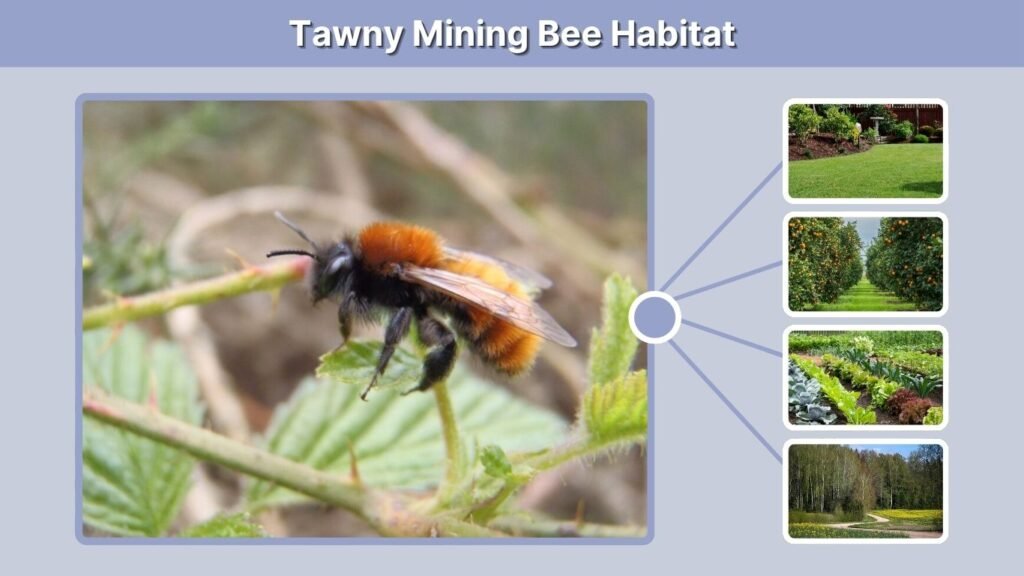
Tawny Mining Bees require both flowers and suitable soil for nesting. They thrive particularly well in human-modified environments because lawns, parks, orchards, and gardens can provide both resources.
Typical Habitats
They can be found in:
- Garden lawns
- Parks
- Orchards
- Pastures
- Chalk grassland
- Field margins
- Open woodland
- Flower-rich gardens
- Roadside banks
- Short grassland
South-facing banks and areas with sparse vegetation can provide especially attractive nesting conditions.
Tawny Mining Bee Range in the UK and Ireland
The Tawny Mining Bee is widespread through much of lowland England and Wales. Records have expanded northward, with the species now reported in Scotland as well. Current conservation information also notes a small number of records from Ireland.
Are Tawny Mining Bees Rare?
They are not considered scarce or threatened in Britain.
Wildlife Trusts lists the species as common, while BWARS describes it as common and widespread across England and Wales.
Do Tawny Mining Bees Live in Canada?
The true Tawny Mining Bee, Andrena fulva, is a European species rather than a native Canadian bee. Its established range is centered in western and central Europe and extends eastward toward the Balkans.
Canada has many native Andrena mining bees, some of which can appear reddish or superficially similar. A reddish mining bee photographed in Canada should therefore not automatically be identified as A. fulva.
Should You Get Rid of Tawny Mining Bees?
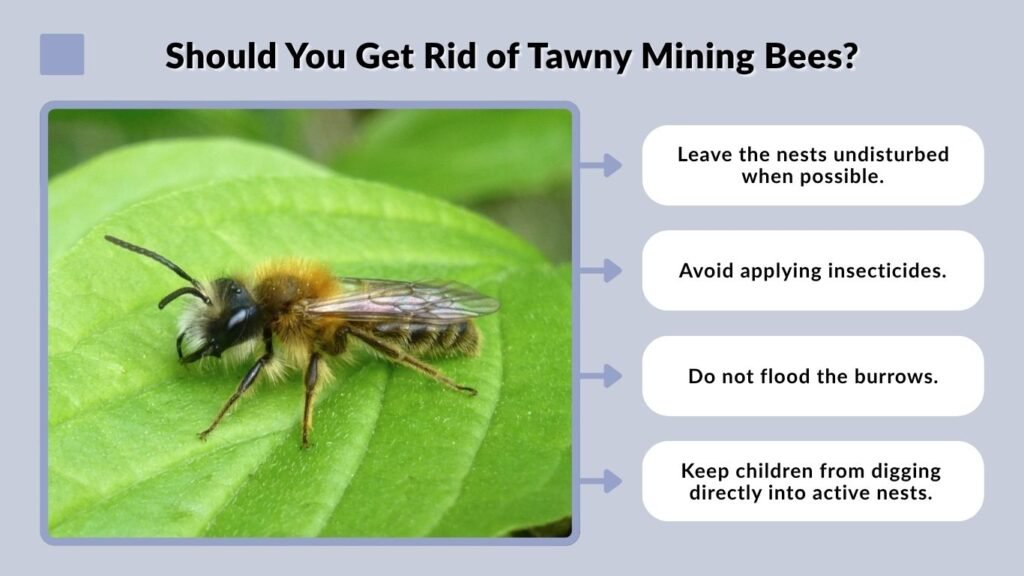
Usually, no. Their nests cause little lasting damage to healthy lawns, the adults are gentle, and their spring pollination benefits gardens and fruit trees.
What to Do About Nests
If bees are nesting in your lawn:
- Leave the nests undisturbed when possible.
- Avoid applying insecticides.
- Do not flood the burrows.
- Keep children from digging directly into active nests.
- Allow their short spring activity period to finish naturally.
- Preserve nearby spring flowers.
The small soil mounds usually disappear naturally through weathering and normal lawn growth.
Tawny Mining Bee Predators and Parasites
Underground nesting does not completely protect Tawny Mining Bees. Several insects specialize in exploiting their nests.
Natural Enemies
Known associates include:
- Nomada panzeri cuckoo bees
- Nomada signata cuckoo bees
- Bee-flies such as Bombylius major
- Other nest parasites
Cuckoo bees enter mining-bee nests and use the food provisions collected for the host’s offspring. BWARS records these specialized relationships as a normal part of Tawny Mining Bee ecology.
FAQs
1. What does a Tawny Mining Bee look like?
Females have dense bright orange-red hair over the upper body, with a contrasting black face, legs, and underside. Males are smaller and duller.
2. Do Tawny Mining Bees sting?
Females are capable of stinging but are very unlikely to do so unless physically threatened or handled. Males cannot sting.
3. Where do Tawny Mining Bees nest?
They dig underground nests in lawns, short grass, gardens, parks, banks, and other areas with suitable soil.
4. Are Tawny Mining Bees rare?
No. They are considered common across much of England and Wales and have also been recorded farther north into Scotland.
5. What do Tawny Mining Bees eat?
Adults drink nectar, while females collect both nectar and pollen from plants such as dandelion, willow, hawthorn, blackthorn, and flowering fruit trees.
