
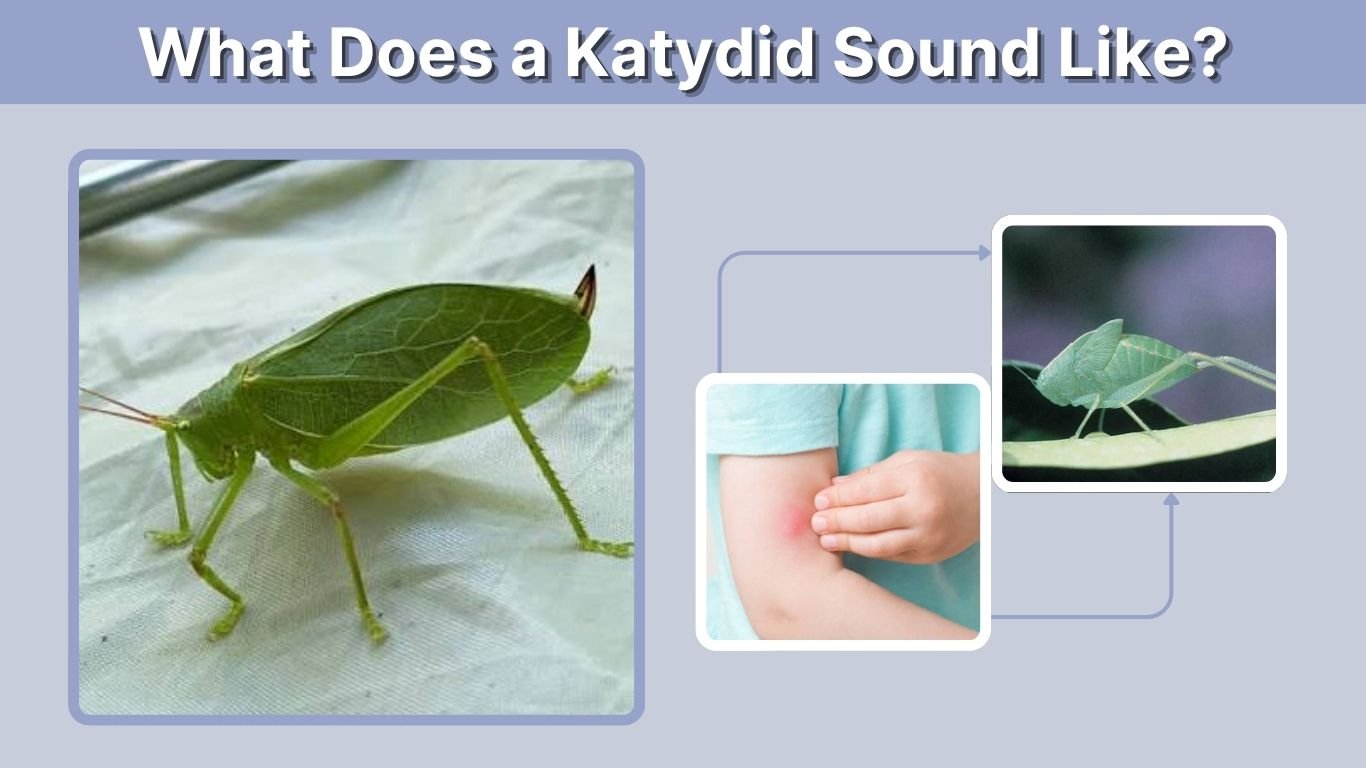
What does a katydid sound like? Depending on the species, a katydid may produce sharp clicks, raspy buzzes, rapid ticks, chirps, or repeated phrases that can sound like “katy-did, katy-didn’t.” These calls are especially noticeable on warm summer nights when males sing from trees, shrubs, and tall grasses. Katydids are also easy to recognize by their extremely long antennae and leaflike green bodies. Their unusual sounds, excellent camouflage, and nighttime activity make them some of the most recognizable insects in gardens and woodlands.
What Does a Katydid Sound Like?
There is no single katydid sound because thousands of species produce different calls. Some create short, isolated ticks, while others make loud buzzing or repetitive rhythmic phrases. The familiar name “katydid” comes from the way people interpret the call of certain true katydids as sounding roughly like the words “Katy did, Katy didn’t.”
Common Katydid Sounds
Katydid calls may be described as:
- Sharp clicks
- Rapid ticking
- Rasping noises
- Buzzing
- Chirping
- Repeated two- or three-part phrases
- Pulsing sounds
- High-pitched trills
- Scratchy nighttime calls
Some sounds are slow and easy to distinguish, while others merge into an almost continuous buzz when many katydids are calling together.
Why Do Katydids Make Sounds?
Most of the loud sounds people hear are produced by male katydids trying to attract females.
Rather than singing with their mouths, males usually rub specialized parts of their forewings together. This process, called stridulation, creates the characteristic clicks, buzzes, and rasps.
Each species generally has its own calling pattern. This allows females to recognize males of their own species even when several different insects are singing nearby.
What Does a Katydid Sound Like at Night?
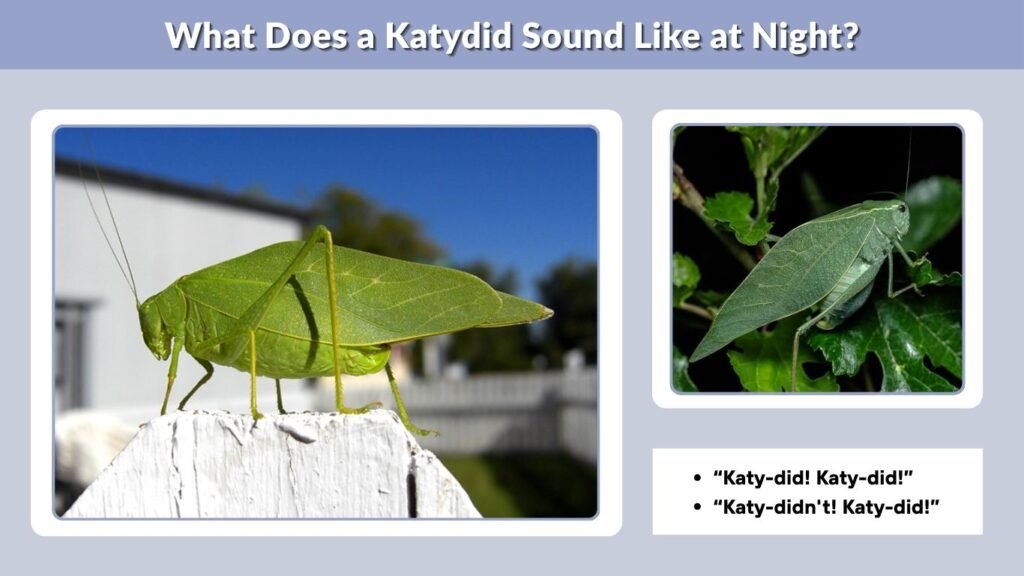
Katydids are particularly famous for their nighttime songs. On warm evenings, males may call repeatedly from leaves, bushes, grasses, or tree canopies.
A single insect can be surprisingly loud, while a large population may create an almost continuous chorus.
Why Are Katydids Louder at Night?
Katydids are primarily nocturnal, so nighttime is when many species become most active.
Calling after sunset allows males to advertise for mates while remaining relatively well hidden among vegetation. Warm temperatures can also increase activity, causing calls to become faster or more frequent.
Their nighttime chorus is especially noticeable from midsummer through early autumn in regions where katydids are abundant.
What Does a True Katydid Sound Like?
True katydids are among the insects responsible for the classic repetitive “katydid” call.
Their songs are often described as:
“Katy-did! Katy-did!”
or
“Katy-didn’t! Katy-did!”
The actual sound is a rough, mechanical series of pulses rather than clear human words, but the resemblance inspired the insect’s common name.
How Do Katydids Make Their Sound?
Katydids produce sound differently from animals that use vocal cords. A male has specialized structures on its forewings that work somewhat like a file and scraper.
When the wings move across one another, they vibrate and generate sound.
How Katydid Singing Works
The basic process includes:
- The male raises or positions his forewings.
- Specialized wing surfaces rub together.
- Friction produces vibrations.
- Wing membranes help amplify the sound.
- Females detect the call from nearby vegetation.
Katydids have hearing organs called tympana on their front legs, which is an unusual location compared with human ears.
Do Female Katydids Make Sounds?
Male katydids are responsible for most prominent mating songs.
In some katydid species, females can produce quieter sounds or respond to males, but they generally do not create the loud nighttime songs associated with male calling.
A female can often be recognized by the prominent egg-laying structure extending from the end of her abdomen.
What Does a Katydid Look Like?
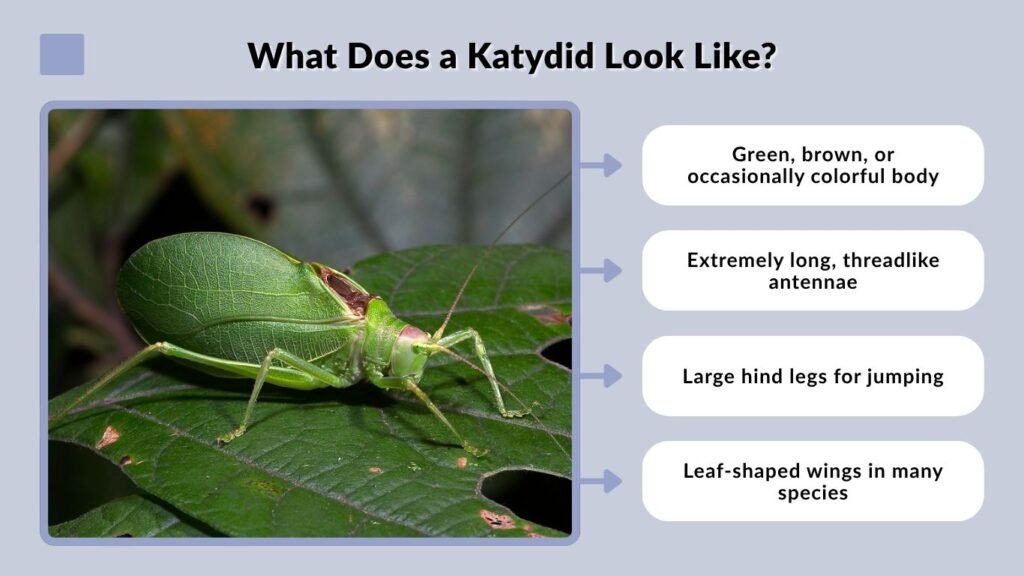
Katydids are relatives of crickets and grasshoppers. Many are bright green and have broad wings that resemble leaves, making them exceptionally difficult to spot when resting on plants.
Their most recognizable feature is often their very long antennae, which can extend far beyond the length of the body.
Katydid Identification
Look for these characteristics:
- Green, brown, or occasionally colorful body
- Extremely long, threadlike antennae
- Large hind legs for jumping
- Leaf-shaped wings in many species
- Long, narrow legs
- Chewing mouthparts
- Wings held along the back
- Female ovipositor in many species
Katydids vary greatly in appearance because the family contains many different forms, including coneheads, meadow katydids, bush katydids, shield-backed katydids, and true katydids.
Why Do Katydids Look Like Leaves?
Leaf mimicry provides camouflage.
Many species have green wings containing veins similar to those of leaves. Some even have irregular edges, spots, or brown patches that resemble damaged foliage.
When a leaf katydid sits motionless among vegetation, predators such as birds may have difficulty detecting it.
Katydid vs Grasshopper: How to Tell Them Apart
People frequently describe a katydid as a big green grasshopper-like bug because the two insects have similar body shapes and strong jumping legs.
The antennae provide one of the easiest differences.
| Feature | Katydid | Grasshopper |
| Antennae | Very long | Usually short |
| Activity | Mostly evening/night | Mostly daytime |
| Appearance | Often leaflike | Usually less leaflike |
| Sound | Wings rubbed together | Often legs and wings |
| Family | Tettigoniidae | Mainly Acrididae |
| Color | Frequently green or brown | Highly variable |
Katydids are actually more closely associated with long-horned orthopterans such as crickets than with typical short-horned grasshoppers.
What Do Baby Katydids Look Like?
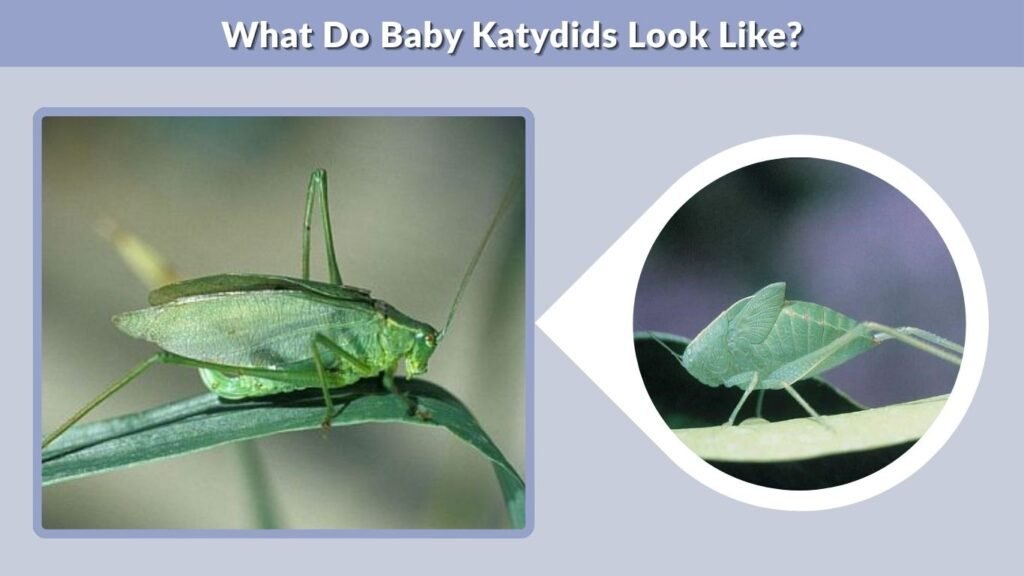
A baby katydid is called a nymph. It resembles a miniature adult but does not yet have fully developed wings.
Young katydids go through incomplete metamorphosis, meaning there is no caterpillar or pupal stage.
Katydid Nymph Identification
Baby katydids typically have:
- Small green or brown bodies
- Very long antennae
- Large hind legs
- No functional adult wings
- Developing wing pads in older nymphs
- Adult-like overall body shape
Nymphs grow through repeated molts. Their wings gradually develop until they reach adulthood.
What Do Katydid Eggs Look Like?
Katydid eggs vary by species but are often small, flattened, oval structures.
Females may deposit them along plant stems, leaves, twigs, bark, or other suitable surfaces.
Katydid Egg Appearance
Depending on species, eggs may be:
- Gray
- Brown
- Tan
- Oval or flattened
- Arranged in neat rows
- Overlapping like roof shingles
- Attached to leaves or stems
Katydids do not generally produce a large silk egg sac like many spiders. Instead, females place individual eggs or organized groups of eggs directly onto or into plant material.
What Does a Female Katydid Look Like?
Female katydids usually resemble males in overall color and body structure, but many have a conspicuous ovipositor extending from the rear of the abdomen.
The ovipositor is used for laying eggs.
Is the Ovipositor a Stinger?
No. Although a long, pointed ovipositor can look intimidating, it is not a stinger.
Females use it to place eggs in plant tissue, soil, bark, or other suitable locations depending on the species.
This structure is often one of the easiest ways to distinguish an adult female katydid from a male.
What Does a Katydid Bite Look Like?
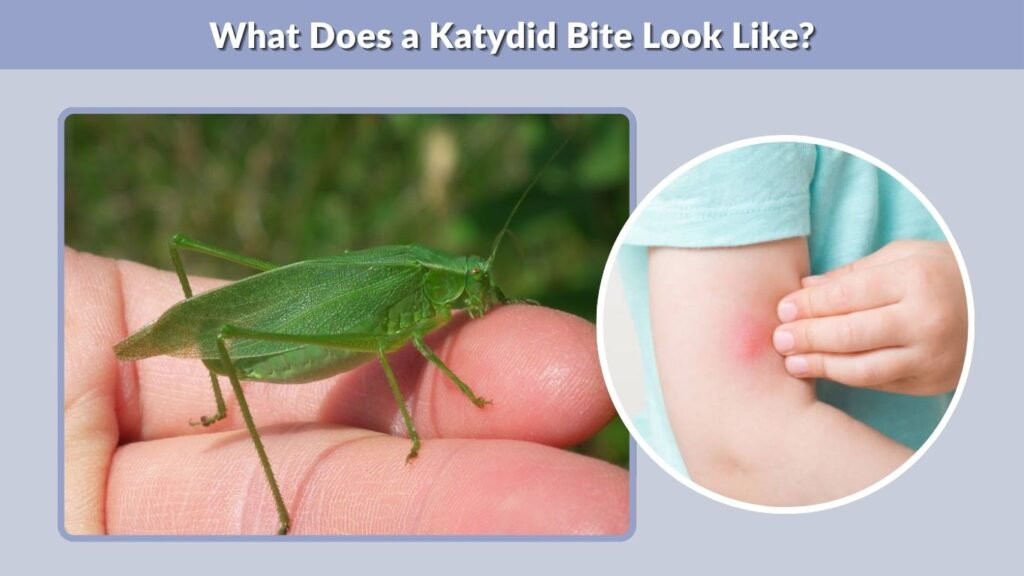
Katydids are not blood-feeding insects and do not normally bite people. However, they have strong chewing mouthparts and a large katydid may pinch if it is squeezed or handled roughly.
A defensive bite might cause:
- Mild redness
- Temporary soreness
- A small superficial mark
- Minor skin irritation
There is no distinctive appearance that identifies a katydid bite with certainty.
Are Katydids Dangerous?
Katydids are generally harmless to people.
They do not have venomous fangs or stingers. The best approach is simply to avoid grabbing a large individual tightly. If one enters a house, it can usually be moved outside using a cup or container.
Katydid Sounds vs Other Night Insects
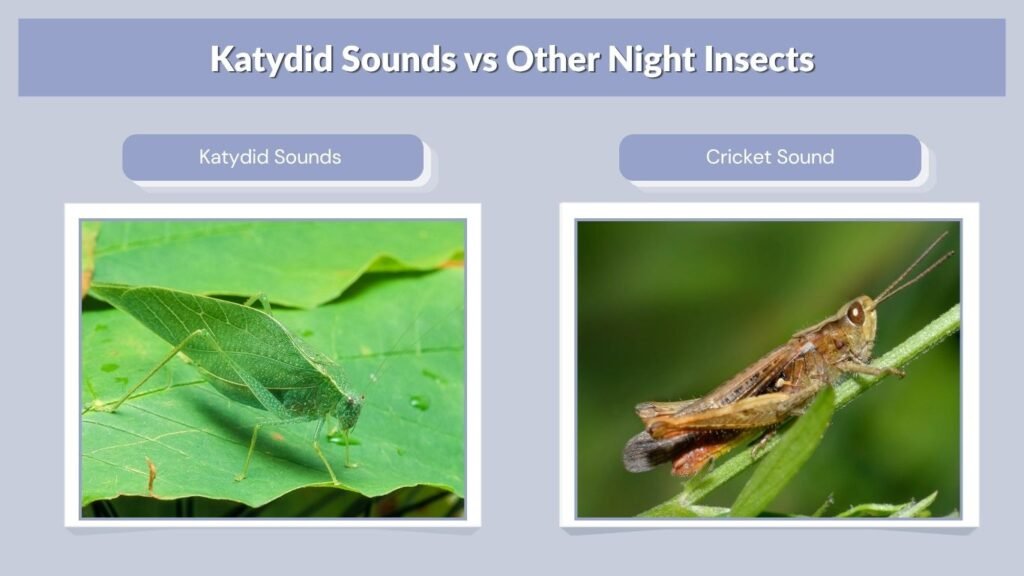
Katydids are often confused with crickets and cicadas because all three can contribute to loud insect choruses.
Katydid vs Cricket Sound
Crickets often produce more regular, musical chirps, while katydids commonly create sharper clicks, rasps, ticks, or buzzing phrases.
Katydid sounds can also be more mechanical or harsh.
Katydid vs Cicada Sound
Cicadas usually produce very loud buzzing or whining calls and are most active during the day or evening, depending on species.
Katydids frequently continue calling well after dark and generally produce more distinct clicking, ticking, or rasping rhythms.
FAQs
What does a katydid sound like?
Katydids can sound like clicking, buzzing, rasping, ticking, or chirping. Some true katydids produce a repetitive call people interpret as “katy-did” or “katy-didn’t.”
What does a katydid look like?
Most katydids have long antennae, powerful hind legs, and green or brown bodies. Many species have broad wings that closely resemble leaves.
Why do katydids make noise at night?
Male katydids call mainly to attract females. Many species are nocturnal, so their mating songs are particularly noticeable after sunset.
What do katydid eggs look like?
Katydid eggs are usually small, flattened, oval structures that may be brown, gray, or tan. Females often arrange them in rows on leaves, stems, or twigs.
Do katydids bite humans?
Katydids do not normally bite people, but a large individual may give a defensive pinch if handled roughly. They are not considered dangerous to humans.
