
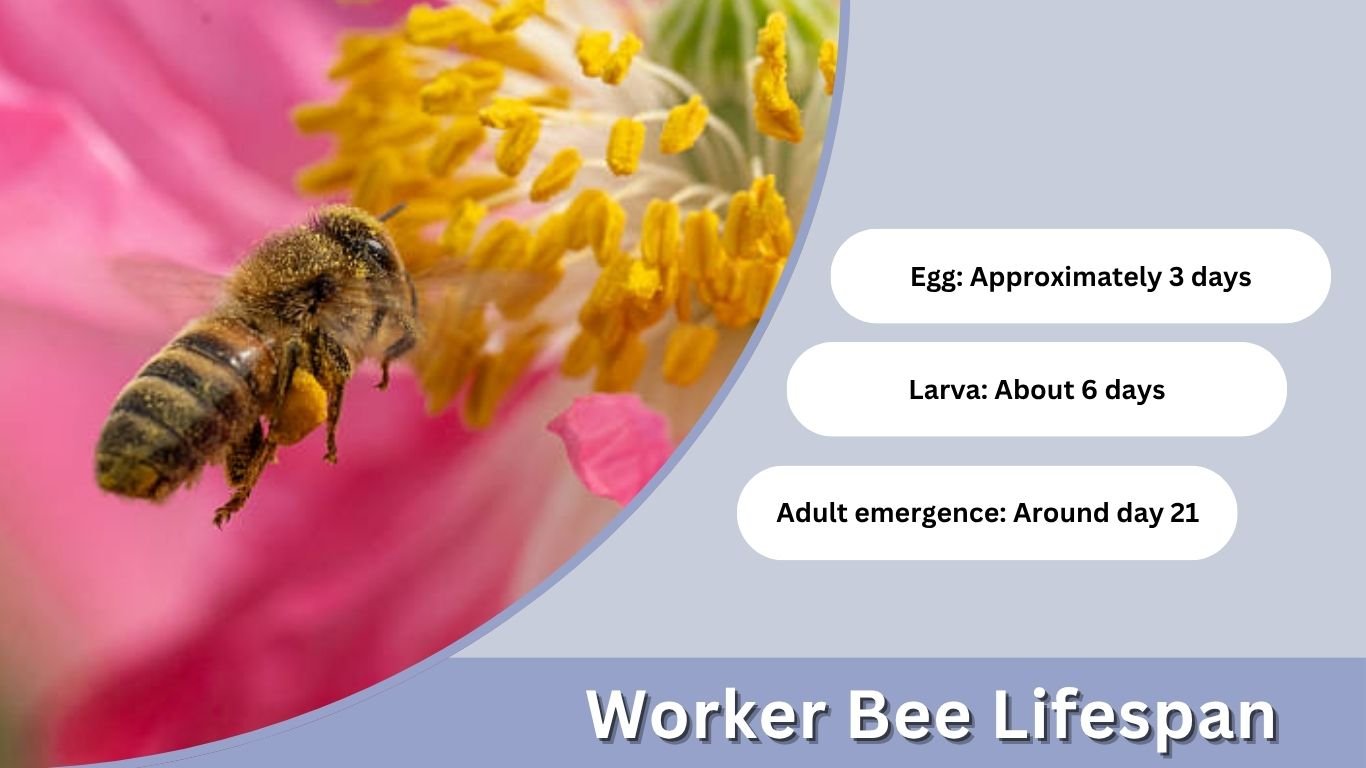
The worker bee lifespan changes dramatically depending on the season and the jobs a bee performs inside and outside the colony. During spring and summer, worker honey bees often live only about four to six weeks because intense foraging quickly wears down their bodies. Winter workers can survive several months because they remain inside the hive and conserve energy. Queens and drones have very different lifespans. Understanding worker bee development, seasonal survival, duties, nutrition, and colony roles explains why genetically similar bees can live for such different lengths of time.
What Is the Average Worker Bee Lifespan?
Worker honey bees are female members of the colony that perform almost every task required for hive survival. Their lifespan is not fixed. A worker emerging during a busy summer may survive only a few weeks, while one developing before winter can remain alive for several months. Temperature, workload, nutrition, disease, and colony conditions all influence longevity.
Typical Worker Bee Lifespan
A worker honey bee commonly lives:
- Spring and summer: About 4–6 weeks
- Autumn workers: Often considerably longer
- Winter workers: Several months
- Under heavy stress: Potentially much shorter
- In favorable colonies: Toward the upper end of the normal seasonal range
The dramatic difference between summer and winter workers is largely connected with activity and physiology rather than a completely different type of bee.
Why Do Summer Workers Live Such Short Lives?
Summer workers perform demanding jobs every day.
They eventually leave the hive to collect nectar, pollen, water, and plant resins. A foraging bee may make repeated flights covering considerable distances while carrying heavy loads.
Flight gradually damages the wings and places substantial metabolic stress on the body. Foragers also face predators, bad weather, pesticides, vehicles, and the possibility of becoming lost.
A summer worker may therefore die from cumulative wear rather than simply reaching a predetermined age.
Worker Bee Lifespan in Summer vs Winter
Season is one of the strongest influences on worker honey bee longevity. Colonies produce physiologically different long-lived workers as winter approaches. These winter bees do not spend their first weeks performing the intense brood-rearing and foraging work typical of summer workers, allowing them to retain nutritional reserves for much longer.
Summer Worker Bees
Summer workers typically:
- Care for large quantities of brood
- Produce wax
- Clean brood cells
- Guard the hive
- Process nectar
- Collect pollen
- Carry water
- Forage repeatedly
- Fly during hot weather
All of these activities require substantial energy.
A worker usually begins life performing tasks inside the hive before eventually becoming a forager. Once regular foraging begins, physical deterioration can occur rapidly.
Winter Worker Bees
Winter workers may survive for several months because their role is very different.
During cold weather, honey bees form a cluster and generate heat by contracting their flight muscles. Workers rotate through different areas of the cluster and feed on stored honey.
They make relatively few foraging flights and generally rear much less brood during the coldest period.
Winter workers also develop larger internal nutrient reserves, particularly in their fat bodies, helping them survive until spring flowers become available.
Worker Honey Bee Life Stages
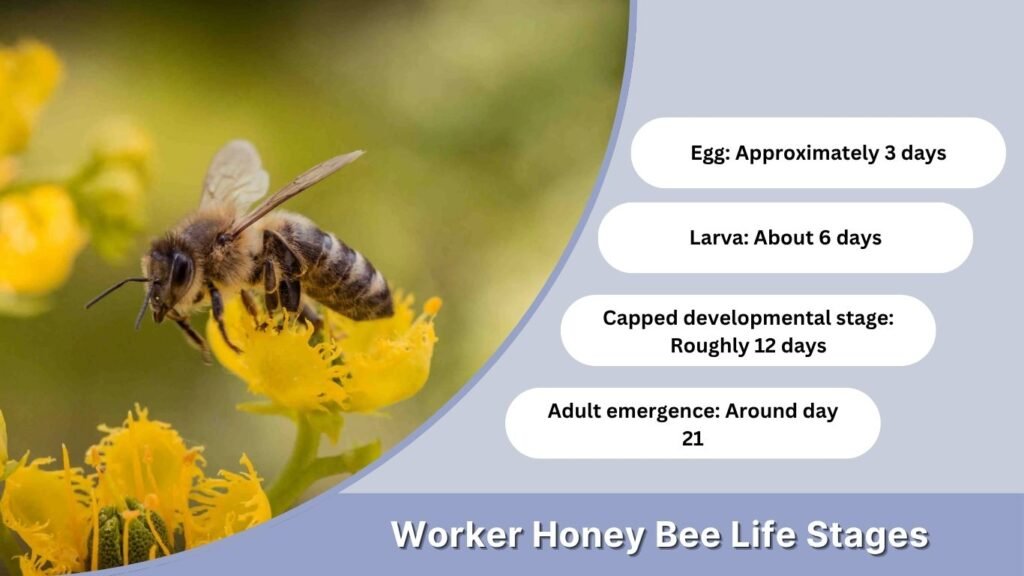
A worker’s life begins long before she emerges as an adult. Honey bees undergo complete metamorphosis, developing through egg, larva, pupa, and adult stages. From egg laying to adult emergence takes approximately three weeks for a worker honey bee.
Worker Bee Development
The basic development includes:
- Egg: Approximately 3 days
- Larva: About 6 days
- Capped developmental stage: Roughly 12 days
- Adult emergence: Around day 21
After emerging, the worker begins performing hive duties almost immediately.
The exact timing of later jobs is flexible and changes according to colony needs.
Young Worker Duties
Young workers commonly spend their early adult lives cleaning cells and caring for developing brood.
As they mature, they may begin producing wax, handling food, maintaining the nest, and guarding entrances.
Eventually, many become foragers.
This gradual progression is called age-related division of labor, although colonies can adjust the normal schedule when necessary.
How Worker Bee Jobs Affect Lifespan
Worker honey bees perform numerous roles throughout life. The transition from indoor worker to outdoor forager usually marks a major increase in risk. Bees working safely inside the hive are protected from many dangers faced by individuals flying through the environment.
Common Worker Bee Jobs
Workers may perform tasks such as:
- Cleaning cells
- Feeding larvae
- Caring for the queen
- Producing wax
- Building comb
- Processing nectar
- Storing pollen
- Ventilating the hive
- Guarding entrances
- Removing dead bees
- Collecting water
- Foraging for nectar and pollen
Not every bee performs every job for the same amount of time.
Colony conditions strongly influence how quickly workers transition between roles.
Foraging and Physical Wear
Foraging is among the most demanding tasks.
A worker’s wings beat extremely rapidly while flying, and repeated trips gradually cause visible wear along wing edges.
Older workers may eventually have torn wings, reduced flight performance, and depleted physiological reserves.
Because foragers operate outside the protected colony, mortality also rises substantially from environmental hazards.
Queen Bee Lifespan vs Worker Bee Lifespan
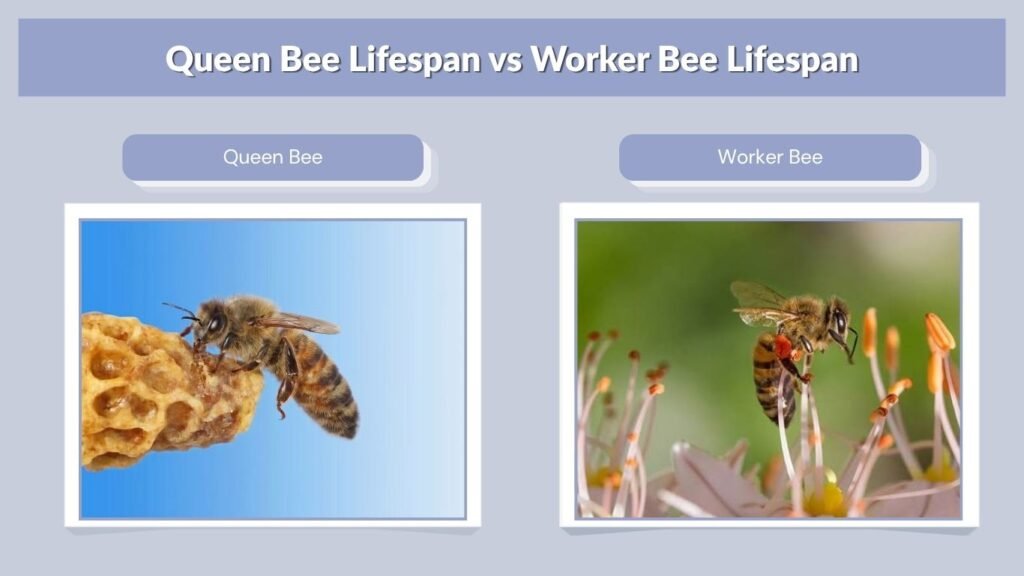
Queens and workers are both female honey bees and originate from fertilized eggs, yet their adult lifespans are dramatically different. A queen may survive for several years, while a summer worker often lives only weeks. Diet, reproductive development, physiology, and workload all contribute to this difference.
How Long Does a Queen Bee Live?
A queen honey bee can potentially live for several years, although colonies commonly replace queens earlier if egg production declines.
Her primary responsibility is laying eggs rather than performing dangerous outside work.
Workers feed and protect her inside the hive, dramatically reducing the environmental hazards she faces compared with foragers.
Does Royal Jelly Explain the Difference?
Nutrition plays a major role in determining whether a female larva develops into a worker or queen.
Queen-destined larvae receive a specialized diet rich in royal jelly throughout their larval development. This nutritional pathway changes gene expression, reproductive development, body structure, and physiology.
However, royal jelly alone should not be viewed as a simple “longevity medicine.” A queen’s long lifespan also reflects her unique biology, protected lifestyle, and reproductive role.
Worker, Drone and Queen Bee Lifespan
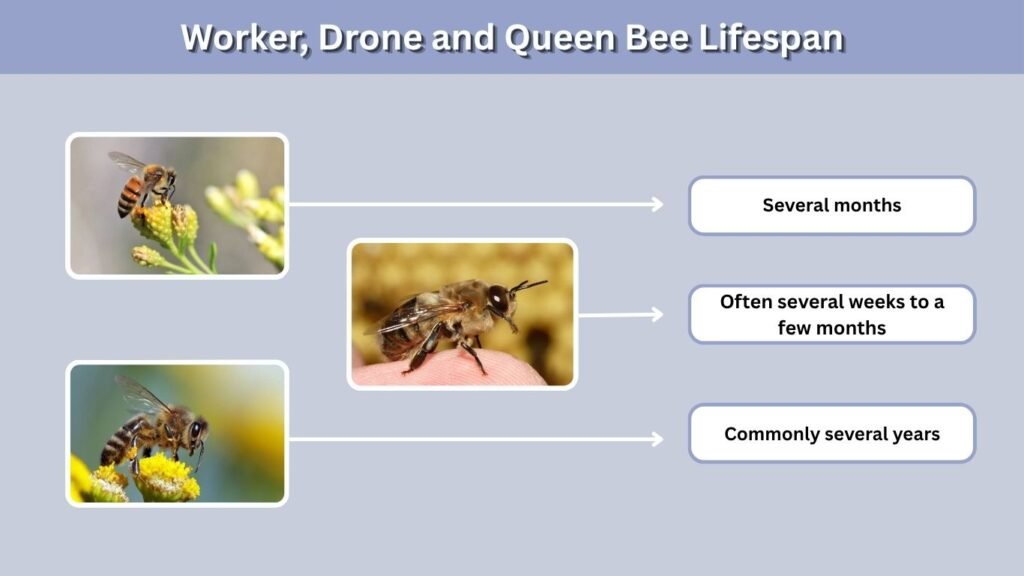
The three major adult honey bee castes have remarkably different lifestyles and survival patterns. Workers maintain the colony, queens reproduce, and drones exist mainly to mate with queens from other colonies.
Lifespan Comparison
Typical patterns are:
- Summer worker: About 4–6 weeks
- Winter worker: Several months
- Drone: Often several weeks to a few months
- Queen: Commonly several years
These are approximate ranges rather than guaranteed lifespans.
Food availability, weather, genetics, parasites, and colony health can shorten or extend survival.
How Long Do Drone Bees Live?
Drone bees do not forage, defend the hive, or care for larvae.
Their primary biological role is mating. A drone that successfully mates with a queen dies shortly afterward because mating causes fatal damage to his reproductive structures.
Drones that do not mate may live for weeks or months during the warm season. Colonies often remove remaining drones before winter because they consume stored food without contributing to cold-season colony survival.
What Shortens a Worker Bee’s Lifespan?
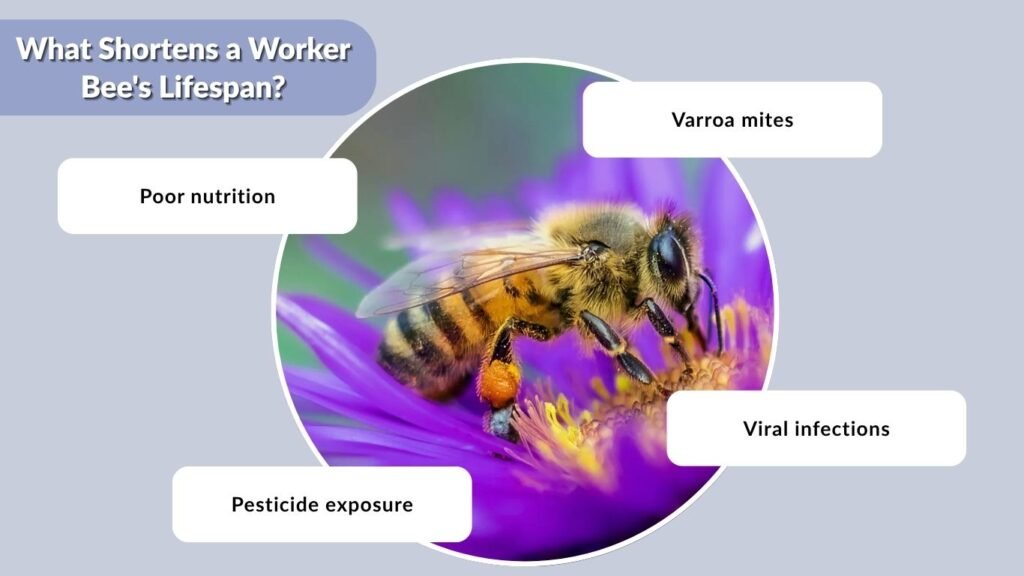
Not every worker reaches the normal seasonal lifespan. Honey bees face numerous biological and environmental stresses that can dramatically increase mortality.
Factors That Reduce Lifespan
Important threats include:
- Varroa mites
- Viral infections
- Poor nutrition
- Pesticide exposure
- Extreme heat
- Cold stress
- Food shortages
- Predators
- Heavy foraging demands
- Queen or colony problems
- Other parasites and diseases
Varroa mites are particularly serious because they feed on developing and adult bees while transmitting damaging viruses.
Nutrition and Lifespan
A diverse supply of pollen is essential because pollen provides proteins, fats, vitamins, minerals, and other nutrients.
Colonies surrounded by limited floral resources may experience nutritional stress.
Nectar and honey supply carbohydrates needed for flight, heat production, and everyday activity.
Healthy landscapes containing flowers across much of the growing season support stronger worker populations.
How Far Does a Worker Bee Fly During Its Life?
Worker bees can travel remarkable cumulative distances during their relatively short adult lives. Exact lifetime distance cannot be generalized because it depends on forage location, weather, colony demands, and how many days the bee spends foraging.
Daily Foraging
Foragers may leave the hive many times during suitable weather.
They typically search within a few miles of the colony but can travel farther when resources are scarce.
Shorter distances are generally more efficient because workers can collect more food while spending less energy on flight.
Over thousands of individual journeys made by a colony’s workers, an enormous amount of total flight activity is required to produce stored honey.
Why Worker Bee Lifespan Matters to the Colony
A honey bee colony functions as a coordinated social system rather than simply a collection of individuals. Summer workers are constantly being replaced as older foragers die, while winter survival depends on a long-lived population capable of maintaining the cluster until spring.
Colony Population Replacement
During peak breeding periods, the queen may lay large numbers of eggs each day.
This continuous reproduction is necessary because thousands of workers may disappear through normal mortality over a relatively short period.
When brood production cannot replace dying workers, colony strength declines.
This balance explains why queen health, food availability, parasite management, and worker longevity are closely connected.
FAQs
Worker bee longevity can seem surprisingly short until the intense workload of a honey bee colony is considered. Seasonal physiology allows the same species to produce short-lived summer workers and much longer-lived winter workers.
What is the average lifespan of a worker bee?
A summer worker honey bee typically lives around four to six weeks. Winter workers can survive several months because they forage less and have greater physiological reserves.
How long does a worker bee live in winter?
Winter workers may live several months, sometimes surviving from autumn until early spring. Their exact longevity depends on colony health, climate, nutrition, and disease pressure.
Why do queen bees live longer than worker bees?
Queens have different developmental nutrition and physiology and spend most of their lives protected inside the colony. Workers perform physically demanding and dangerous jobs, particularly foraging.
Do all worker bees live only 4–6 weeks?
No. The four-to-six-week estimate mainly applies to active summer workers. Workers produced before winter can live far longer.
Which lives longer: a worker, drone, or queen bee?
Queens normally live the longest, potentially surviving for several years. Drones generally live weeks or months, while summer workers usually have the shortest adult lifespan.
