




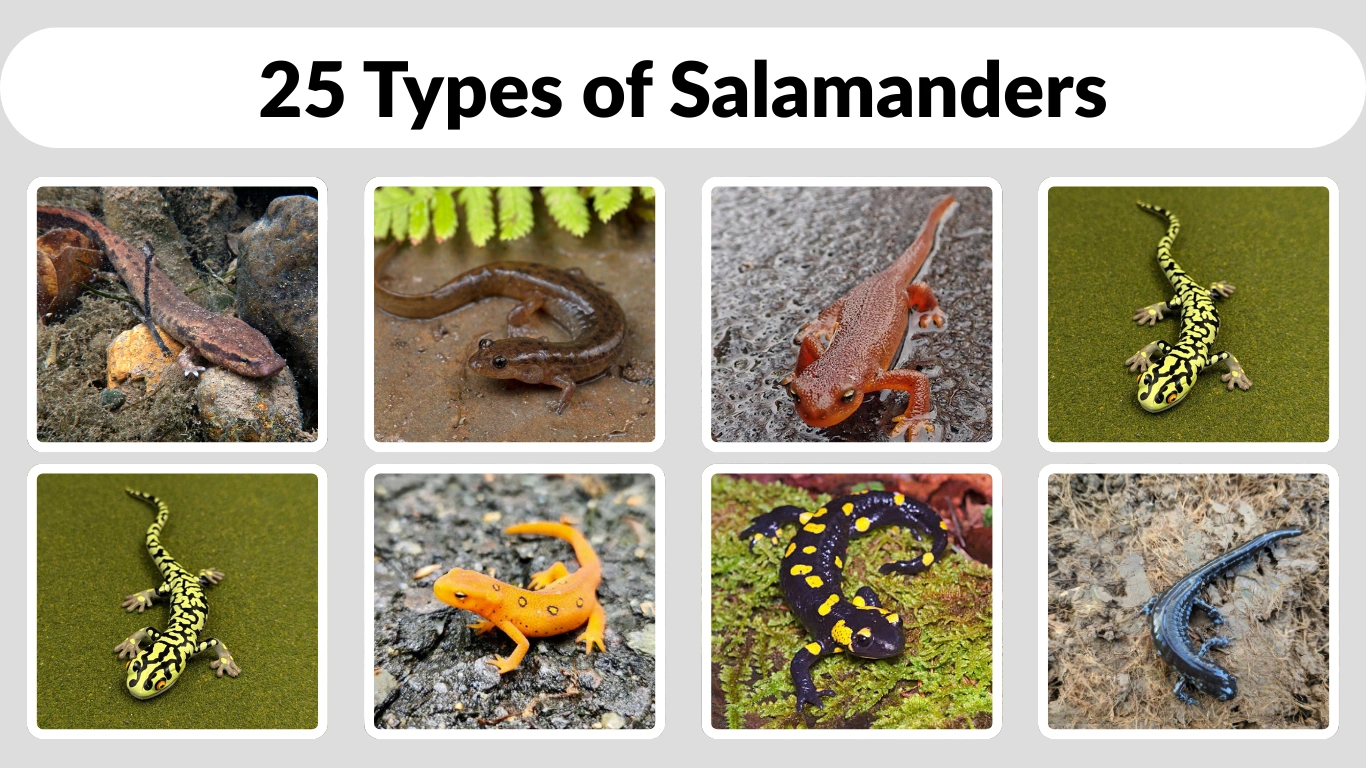
Salamanders are fascinating amphibians known for their moist skin, long tails, and incredible ability to regenerate lost body parts. Found in forests, streams, caves, and wetlands around the world, these creatures vary widely in size, color, and behavior. This guide explores 25 different types of salamanders, highlighting their unique identification features, natural habitats, and behavioral traits to help you understand and recognize each species more easily.
1. Axolotl (Ambystoma mexicanum)

The axolotl is a unique salamander known for retaining its larval features throughout its life. Native to Mexico, it is famous for its external feathery gills, wide head, and remarkable ability to regenerate lost body parts, making it one of the most studied amphibians in the world.
Identification
- Soft, smooth skin with no scales
- External feathery gills on both sides of the head
- Broad head with small, lidless eyes
- Long, flat tail adapted for swimming
- Common colors include pink (leucistic), brown, black, and golden
Habitat
Axolotls are native to freshwater lakes and canals, primarily Lake Xochimilco near Mexico City. They prefer cool, slow-moving water with plenty of vegetation and muddy bottoms. Due to urbanization and pollution, their natural habitat has drastically declined.
Behaviors
Axolotls are mostly nocturnal and spend much of their time resting at the bottom of the water. They are solitary and non-aggressive, feeding on small fish, worms, and insects. Unlike most salamanders, axolotls remain aquatic for their entire lives and do not undergo full metamorphosis.
2. Tiger Salamander (Ambystoma tigrinum)

The tiger salamander is one of the largest terrestrial salamanders in North America. It is well known for its bold yellow or olive markings on a dark body and its adaptability to a wide range of environments, from grasslands to forests.
Identification
- Thick, robust body with smooth skin
- Dark brown, black, or gray base color
- Yellow or olive blotches, spots, or stripes
- Broad head with small eyes
- Strong legs suited for digging
Habitat
Tiger salamanders inhabit forests, grasslands, wetlands, and agricultural areas. They spend most of their lives underground in burrows and migrate to ponds or lakes during the breeding season. They prefer moist soil and freshwater bodies without fish predators.
Behaviors
Tiger salamanders are primarily nocturnal and spend daylight hours hidden underground. They are opportunistic feeders, eating insects, worms, snails, and small vertebrates. During breeding season, adults travel long distances to return to their natal ponds, often during rainy nights.
3. Fire Salamander (Salamandra salamandra)

The fire salamander is a strikingly colored species famous for its bold black body with bright yellow or orange patterns. Native to Europe, it is often associated with folklore and is known for its toxic skin secretions that deter predators.
Identification
- Glossy black body with yellow or orange spots or bands
- Stocky build with short legs
- Rounded head with prominent eyes
- Smooth, slightly shiny skin
- Poison glands located behind the eyes
Habitat
Fire salamanders live in deciduous and mixed forests, especially in mountainous regions. They prefer cool, moist environments with access to clean streams or springs, where larvae develop. They often hide under logs, rocks, and leaf litter.
Behaviors
Fire salamanders are mostly nocturnal and become active after rain. They move slowly and rely on their toxic skin secretions rather than speed for defense. Adults feed on insects, worms, and slugs, while larvae are aquatic and carnivorous.
4. Spotted Salamander (Ambystoma maculatum)

The spotted salamander is a large, secretive amphibian recognized by its bright yellow or orange spots running along a dark body. It is commonly found in eastern North America and is well known for its dramatic mass migrations to breeding ponds in early spring.
Identification
- Black or dark gray body
- Two rows of yellow or orange spots along the back
- Smooth, moist skin
- Broad head with a rounded snout
- Stout body with a thick tail
Habitat
Spotted salamanders inhabit deciduous forests with moist soil and abundant leaf litter. They spend most of the year underground and require fish-free vernal pools or temporary ponds for breeding. These seasonal wetlands are critical for their life cycle.
Behaviors
Spotted salamanders are nocturnal and emerge mainly during rainy nights. In early spring, they migrate in large numbers to breeding ponds, an event often called a “big night.” They feed on insects, worms, and other small invertebrates found on the forest floor.
5. Marbled Salamander (Ambystoma opacum)

The marbled salamander is a striking species known for its bold black-and-white or gray marbled pattern. Unlike many salamanders, it breeds in the fall rather than spring, making its life cycle somewhat unique among North American amphibians.
Identification
- Black or dark gray body with white or silvery crossbands
- Stout, compact body shape
- Smooth skin with a glossy appearance
- Short legs and a relatively short tail
- Males usually have brighter markings than females
Habitat
Marbled salamanders live in deciduous forests, floodplains, and wooded wetlands. They prefer areas with moist soil and plenty of cover such as logs, leaf litter, and rocks. Breeding occurs in dry pond basins that later fill with water during winter rains.
Behaviors
Marbled salamanders are mostly nocturnal and spend much of their time hidden underground or under debris. Females guard their eggs laid in dry pond beds until flooding occurs. They feed on insects, spiders, worms, and other small invertebrates.
6. Hellbender (Cryptobranchus alleganiensis)

The hellbender is one of the largest salamanders in the world and is often called a “living fossil” due to its ancient lineage. Native to the eastern United States, it is fully aquatic and depends on clean, fast-flowing streams to survive.
Identification
- Large, flattened body with loose, wrinkled skin
- Brown, gray, or reddish coloration with dark mottling
- Broad, flat head with small eyes
- Short legs with strong toes
- Folded skin along the sides to aid oxygen absorption
Habitat
Hellbenders inhabit clear, cool rivers and streams with rocky bottoms. They rely on large, flat rocks for shelter and nesting. High oxygen levels and low pollution are essential, making them sensitive indicators of water quality.
Behaviors
Hellbenders are nocturnal and spend most of the day hiding under rocks. They are ambush predators, feeding mainly on crayfish, small fish, and aquatic insects. During breeding season, males guard nests and protect eggs from predators.
7. Eastern Newt (Notophthalmus viridescens)

The eastern newt is a well-known salamander with a complex life cycle that includes both aquatic and terrestrial stages. It is widely distributed across eastern North America and is easily recognized by its bright red juvenile form.
Identification
- Small to medium-sized body
- Juvenile “eft” stage is bright red or orange
- Adults are olive green to brown with dark spots
- Rough, granular skin texture
- Yellow belly with black spots
Habitat
Eastern newts live in forests, wetlands, ponds, lakes, and slow-moving streams. Juveniles inhabit moist forest floors, while adults return to freshwater habitats. They require clean water and damp terrestrial environments to thrive.
Behaviors
Eastern newts are active both day and night depending on conditions. The red eft stage is terrestrial and highly toxic to predators. Adults are aquatic and feed on insects, small crustaceans, and worms. They use chemical cues to navigate between land and water habitats.
8. Red-backed Salamander (Plethodon cinereus)

The red-backed salamander is a small, lungless salamander commonly found in North American forests. It is known for its color variation and its important role in maintaining healthy forest ecosystems.
Identification
- Small, slender body
- Gray or black body with a red or orange stripe along the back
- Some individuals lack the stripe and are fully dark
- Smooth, moist skin
- No lungs; breathes through skin
Habitat
Red-backed salamanders live in moist deciduous and mixed forests. They are usually found under logs, rocks, and leaf litter, where humidity remains high. Because they lack lungs, they depend heavily on cool, damp environments.
Behaviors
These salamanders are mostly nocturnal and territorial. They feed on small insects, mites, and other invertebrates. Red-backed salamanders are known to defend territories aggressively and can autotomize their tails to escape predators.
9. Blue-spotted Salamander (Ambystoma laterale)

The blue-spotted salamander is a secretive amphibian recognized by its dark body covered with light blue or bluish-white spots. It is native to northeastern North America and is often found only during breeding migrations.
Identification
- Dark black or bluish-gray body
- Blue or white spots along the sides and limbs
- Slender body with a long tail
- Smooth, moist skin
- Females generally larger than males
Habitat
Blue-spotted salamanders inhabit moist woodlands near swamps, marshes, and vernal pools. They spend most of the year underground and rely on temporary, fish-free ponds for breeding during early spring.
Behaviors
These salamanders are nocturnal and emerge mainly on rainy nights. They migrate to breeding ponds shortly after snowmelt. Blue-spotted salamanders feed on insects, worms, and small invertebrates and remain hidden for much of the year.
10. Green Salamander (Aneides aeneus)

The green salamander is a rare and distinctive species known for its flattened body and mottled green coloration, which provides excellent camouflage against mossy rock surfaces. It is native to parts of the eastern United States.
Identification
- Flattened body and head
- Green, yellow, or lichen-like blotches on a dark background
- Large eyes adapted for low light
- Squared snout
- Long limbs with expanded toe pads
Habitat
Green salamanders live in cool, moist rock crevices, cliffs, and shaded outcrops, often in forested or mountainous areas. They prefer vertical rock faces with deep cracks that retain moisture and offer protection from predators.
Behaviors
Green salamanders are nocturnal and rarely seen due to their secretive nature. They are skilled climbers and use their flattened bodies to wedge into narrow crevices. Their diet consists mainly of insects, spiders, and other small invertebrates found near rock surfaces.
11. Giant Salamander

The giant salamander refers to a group of extremely large, fully aquatic salamanders known for their ancient lineage. These salamanders are among the largest amphibians in the world and are often described as living fossils due to their minimal evolutionary changes over millions of years.
Identification
- Very large, heavy-bodied salamander
- Broad, flattened head
- Small eyes with poor eyesight
- Loose, wrinkled skin along the sides
- Dark brown or gray coloration with mottled patterns
Habitat
Giant salamanders inhabit cold, fast-flowing rivers and streams, usually in mountainous regions. They require clean, oxygen-rich water and rocky substrates where they can hide under large stones or within submerged crevices.
Behaviors
Giant salamanders are nocturnal and highly territorial. They are ambush predators, feeding on fish, crustaceans, frogs, and other aquatic animals. Movement is slow, and they rely more on stealth than speed when hunting prey.
12. Japanese Giant Salamander (Andrias japonicus)

The Japanese giant salamander is one of the largest amphibians in the world and is considered a national natural monument in Japan. It is an ancient species that has remained largely unchanged for millions of years.
Identification
- Massive, flattened body
- Broad head with tiny eyes
- Wrinkled skin with dark brown and black blotches
- Short, sturdy limbs
- Long, laterally flattened tail
Habitat
This species lives in cool, fast-flowing mountain streams and rivers in Japan. It prefers clear, oxygen-rich water with rocky bottoms and submerged shelters where it can hide during the day.
Behaviors
Japanese giant salamanders are nocturnal and highly sedentary. They rely on ambush hunting, feeding on fish, insects, crustaceans, and small amphibians. During breeding season, males guard nests and may become aggressive toward intruders.
13. Chinese Giant Salamander (Andrias davidianus)

The Chinese giant salamander is the largest amphibian species in the world and is often referred to as a “living fossil.” Native to China, it is critically endangered due to habitat loss and overexploitation.
Identification
- Extremely large, heavy-bodied salamander
- Broad, flattened head with small eyes
- Loose, wrinkled skin
- Mottled dark brown, gray, or black coloration
- Wide mouth extending across the head
Habitat
Chinese giant salamanders inhabit cool, fast-flowing rivers, streams, and lakes, usually in mountainous regions. They depend on clean, well-oxygenated water and rocky crevices for shelter and nesting.
Behaviors
These salamanders are nocturnal and solitary. They are ambush predators that feed on fish, frogs, insects, and crustaceans. During the breeding season, males guard nests and protect eggs from predators and rivals.
14. Mudpuppy (Necturus maculosus)
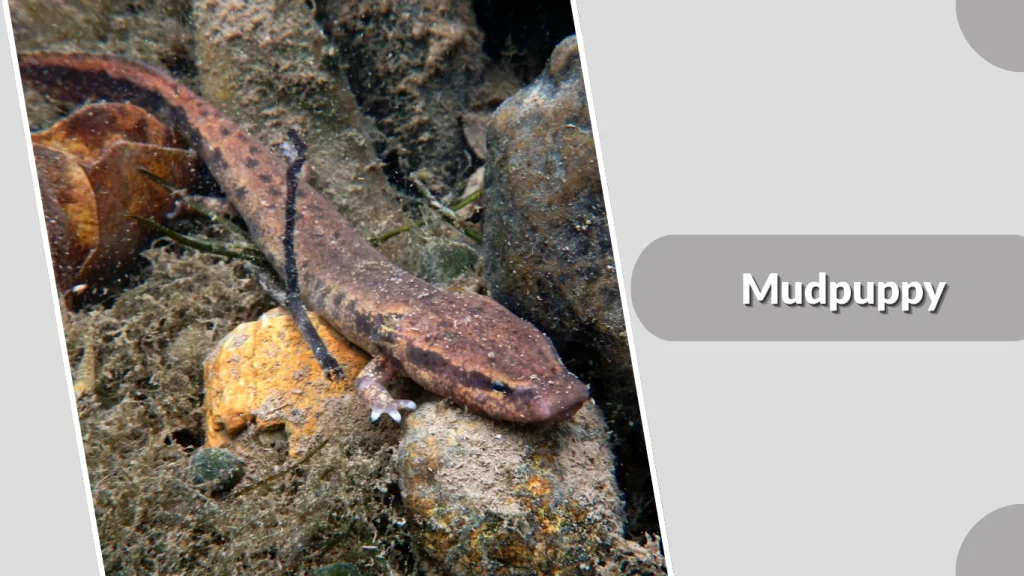
The mudpuppy is a fully aquatic salamander known for retaining its external gills throughout its life. It is common in parts of North America and is often mistaken for a fish due to its aquatic lifestyle.
Identification
- External feathery gills on both sides of the head
- Gray or brown body with dark spots
- Flattened head with small eyes
- Short limbs and long tail
- Smooth, slimy skin
Habitat
Mudpuppies live in lakes, rivers, and streams with slow to moderate currents. They prefer areas with rocks, logs, or debris for shelter and are often found in deep, cool water.
Behaviors
Mudpuppies are nocturnal and spend daylight hours hiding under cover. They feed on insects, crayfish, mollusks, and small fish. Unlike many salamanders, mudpuppies remain active year-round, even under ice in winter.
15. Olm (Proteus anguinus)

The olm is a rare, cave-dwelling salamander adapted to life in complete darkness. Native to the underground waters of southeastern Europe, it is famous for its longevity and extreme adaptations to subterranean environments.
Identification
- Pale pink or white body with translucent skin
- External feathery gills
- Elongated, eel-like body
- Tiny, undeveloped eyes covered by skin
- Long, slender limbs
Habitat
Olms live exclusively in underground freshwater caves, streams, and karst systems. These environments are dark, cold, and nutrient-poor, requiring the species to be highly specialized for survival.
Behaviors
Olms are slow-moving and rely on heightened senses of smell and vibration to locate prey. They feed on small crustaceans and insects. Due to low food availability, olms have a very slow metabolism and can survive for years without eating.
16. Slimy Salamander (Plethodon glutinosus)

The slimy salamander is a lungless species named for the sticky, milky secretion it produces when threatened. It is common in eastern North America and plays an important role in forest ecosystems.
Identification
- Black or dark gray body
- White or silvery flecks scattered across the skin
- Smooth, moist skin
- Stout body with short limbs
- Produces sticky, glue-like secretions
Habitat
Slimy salamanders inhabit moist deciduous forests, often near streams or rocky slopes. They shelter under logs, rocks, and leaf litter where humidity is high and temperatures remain cool.
Behaviors
These salamanders are nocturnal and territorial. When threatened, they exude a sticky secretion that can deter predators. Slimy salamanders feed on insects, worms, spiders, and other small invertebrates found on the forest floor.
17. Long-toed Salamander (Ambystoma macrodactylum)

The long-toed salamander is named for its noticeably elongated fourth toe on the hind feet. It is widely distributed across western North America and is adapted to a variety of climates, from lowlands to mountainous regions.
Identification
- Slender body with smooth skin
- Elongated fourth toe on hind feet
- Yellow or orange stripe along the back
- Dark brown or black body coloration
- Long, rounded tail
Habitat
Long-toed salamanders live in forests, grasslands, wetlands, and alpine environments. They breed in ponds, lakes, and slow-moving streams, often in cold or high-elevation areas, and spend much of their lives underground.
Behaviors
These salamanders are mostly nocturnal and secretive. They emerge during breeding season and rainy nights to feed and migrate. Their diet includes insects, worms, snails, and other small invertebrates.
18. Ensatina (Ensatina eschscholtzii)

Ensatina is a complex of closely related salamander subspecies known for their wide variation in color and pattern. Found along the western coast of North America, they are often cited as a classic example of a “ring species.”
Identification
- Medium-sized, slender body
- Color varies from brown and orange to black and blotched
- Large eyes with a rounded head
- Smooth, moist skin
- Constricted tail base used for defense
Habitat
Ensatinas inhabit moist forests, woodlands, and chaparral areas. They are typically found under logs, rocks, and leaf litter and require cool, damp conditions to survive.
Behaviors
These salamanders are nocturnal and rely on camouflage for protection. They do not have lungs and breathe through their skin. When threatened, they may raise and wave their tail to distract predators while escaping.
19. Cave Salamander (Eurycea lucifuga)

The cave salamander is a brightly colored species often found near cave entrances and rocky crevices. Despite its name, it usually lives near caves rather than deep inside them.
Identification
- Slender body with long tail
- Orange or yellow-orange body with black spots
- Smooth, moist skin
- Large eyes adapted to low light
- Long limbs
Habitat
Cave salamanders inhabit moist caves, rock shelters, and nearby forested areas. They prefer humid environments with access to flowing water or damp surfaces and are often found near cave mouths.
Behaviors
Cave salamanders are nocturnal and active during humid conditions. They feed on insects, spiders, and other small invertebrates. Although capable climbers, they remain close to shelter and rarely venture far from caves.
20. Dusky Salamander (Desmognathus fuscus)

The dusky salamander is a small, stream-dwelling species commonly found in eastern North America. It is known for its variable coloration and strong association with clean, flowing water.
Identification
- Small to medium-sized body
- Brown, gray, or black coloration
- Often has a pale line from eye to jaw
- Rough-textured skin
- Long tail used for swimming
Habitat
Dusky salamanders live along the edges of clear streams, seeps, and springs. They prefer rocky or muddy banks with plenty of cover such as stones, leaf litter, and logs. Moisture is essential for their survival.
Behaviors
These salamanders are active both day and night but are most commonly seen at night. They are quick and agile, feeding on insects, worms, and small aquatic invertebrates. When threatened, they may release a mild defensive secretion.
21. Rough-skinned Newt (Taricha granulosa)

The rough-skinned newt is a highly toxic salamander best known for its powerful chemical defenses. Native to the Pacific Northwest of North America, it is famous for its role in evolutionary studies involving predator–prey relationships.
Identification
- Dark brown or black upper body
- Bright orange or yellow belly
- Rough, granular skin texture
- Stocky body with short limbs
- Small eyes and rounded snout
Habitat
Rough-skinned newts inhabit forests, grasslands, ponds, lakes, and slow-moving streams. They spend part of their life on land and return to freshwater habitats for breeding. Moist environments are critical for their survival.
Behaviors
These newts are slow-moving and rely on toxicity rather than speed for defense. When threatened, they may display their bright belly as a warning. They feed on insects, worms, snails, and small aquatic organisms.
22. Alpine Salamander (Salamandra atra)

The alpine salamander is a rare European species adapted to cold, high-altitude environments. Unlike many salamanders, it gives birth to fully developed young instead of laying eggs in water.
Identification
- Solid black, glossy body
- Stocky build with short limbs
- Rounded head with prominent eyes
- Smooth, shiny skin
- Lacks bright markings
Habitat
Alpine salamanders live in mountainous regions of central and southern Europe. They are found in moist alpine meadows, forests, and rocky slopes, often at elevations above 800 meters where temperatures are cool and humidity is high.
Behaviors
These salamanders are mostly nocturnal and active after rainfall. They move slowly and feed on insects, worms, and slugs. Their ability to give live birth allows them to survive in environments without permanent water sources.
23. Black Salamander (Aneides flavipunctatus)

The black salamander is a dark-colored, secretive species native to the western United States. It is well adapted to cool, moist environments and is often found in rugged, forested terrain.
Identification
- Black or very dark brown body
- Small yellow or white spots in some individuals
- Slender body with long tail
- Smooth, moist skin
- Strong limbs adapted for climbing
Habitat
Black salamanders inhabit moist forests, rocky hillsides, and mountainous regions. They are commonly found under logs, stones, and bark, especially in areas with high humidity and cool temperatures.
Behaviors
These salamanders are mostly nocturnal and remain hidden during dry conditions. They are capable climbers and may be found on trees or rock faces. Their diet consists of insects, spiders, and other small invertebrates.
24. Two-lined Salamander (Eurycea bislineata)

The two-lined salamander is a slender, stream-associated species named for the distinct dark lines running along its body. It is commonly found in eastern North America and is an indicator of clean, healthy waterways.
Identification
- Yellow or orange body
- Two dark stripes running from head to tail
- Slender body with long tail
- Smooth, moist skin
- Large eyes
Habitat
Two-lined salamanders live near clear streams, brooks, and seepages in forests. They are often found under rocks, logs, and leaf litter along stream banks where moisture levels remain high.
Behaviors
These salamanders are active both day and night, especially in cool, damp conditions. They are quick and agile, feeding on insects, larvae, and other small invertebrates. When threatened, they may dart rapidly into water or cover.
25. Mole Salamander (Ambystoma talpoideum)

The mole salamander is a stout, burrowing species known for spending much of its life underground. Native to the southeastern United States, it is closely associated with wetlands and seasonal ponds.
Identification
- Short, thick body
- Dark gray, brown, or black coloration
- Small head with short snout
- Smooth, moist skin
- Strong limbs adapted for digging
Habitat
Mole salamanders inhabit forests, floodplains, and areas near ponds or wetlands. They spend most of the year underground in burrows and emerge during rainy periods to breed in temporary pools.
Behaviors
These salamanders are primarily nocturnal and secretive. They feed on insects, worms, and other small invertebrates. Some populations exhibit paedomorphosis, remaining aquatic and retaining larval features throughout adulthood.
FAQs
What is a salamander?
A salamander is an amphibian belonging to the order Caudata. They typically have long bodies, tails, short legs, and moist skin. Most salamanders live in damp environments and begin life in water before moving to land or staying aquatic.
Are salamanders poisonous?
Some salamanders are poisonous, while others are not. Species like the fire salamander and rough-skinned newt produce toxic skin secretions to deter predators. However, most salamanders are harmless to humans if not handled excessively.
Where do salamanders live?
Salamanders are found on every continent except Antarctica. They commonly live in forests, wetlands, streams, ponds, caves, and underground burrows, usually in cool and moist environments that prevent their skin from drying out.
What do salamanders eat?
Salamanders are carnivorous and mainly eat insects, worms, spiders, snails, and other small invertebrates. Larger species may also consume small fish, frogs, or crustaceans, depending on their habitat.
Can salamanders regenerate body parts?
Yes, many salamanders can regenerate lost body parts such as tails, limbs, and even parts of their heart or spinal cord. This remarkable ability has made them important subjects in scientific and medical research.