
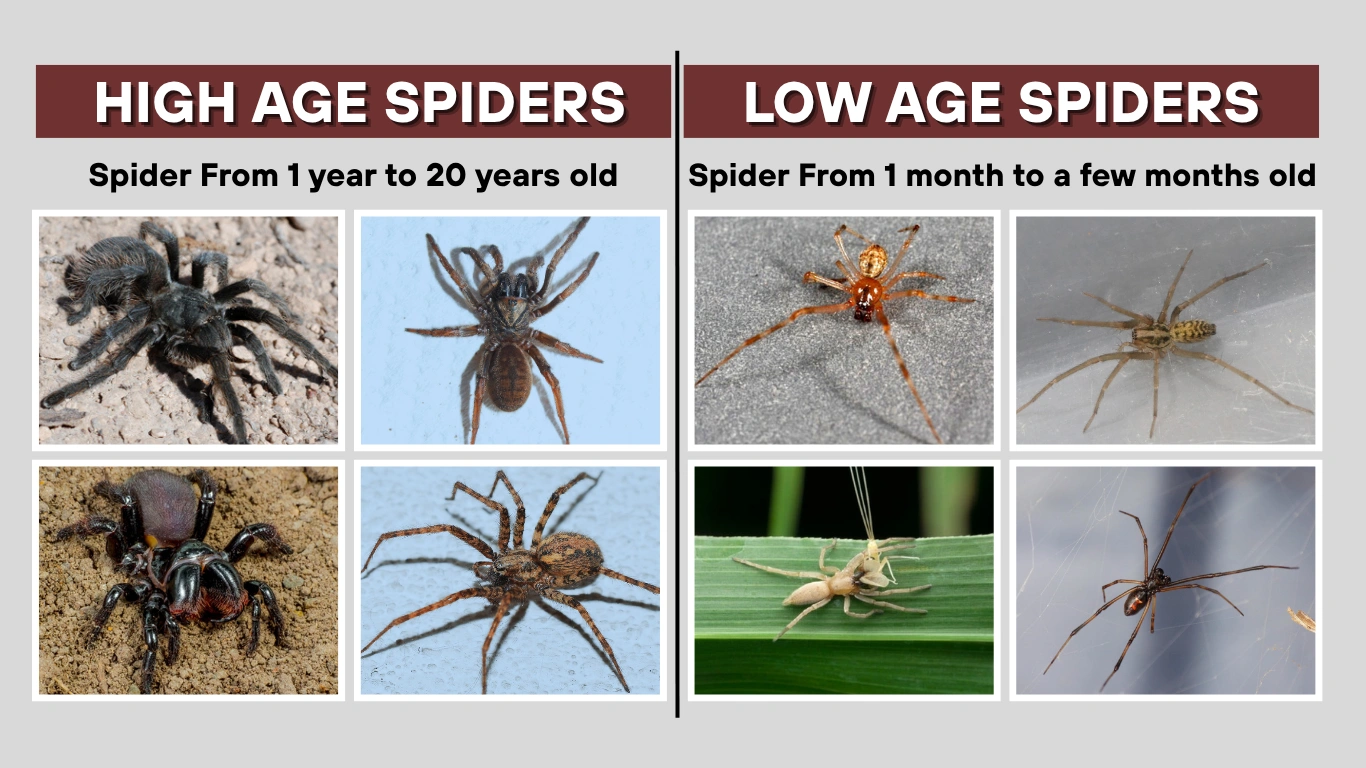
Some spiders live for just a few months—others can outlive your pet dog. Surprised? I was too. Whether you’re a spider enthusiast or just curious about that eight-legged roommate in your shed, this guide ranks 26 common spider species by lifespan. From decade-long burrowers to fast-living hunters, you’ll find out how long each one lives—and what their life cycle looks like.
1. Tarantula Lifespan

Tarantulas are large, ground-dwelling spiders known for their impressive size, hairy bodies, and long life—especially in captivity. These spiders are slow-growing, and their lifespan varies greatly between males and females. They are commonly found in warm climates across the Americas, Africa, Asia, and Australia. Here are the 16 Types of Common tarantulas.
Lifespan
Tarantulas have one of the longest lifespans among all spider species.
- Female Tarantulas can live between 15 to 25 years, and in some cases, even longer. Their longevity is due to slower maturation and extended adult life after reaching sexual maturity. Females continue to molt even in adulthood, which contributes to their extended life.
- Male Tarantulas, on the other hand, typically live only 3 to 6 years. Once they reach sexual maturity (usually after 2–5 years), they stop molting and die shortly after mating or from natural decline.
This stark contrast in lifespan is common in many spider species, but it is especially pronounced in tarantulas.
Life Stages
Egg Stage:
The female lays 50 to 200+ eggs in a silk sac and guards it for about 6 to 9 weeks until the spiderlings hatch.
Spiderling Stage:
Freshly hatched spiderlings stay near the egg sac briefly, then disperse to live independently after their first molt.
Juvenile/Subadult Stage:
During this stage, they molt multiple times as they grow. This phase can last several years for females.
Adult Stage:
Males live a short time after maturity, while females may continue to molt and reproduce for decades.
2. Trapdoor Spider Lifespan

Trapdoor spiders are burrow-dwelling arachnids known for their camouflaged trapdoor-style burrows. They are slow-growing and have surprisingly long lifespans, especially among females.
Lifespan
Trapdoor spiders are among the longest-living spiders in the wild.
- Female Trapdoor Spiders typically live 10 to 20 years, and in some rare cases, even longer. They spend most of their lives inside the same burrow, venturing out only to catch prey or mate.
- Male Trapdoor Spiders usually live 5 to 7 years. After reaching maturity, they leave their burrows in search of females, mate once, and then die shortly after.
Their sedentary lifestyle contributes to their longevity, especially in stable, undisturbed environments.
Life Stages
Egg Stage:
The female lays her eggs in a silk sac inside the burrow, where they stay safe for 6 to 8 weeks before hatching.
Spiderling Stage:
Spiderlings stay inside the mother’s burrow for a short time, then leave to dig their own small burrows.
Juvenile/Subadult Stage:
They remain hidden in burrows, molting and growing slowly over several years.
Adult Stage:
Mature females continue life in their original burrow. Males leave to mate and typically die soon afterward.
3. Mouse Spider Lifespan

Mouse spiders are robust, ground-dwelling spiders native to Australia, known for their powerful fangs and burrow-based lifestyle.
Lifespan
Mouse spiders are long-living compared to many other species.
- Female Mouse Spiders live around 10 to 15 years. They remain inside their burrows for nearly their entire lives and are rarely seen.
- Male Mouse Spiders live about 3 to 5 years, dying shortly after reaching maturity and mating.
Their long life is closely tied to their stable underground habitats and minimal movement.
Life Stages
Egg Stage:
Eggs are laid in a silk sac and kept in the burrow until hatching, usually in 6 to 7 weeks.
Spiderling Stage:
The young remain briefly in the burrow before dispersing to build their own shallow tunnels.
Juvenile/Subadult Stage:
They grow slowly in their own burrows, molting several times over a period of years.
Adult Stage:
Females rarely leave their burrows. Males mature, search for a mate, and typically die soon after mating.
4. Wolf Spider Lifespan

Wolf spiders are fast, ground-dwelling hunters found across the globe. Unlike web-building spiders, they actively chase and pounce on prey. They’re also known for their excellent vision and maternal care.
Lifespan
Wolf spiders have a moderate lifespan among spiders.
- Female Wolf Spiders generally live 1 to 3 years. They often survive through one or two breeding seasons and can live longer in captivity.
- Male Wolf Spiders live about 1 year or less, typically dying soon after reaching maturity and mating.
Their active, above-ground lifestyle exposes them to more predators and environmental threats, which can shorten their life expectancy in the wild.
Life Stages
Egg Stage:
The female carries the egg sac attached to her spinnerets for about 2 to 3 weeks, protecting it from damage and predators.
Spiderling Stage:
Once hatched, spiderlings climb onto the mother’s back and stay there for about a week before dispersing into the environment.
Juvenile/Subadult Stage:
They grow through multiple molts over several months, developing stronger legs and better hunting abilities.
Adult Stage:
Once mature, males leave their habitat in search of females and die after mating. Females continue hunting and may reproduce again.
5. Fishing Spider Lifespan

Fishing spiders are semi-aquatic hunters often found near ponds, streams, and wetlands. They can walk on water and even dive to catch prey like tadpoles and small fish.
Lifespan
Fishing spiders live relatively short lives but slightly longer than many typical house spiders.
- Female Fishing Spiders can live 2 to 3 years, depending on species and environmental conditions.
- Male Fishing Spiders live about 1 to 2 years, usually dying soon after mating.
Their habitat and predatory style expose them to both aquatic and terrestrial dangers, impacting survival rates.
Life Stages
Egg Stage:
The female carries her egg sac in her jaws and guards it carefully for about 2 weeks until the spiderlings emerge.
Spiderling Stage:
After hatching, spiderlings ride on the mother’s back briefly, then disperse to hunt on their own.
Juvenile/Subadult Stage:
They molt several times over months, gradually growing into strong, agile hunters that stalk prey along water edges.
Adult Stage:
Mature males die soon after mating. Females continue to hunt near water and may lay multiple egg sacs during their lifetime.
6. Funnel Web Spider Lifespan

Funnel web spiders are aggressive, venomous spiders found mainly in Australia. They are known for their funnel-shaped silk tunnels and highly toxic bites in some species, like the Sydney funnel-web.
Lifespan
Funnel web spiders have a moderate to long lifespan depending on gender and habitat.
- Female Funnel Web Spiders typically live 8 to 10 years, remaining in the same burrow throughout their lives.
- Male Funnel Web Spiders live around 3 to 4 years, and usually die within months after reaching maturity and mating.
Their burrow-based life helps females survive longer, while males face greater risk as they wander to find mates.
Life Stages
Egg Stage: The female lays her eggs inside her silk-lined burrow and encloses them in a secure silk sac, which she guards for about 3 to 4 weeks.
Spiderling Stage: After hatching, the spiderlings remain in the burrow for a few days, then disperse to dig their own tunnels.
Juvenile/Subadult Stage: They molt and grow slowly over several years inside their burrows, only emerging to hunt or expand their tunnels.
Adult Stage: Males leave their burrows to search for females and die soon after mating. Females continue life in the same tunnel, occasionally mating and producing more egg sacs.
7. Black Widow Spider Lifespan

Black widow spiders are famous for their shiny black bodies and red hourglass markings. Females are known for their potent venom and occasional post-mating cannibalism.
Lifespan
Black widows have a short to moderate lifespan, with females living significantly longer than males.
- Female Black Widow Spiders live around 1 to 3 years. In controlled environments, they can live even longer.
- Male Black Widow Spiders usually live less than 1 year, often dying shortly after mating.
The female’s reclusive behavior and secure web-building habits contribute to her longer survival.
Life Stages
Egg Stage: The female lays up to 400 eggs in a silken sac and guards it within her web for about 2 to 4 weeks.
Spiderling Stage: Only a small fraction of spiderlings survive, as many eat each other. Survivors disperse after their first molt.
Juvenile/Subadult Stage: They go through several molts over a few months, gradually taking on adult form and markings.
Adult Stage: Males reach maturity quickly and die soon after mating. Females continue building webs and may produce multiple egg sacs during their lifetime.
8. Brown Recluse Spider Lifespan

Brown recluse spiders are shy, nocturnal hunters known for their violin-shaped marking and necrotic venom. They prefer dark, undisturbed areas inside homes or under rocks and logs outdoors.
Lifespan
Brown recluse spiders have a moderate lifespan, with females outliving males.
- Female Brown Recluse Spiders live around 1 to 2 years, though some may survive up to 3 years in ideal conditions.
- Male Brown Recluse Spiders typically live less than 1 year, dying shortly after mating.
Their secretive nature and low-activity lifestyle help them survive for extended periods, even without frequent access to food.
Life Stages
Egg Stage: The female lays around 40–50 eggs per sac and can produce several sacs yearly. Each sac is guarded or hidden in sheltered areas for about 1 month.
Spiderling Stage: Spiderlings hatch and remain near the sac briefly before dispersing. They are independent from the start and begin hunting on their own.
Juvenile/Subadult Stage: They grow slowly, molting multiple times over several months to a year before reaching sexual maturity.
Adult Stage: Males die shortly after mating. Females may live an additional year or more, producing more eggs during this time.
9. Huntsman Spider Lifespan

Huntsman spiders are large, fast-moving arachnids commonly found in warm climates. Known for their crab-like legs and speed, they are often seen on walls, ceilings, or hiding behind objects.
Lifespan
Huntsman spiders have a relatively short to moderate lifespan.
- Female Huntsman Spiders typically live 1 to 2 years, with some species living slightly longer in captivity.
- Male Huntsman Spiders live less than 1 year, usually dying after mating.
They are free-roaming hunters that do not build webs, which exposes them to more threats but allows flexibility in habitat.
Life Stages
Egg Stage: The female lays up to 200 eggs in a flat silk sac, which she may carry under her body or hide. The incubation period lasts about 2 to 4 weeks.
Spiderling Stage: Spiderlings hatch and stay near the mother for a few days before dispersing to hunt independently.
Juvenile/Subadult Stage: They grow by molting multiple times over several months, gradually developing into agile, quick adult hunters.
Adult Stage: Males live briefly after reaching maturity. Females continue roaming and may lay several egg sacs in their lifetime.
10. Garden Orb Weaver Lifespan

Garden orb weavers are common in gardens and wooded areas. They are known for their large, intricate circular webs and passive nature, usually rebuilding their webs every evening.
Lifespan
Garden orb weavers have a short lifespan, typical of many seasonal spiders.
- Female Garden Orb Weavers usually live about 1 year, often dying after laying their final egg sac in late fall.
- Male Garden Orb Weavers live only a few months, typically dying after mating.
Their life cycle is synchronized with the seasons, which limits their lifespan to a single warm-weather cycle in most regions.
Life Stages
Egg Stage: The female lays hundreds of eggs in a silk sac, attaching it to vegetation or hidden in crevices. Eggs hatch in 2 to 4 weeks but may overwinter in colder climates.
Spiderling Stage: Tiny spiderlings disperse by ballooning—floating on silk strands through the air. Many do not survive this stage due to predators and environmental risks.
Juvenile/Subadult Stage: Survivors molt several times through spring and summer, growing into full-sized orb weavers by late summer.
Adult Stage: Males die after mating. Females live a bit longer, producing egg sacs and dying as temperatures drop.
11. Golden Silk Orb-Weaver (Banana Spider) Lifespan

Golden silk orb-weavers are known for their impressive size and golden-colored webs. Found in warm, humid climates, these spiders often hang upside down in large, symmetrical webs.
Lifespan
Golden silk orb-weavers have a lifespan similar to other seasonal orb-weaving spiders.
- Female Golden Silk Orb-Weavers live about 1 year, with their life typically ending after laying eggs.
- Male Golden Silk Orb-Weavers live a few months, often dying shortly after mating.
Their striking webs and large bodies are most visible during mid to late summer.
Life Stages
Egg Stage: The female lays several hundred eggs in a protective silk sac, usually hidden near the web. Eggs hatch in about 3 to 4 weeks.
Spiderling Stage: Hatchlings stay together briefly, then disperse to find their own spots to spin small webs.
Juvenile/Subadult Stage: They molt multiple times as they grow, becoming more colorful and larger by late summer.
Adult Stage: Males reach maturity quickly and die after mating. Females persist into fall, producing eggs before dying as the season ends.
12. Nursery Web Spider Lifespan

Nursery web spiders resemble wolf spiders but are more commonly found near vegetation close to water. They are known for their strong maternal care and ability to walk on water.
Lifespan
Nursery web spiders have a relatively short lifespan.
- Female Nursery Web Spiders live around 1 year, long enough to raise at least one brood.
- Male Nursery Web Spiders live less than 1 year, often dying shortly after mating.
Their reproductive behavior and protective instincts define much of their adult life cycle.
Life Stages
Egg Stage: The female carries the egg sac in her fangs, then spins a protective “nursery” web in foliage to guard the eggs until they hatch in about 2 to 3 weeks.
Spiderling Stage: The young remain in the nursery web for a few days under the mother’s protection, then disperse into nearby vegetation.
Juvenile/Subadult Stage: They molt several times, hunting small insects while staying near water or grassy areas.
Adult Stage: After mating, males die. Females live long enough to care for their young before dying near the end of the season.
13. Spiny Orb Weaver Lifespan

Spiny orb weavers are small, colorful spiders with spiked abdomens, often spotted in gardens and forests. Despite their fierce appearance, they are harmless to humans.
Lifespan
Spiny orb weavers live short, seasonal lives.
- Female Spiny Orb Weavers live less than 1 year, typically from spring to late fall.
- Male Spiny Orb Weavers live only a few months, dying shortly after mating.
They are most commonly seen in late summer when their webs become widespread.
Life Stages
Egg Stage: Eggs are laid in a silk sac attached to leaves or bark. They hatch in about 2 weeks, though in colder areas they may overwinter.
Spiderling Stage: The spiderlings disperse shortly after hatching, using silk threads to move with the wind.
Juvenile/Subadult Stage: They grow quickly over a few months, molting several times as they increase in size and develop distinctive spines.
Adult Stage: Males die after mating, while females lay eggs and die before winter sets in.
14. Lynx Spider Lifespan

Lynx spiders are agile, daytime hunters found in vegetation such as shrubs, flowers, and crops. They are known for their bright green or orange bodies and spiny legs.
Lifespan
Lynx spiders have a short lifespan, typical of many active hunting spiders.
- Female Lynx Spiders live less than 1 year, often from spring until late fall.
- Male Lynx Spiders live only a few months, usually dying after mating.
Their quick movements and excellent vision help them hunt efficiently during their brief lives.
Life Stages
Egg Stage: The female deposits her eggs in a silk sac attached to leaves or stems and guards it until they hatch in about 2 to 3 weeks.
Spiderling Stage: Spiderlings stay near the egg sac briefly before dispersing into surrounding plants.
Juvenile/Subadult Stage: They molt several times while actively hunting insects in the vegetation.
Adult Stage: Males die after mating. Females survive long enough to lay eggs and may produce more than one egg sac before dying with the change of seasons.
15. Green Lynx Spider Lifespan

The green lynx spider is a bright green, long-legged hunter commonly found in shrubs, gardens, and agricultural fields. It is especially valued for preying on crop pests.
Lifespan
Green lynx spiders live brief, seasonal lives.
- Female Green Lynx Spiders live about 1 year, completing their life cycle within one growing season.
- Male Green Lynx Spiders live only a few months, often dying after completing mating.
They are most visible in late summer and fall, guarding their egg sacs.
Life Stages
Egg Stage: The female lays about 100 to 300 eggs in a silken sac and suspends it on plant stems, remaining close to defend it. Hatching occurs in roughly 2 to 4 weeks.
Spiderling Stage: Newly emerged spiderlings stay near the sac briefly, then disperse to start hunting on their own.
Juvenile/Subadult Stage: They molt several times, quickly growing into active predators among flowers and leaves.
Adult Stage: Males mate and die. Females produce one or more egg sacs and die once their reproductive cycle ends.
16. Jumping Spider Lifespan

Jumping spiders are small, active hunters known for their excellent vision, curious behavior, and sudden leaping movements. They are common in gardens, homes, and forests.
Lifespan
Jumping spiders have a relatively short lifespan.
- Female Jumping Spiders typically live about 1 year, sometimes slightly longer in captivity.
- Male Jumping Spiders live less than 1 year, dying shortly after mating.
Their active, day-hunting lifestyle keeps them exposed to predators but also helps them efficiently catch prey.
Life Stages
Egg Stage: The female lays eggs in a silk sac inside a hidden retreat, such as under bark or leaves. Eggs hatch in 2 to 3 weeks.
Spiderling Stage: Spiderlings remain in the sac briefly, then leave to hunt small insects independently.
Juvenile/Subadult Stage: They molt several times over a few months, gaining the ability to leap farther and recognize visual prey.
Adult Stage: Males live short lives post-mating. Females may lay multiple sacs during the warmer months before dying.
17. Bold Jumping Spider Lifespan

The bold jumping spider, also called Phidippus audax, is one of the most recognizable jumping spiders in North America. It has a black body with white spots and iridescent green or blue chelicerae.
Lifespan
Bold jumping spiders have a short but energetic life.
- Female Bold Jumping Spiders live up to 1 year, possibly longer in captivity.
- Male Bold Jumping Spiders live less than 1 year, dying shortly after they reproduce.
Their intelligence, curiosity, and strong vision make them excellent solitary hunters.
Life Stages
Egg Stage: The female lays her eggs in a well-hidden silk sac, usually inside a curled leaf or bark crevice. The eggs hatch in about 2 to 3 weeks.
Spiderling Stage: Spiderlings stay protected in the silk nest briefly, then venture out to hunt alone.
Juvenile/Subadult Stage: They grow by molting several times, becoming bolder and more capable with each stage.
Adult Stage: Males search for mates and die shortly after. Females may produce multiple egg sacs and live slightly longer.
18. Zebra Spider Lifespan

Zebra spiders are small jumping spiders named for their black-and-white striped bodies. They are commonly found on walls, windowsills, rocks, and tree bark, often stalking prey in sunny areas.
Lifespan
Zebra spiders have a brief lifespan typical of jumping spiders.
- Female Zebra Spiders live up to 1 year, depending on environmental conditions.
- Male Zebra Spiders live a few months, generally dying shortly after mating.
Their small size and high activity levels make them efficient hunters with short life cycles.
Life Stages
Egg Stage: Eggs are laid in silk sacs placed in cracks, crevices, or under bark. The incubation period lasts about 2 to 3 weeks.
Spiderling Stage: Spiderlings remain inside the sac for a few days, then begin exploring and hunting independently.
Juvenile/Subadult Stage: They molt several times over a few months, improving their jumping precision and vision.
Adult Stage: Males die after mating. Females live slightly longer, producing multiple egg sacs during the summer.
19. Crab Spider Lifespan

Crab spiders are ambush predators that resemble crabs in appearance and movement. They often hide in flowers, waiting for prey rather than building webs.
Lifespan
Crab spiders have a short lifespan centered around seasonal flower cycles.
- Female Crab Spiders live about 1 year, often dying after laying eggs.
- Male Crab Spiders live a few months, usually perishing after mating.
Their camouflage and ambush tactics allow them to catch prey much larger than themselves.
Life Stages
Egg Stage: Eggs are deposited in a silk sac attached to leaves or petals. The mother often guards the sac until her death. Hatching occurs in about 2 to 4 weeks.
Spiderling Stage: Spiderlings stay near the sac for a short time, then begin hunting tiny insects on nearby plants.
Juvenile/Subadult Stage: They molt multiple times through spring and summer while perfecting their hunting technique.
Adult Stage: Males die after mating. Females complete one or more egg cycles before dying in late summer or fall.
20. Long-Bodied Cellar Spider Lifespan

Long-bodied cellar spiders, also known as “daddy long-legs” (not to be confused with harvestmen), are thin-legged spiders commonly found in dark, damp places like basements and sheds.
Lifespan
These spiders have a longer lifespan than most common house spiders.
- Female Long-Bodied Cellar Spiders live 1 to 2 years, sometimes longer in indoor conditions.
- Male Long-Bodied Cellar Spiders live less than 1 year, typically dying after mating.
Their preference for stable indoor environments helps extend their lifespan.
Life Stages
Egg Stage: The female carries the egg sac with her mouthparts, holding it gently until it hatches in 2 to 3 weeks.
Spiderling Stage: Once hatched, spiderlings stay in the web for a few days, then disperse nearby.
Juvenile/Subadult Stage: They grow gradually through several molts, remaining in dark, sheltered areas.
Adult Stage: Males die after mating, while females may live another year and produce multiple egg sacs.
21. Common House Spider Lifespan

The common house spider (Parasteatoda tepidariorum) is a cobweb-building species found in corners, windows, and undisturbed areas of buildings.
Lifespan
Common house spiders have moderate lifespans for web-building spiders.
- Female Common House Spiders live up to 1 year, with some surviving longer in undisturbed indoor spaces.
- Male Common House Spiders live a few months, often dying after reproduction.
Their ability to survive indoors reduces threats from predators and weather changes.
Life Stages
Egg Stage: Females lay 100–400 eggs in a round, papery sac and guard or hide it in webbed corners. Eggs hatch in about 2 to 3 weeks.
Spiderling Stage: Spiderlings remain near the web briefly, then disperse to create their own tiny webs.
Juvenile/Subadult Stage: They go through several molts over a few months, slowly expanding their webs and hunting tiny insects.
Adult Stage: Males wander in search of mates and die soon after mating. Females may produce multiple sacs over their lifetime.
22. Cobweb Spider Lifespan

Cobweb spiders, also known as comb-footed spiders, are small web builders often found in corners of homes, sheds, and under furniture. They include several species, such as the common house spider and relatives of the black widow.
Lifespan
Cobweb spiders have a short to moderate lifespan depending on species and environment.
- Female Cobweb Spiders live around 1 year, occasionally longer in stable indoor conditions.
- Male Cobweb Spiders live a few months, typically dying after mating.
Their messy, sticky webs provide shelter and help them trap small insects for food.
Life Stages
Egg Stage: The female spins a spherical egg sac that can contain 100–200 eggs. It’s usually hidden in the web and hatches in 2 to 4 weeks.
Spiderling Stage: Spiderlings stay near the web for a few days before scattering to find their own places to build.
Juvenile/Subadult Stage: They grow steadily through multiple molts, building increasingly larger webs.
Adult Stage: Males search for females and die after mating. Females may lay several egg sacs before the end of their life.
23. Tangle Web Spider Lifespan

Tangle web spiders are part of the Theridiidae family and are known for their irregular, tangled silk webs. Many species, including cobweb and comb-footed spiders, fall into this group.
Lifespan
Tangle web spiders have short lifespans similar to other small web-building species.
- Female Tangle Web Spiders live around 1 year, with some surviving longer indoors.
- Male Tangle Web Spiders live only a few months, dying after locating and mating with a female.
Their tangled webs allow them to catch prey with minimal movement, which helps conserve energy.
Life Stages
Egg Stage: The female deposits eggs in a silk sac suspended in the web. The sac holds around 100 eggs and hatches in about 2 to 3 weeks.
Spiderling Stage: Hatchlings remain in the mother’s web briefly before dispersing to build their own small webs.
Juvenile/Subadult Stage: They grow through regular molting, increasing in size and web-building skill over a few months.
Adult Stage: Males die post-mating. Females may produce multiple sacs before dying after their final breeding cycle.
24. Yellow Sac Spider Lifespan

Yellow sac spiders are small, pale-colored hunters often found indoors in corners, ceilings, or behind furniture. They do not build webs but instead create silk sacs for resting during the day.
Lifespan
Yellow sac spiders have a short, seasonal lifespan.
- Female Yellow Sac Spiders live up to 1 year, often dying after producing multiple egg sacs.
- Male Yellow Sac Spiders live only a few months, dying shortly after mating.
They are most active at night and tend to appear more frequently in homes during cooler months.
Life Stages
Egg Stage: Eggs are laid in flat silk sacs hidden in crevices or corners. Each sac contains 30–50 eggs and hatches in about 2 to 3 weeks.
Spiderling Stage: The spiderlings stay in the sac for a few days before venturing out to hunt on their own.
Juvenile/Subadult Stage: They grow quickly through multiple molts, hiding during the day in silk retreats.
Adult Stage: Males die soon after mating. Females produce several sacs and die after completing their reproductive cycle.
25. Zebra Spider Lifespan
Zebra spiders are small jumping spiders with distinctive black-and-white stripes, commonly seen hunting on sunny walls, fences, and rocks.
Lifespan
Zebra spiders have a brief, typical jumping spider lifespan.
- Female Zebra Spiders live up to 1 year, occasionally longer under protected conditions.
- Male Zebra Spiders live a few months, usually dying after mating.
Their excellent vision and active hunting behavior define their short but dynamic lives.
Life Stages
Egg Stage: The female lays eggs in a silk sac inside a hidden shelter, such as under bark or rocks. Eggs hatch in about 2 to 3 weeks.
Spiderling Stage: Spiderlings remain protected in the sac briefly, then disperse to begin hunting.
Juvenile/Subadult Stage: They molt several times, gradually becoming faster and more agile hunters.
Adult Stage: Males seek out mates and die shortly after. Females lay multiple egg sacs before dying near the end of the season.
26. Redback Spider Lifespan

The redback spider, closely related to the black widow, is known for the female’s distinctive black body with a red stripe on the abdomen. Native to Australia, they are venomous but rarely deadly due to effective medical treatment.
Lifespan
Redback spiders have a moderate lifespan, with noticeable gender differences.
- Female Redback Spiders live 1 to 2 years, often surviving multiple mating cycles and producing several egg sacs.
- Male Redback Spiders live a few months, commonly dying during or shortly after mating—sometimes being consumed by the female.
Their web-based, sedentary lifestyle helps females survive longer, particularly in sheltered environments.
Life Stages
Egg Stage: The female lays around 200–300 eggs in a round silk sac, attaching it within the web. Eggs hatch in about 2 to 4 weeks.
Spiderling Stage: Spiderlings stay in the web for a short time before ballooning away to find new locations.
Juvenile/Subadult Stage: They grow steadily, molting several times and developing the distinctive adult markings.
Adult Stage: Males die after mating, often being eaten. Females continue to live and reproduce over multiple seasons before eventually dying.
