
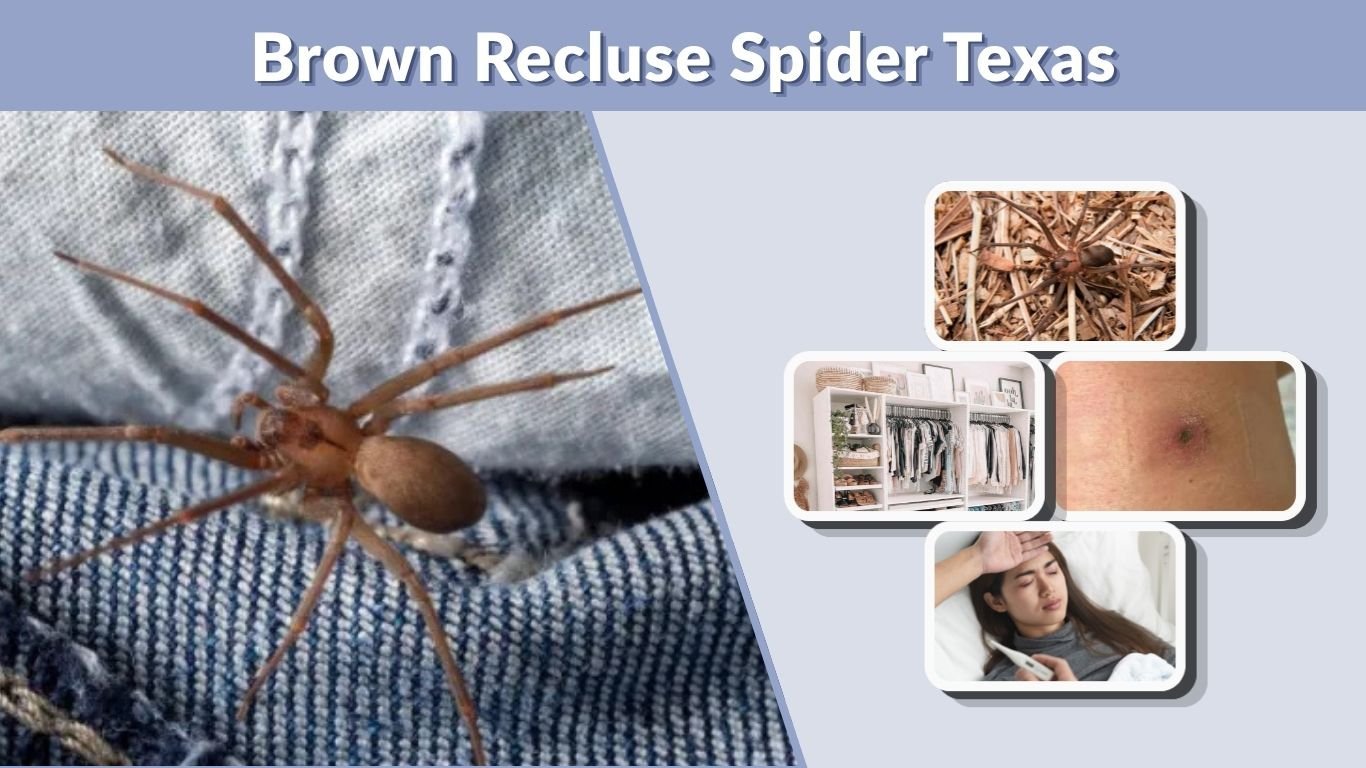
The brown recluse spider is found in Texas, but not every brown spider in a Texas home is a brown recluse. This spider is medically important, shy, and most often found in dark, quiet, undisturbed spaces such as closets, garages, attics, crawl spaces, and storage boxes. Texas also has other recluse species that look similar, so correct identification matters. If you find a suspected brown recluse, avoid handling it, use sticky traps, reduce clutter, and seek medical advice if a possible bite causes worsening symptoms.
Are Brown Recluse Spiders Found in Texas?
Yes, brown recluse spiders occur in Texas. Texas A&M’s Field Guide to Common Texas Insects says the brown recluse occurs west to Nebraska and Texas, while noting there were no records from the Lower Rio Grande Valley in that source. It also lists several other Loxosceles species recorded from Texas, including the Big Bend recluse, Texas recluse, Apache recluse, and Mediterranean recluse.
Texas Department of State Health Services broadly lists the brown recluse and black widow as Texas venomous spiders and says both can be found indoors and outdoors throughout the state. Texas A&M gives a more detailed entomology view by noting that other recluse species in Texas can be mistaken for the brown recluse.
This matters because a spider in Austin, Dallas, San Antonio, East Texas, Central Texas, West Texas, or the Panhandle may be a brown recluse or another similar recluse species. For a homeowner, the safety advice is mostly the same: do not handle it, reduce hiding places, monitor with sticky traps, and get expert identification when possible.
What Does a Texas Brown Recluse Spider Look Like?
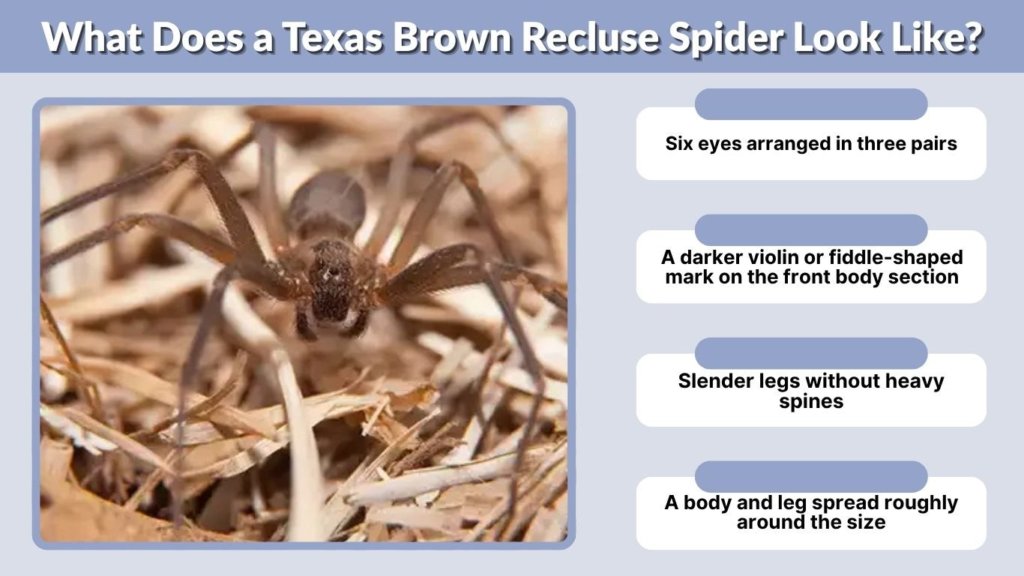
A brown recluse is usually tan, light brown, grayish brown, or golden brown. Texas A&M describes it as having slender, tapering legs and a brown violin-shaped mark on the head region. Texas DSHS also describes the spider as golden brown with a dark brown to black fiddle-shaped pattern on the head area.
Key Identification Features
The best identification features include:
- Six eyes arranged in three pairs
- A darker violin or fiddle-shaped mark on the front body section
- Slender legs without heavy spines
- A fairly plain abdomen without bold stripes or patterns
- A body and leg spread roughly around the size of a quarter to half-dollar
Texas A&M notes that two useful traits are the violin-shaped marking and the semicircular paired arrangement of six eyes. However, the violin mark alone is not enough because many brown spiders have dark markings that people mistake for a fiddle shape.
Brown Recluse Spider Pictures in Texas
Pictures can help, but they can also mislead. Lighting, camera angle, spider age, and crushed or dried specimens can make harmless spiders look like brown recluses. If you need a confident ID, take a clear top-down photo and, if safe, a close photo of the eye area. Do not risk a bite just to get a better picture.
Texas Recluse Spider vs Brown Recluse
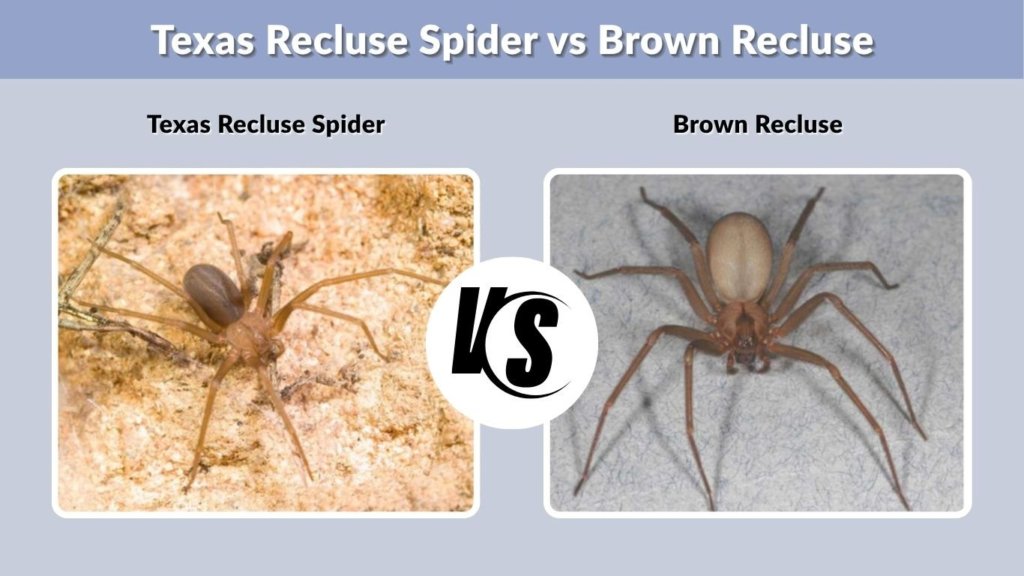
One important Texas-specific issue is that “recluse spider” and “brown recluse spider” are not always the same thing. Texas A&M states that the Texas recluse may be the most common recluse species in Texas and is often mistaken for Loxosceles reclusa, the true brown recluse. The same source also says other Texas recluse species should be considered poisonous and can look very similar.
| Spider Name | Scientific Name | Texas Note |
| Brown recluse | Loxosceles reclusa | Found in Texas and medically important |
| Texas recluse | Loxosceles devia | Found in Central and South Texas; often mistaken for brown recluse |
| Big Bend recluse | Loxosceles blanda | Reported from West Texas |
| Apache recluse | Loxosceles apachea | Recorded from Texas |
| Mediterranean recluse | Loxosceles rufescens | Found in scattered Texas locations |
For most homeowners, the exact species may not change the immediate response. Treat any suspected recluse with caution, avoid bare-hand contact, and focus on safe removal and prevention.
Where Brown Recluse Spiders Hide in Texas Homes
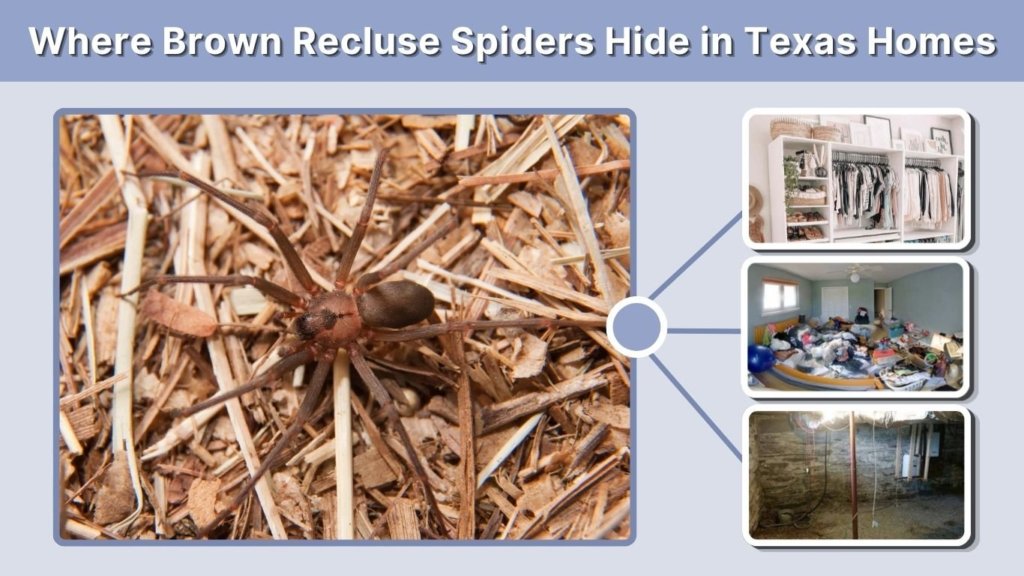
Brown recluse spiders prefer quiet, dry, dark, and undisturbed spaces. Texas A&M says they are often found under old boards, in discarded junk, and in seldom-disturbed storage areas. Indoors, they are common in cluttered closets, garages, crawl spaces, and attics.
Common hiding places include:
- Cardboard boxes
- Closets
- Garages
- Attics
- Crawl spaces
- Basements where present
- Stored clothing
- Shoes and boots
- Old towels and linens
- Woodpiles
- Behind furniture
- Under stored boards or debris
Texas DSHS also notes that brown recluses can hide between boards, boxes, old towels, and clothes in dark, undisturbed areas. This is why bites often happen when people put on stored clothing, reach into boxes, or move clutter without gloves.
Are Brown Recluse Spiders Dangerous in Texas?
Brown recluse spiders are venomous, but they are not aggressive. Texas DSHS says brown recluse spiders are not aggressive but will bite when accidentally trapped, disturbed, or threatened. Texas A&M similarly describes the spider as shy and says bites can occur when the spider is trapped in clothing or bedding.
A bite can be medically significant. Texas DSHS lists possible brown recluse envenomation symptoms such as chills, fever, nausea, necrosis at the bite site, restlessness, weakness, or sometimes no symptoms. The agency also says there is no effective antivenom for brown recluse envenomation and recommends contacting the Texas Poison Center Network or a physician for treatment information.
Most people are not bitten simply because a recluse is present. The bigger risk is accidental contact in high-touch areas such as clothing, bedding, shoes, towels, and stored items.
Texas Wolf Spider vs Brown Recluse
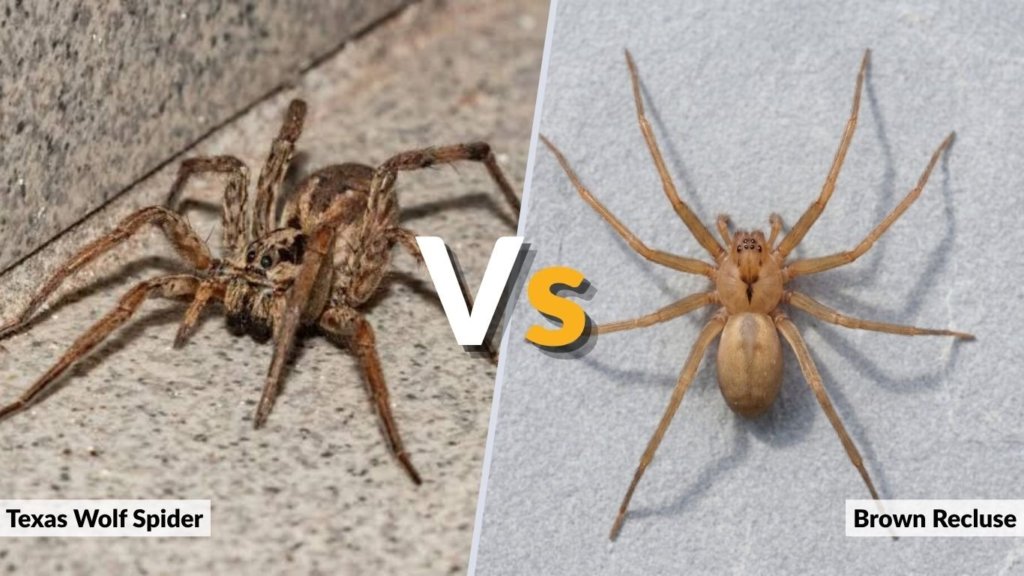
Many Texas homeowners confuse wolf spiders with brown recluses. This is understandable because both can be brown and fast-moving. However, they look and behave differently.
| Feature | Brown Recluse | Wolf Spider |
| Body appearance | Smooth-looking, plain tan to brown | Hairier, bulkier, often patterned |
| Eyes | Six eyes in three pairs | Eight eyes, with two large front eyes |
| Markings | Possible violin-shaped mark | Often stripes or mottled patterns |
| Web use | Uses small retreat webs, not prey-catching webs | Hunts actively, does not use prey web |
| Risk level | Medically important bite | Usually nuisance spider |
| Common confusion | Small brown house spider | Large brown running spider |
A wolf spider is usually more robust and hairy, while a brown recluse usually appears smoother, flatter, and less patterned. If the spider has thick hairy legs, bold stripes, or two large noticeable eyes, it is more likely to be a wolf spider than a brown recluse.
Brown Recluse Spider Bite Texas: What to Know
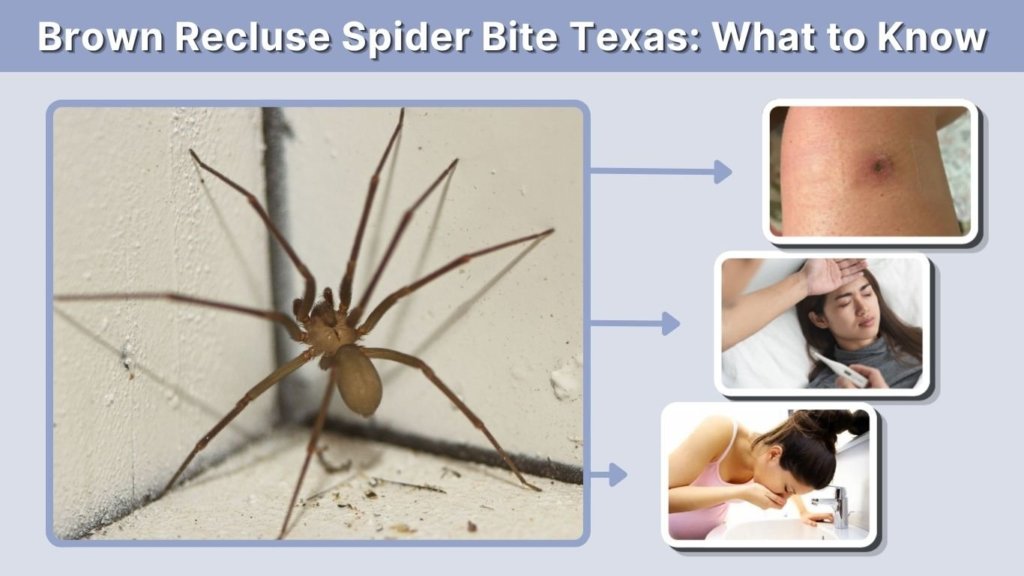
A suspected brown recluse bite should be handled carefully. Texas DSHS says all spider bites have the potential for secondary infection and should be washed thoroughly with soap and water or an antiseptic if available. It also recommends applying an ice pack for pain and swelling and contacting the Texas Poison Center Network or a family physician.
Seek medical help quickly if symptoms include:
- Increasing pain
- Fever or chills
- Nausea
- Weakness
- Spreading redness
- Blistering
- Purple, blue, gray, or black skin
- Open sore or tissue breakdown
- Signs of infection
Do not cut the bite, try to suck out venom, apply harsh chemicals, or delay care if symptoms worsen.
What to Do If You Find a Brown Recluse Spider in Texas
If you find a suspected brown recluse indoors, avoid touching it. Use a jar, vacuum, sticky trap, or broom and dustpan. If possible, preserve the spider in a sealed container for identification.
Then inspect the surrounding area. One spider may be accidental, but repeated sightings can suggest a hidden population.
| Situation | Best Action |
| One spider found indoors | Remove safely and inspect nearby clutter |
| Spider found in shoes or clothing | Shake out items and clean storage areas |
| Several spiders found | Place sticky traps along walls and near storage |
| Spiders in bedrooms | Reduce clutter, move beds from walls, inspect bedding |
| Spiders in attic or garage | Wear gloves, declutter, seal storage boxes |
| Repeated sightings | Contact a pest control professional |
Texas A&M recommends sticky cards for both monitoring and control, especially in out-of-the-way locations next to walls, in closets, and under furniture. Sticky traps help show where spiders are moving and whether control efforts are working.
How to Help Keep Brown Recluse Spiders Out of a Texas Home
Brown recluse control usually requires more than spraying. Texas A&M says well-entrenched infestations can be difficult to control and that a combination of insecticide and sanitation measures is usually required. The same source recommends reducing clutter, removing webs, vacuuming around and behind furniture, and taping stored boxes shut.
Helpful prevention steps include:
- Replace cardboard boxes with sealed plastic bins
- Tape shut stored boxes
- Keep clothing, towels, and linens off the floor
- Shake out shoes before wearing them
- Wear gloves when moving boxes, boards, or firewood
- Vacuum closets, baseboards, garages, and storage rooms
- Seal gaps around doors, windows, pipes, and utility lines
- Reduce insects such as crickets, silverfish, and cockroaches
- Keep outdoor debris and woodpiles away from the foundation
- Use sticky traps along wall edges and behind furniture
Texas A&M notes that large numbers of brown recluse spiders often mean insect prey are also abundant, including crickets, silverfish, and cockroaches. Reducing those insects makes the home less attractive to spiders over time.
Should You Spray for Brown Recluse Spiders in Texas?
Sprays alone are rarely the best answer. Brown recluses hide in cracks, wall voids, boxes, attics, crawl spaces, and protected storage areas where surface sprays may not reach. Texas A&M notes that brown recluse spiders are difficult to kill with most insecticides and that control often requires an integrated approach.
For a serious problem, pest control should include:
- Inspection
- Sticky trap monitoring
- Clutter reduction
- Prey insect control
- Targeted residual treatment
- Dust treatment in inaccessible voids when appropriate
- Follow-up monitoring
If a company only sprays baseboards without inspection, trapping, or sanitation advice, that may not be enough for a brown recluse problem.
FAQs
Is the brown recluse spider common in Texas?
Yes, brown recluse spiders occur in Texas, and related recluse species also occur in the state. Texas A&M lists several Loxosceles species recorded from Texas and notes that the Texas recluse is often mistaken for the brown recluse.
Are brown recluse spiders in Austin, Texas?
They can be found in Central Texas, but not every brown spider in Austin is a brown recluse. The Texas recluse and other lookalikes may also be present. Identification should rely on features such as six eyes in three pairs, body shape, leg structure, and overall markings.
What is the difference between a Texas recluse and a brown recluse?
The brown recluse is Loxosceles reclusa. The Texas recluse is Loxosceles devia. Texas A&M says the Texas recluse may be the most common recluse species in Texas and is often mistaken for the brown recluse.
How do I know if a Texas spider is a brown recluse?
Look for a plain tan to brown spider with slender legs, a possible violin-shaped mark on the front body section, and six eyes arranged in three pairs. Do not rely on color or the violin mark alone because many harmless Texas spiders are brown.
What should I do if I find a brown recluse in my Texas home?
Remove it safely without touching it, place sticky traps along walls and near storage areas, reduce clutter, seal storage boxes, shake out shoes and clothing, and call a professional if you find more than one or catch several on traps. If a suspected bite worsens, contact a physician or the Texas Poison Center Network.