
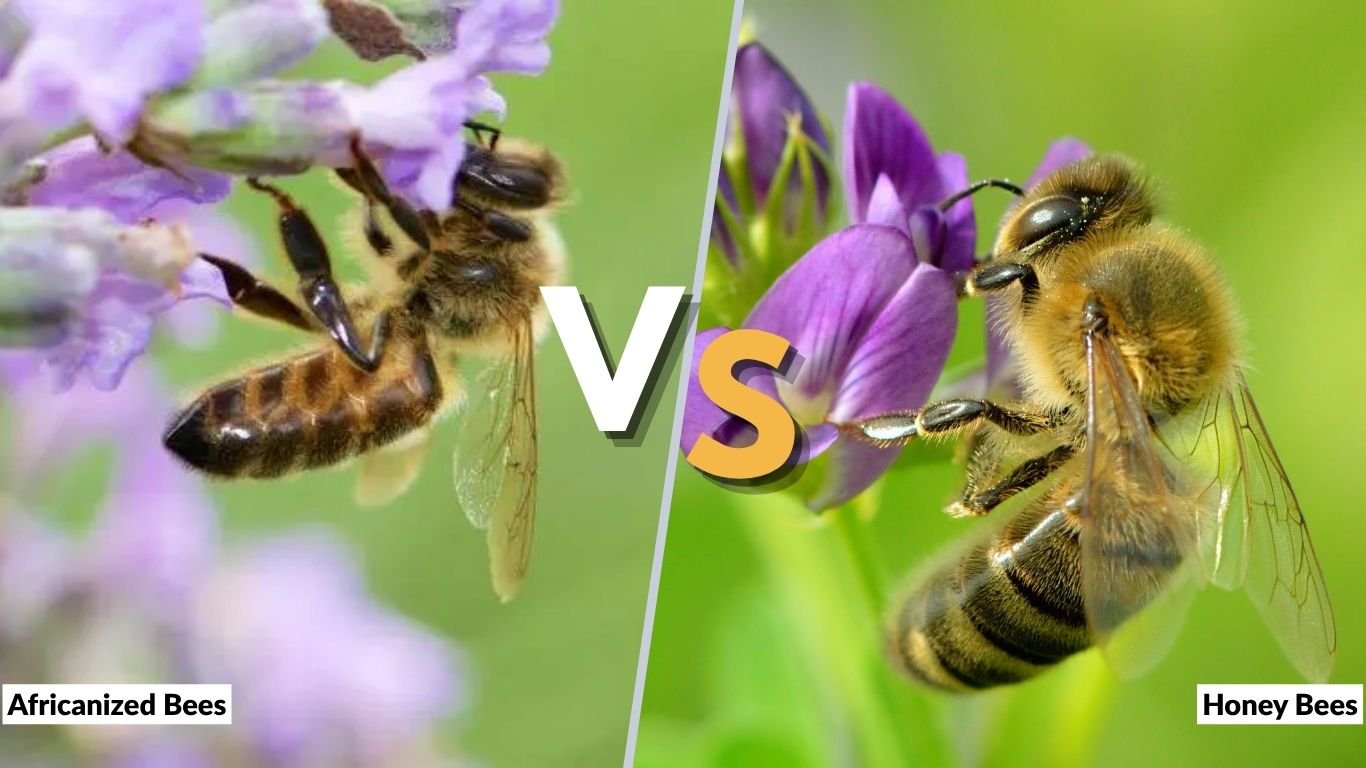
Africanized bees and regular honey bees look almost identical, but their colony behavior can be dramatically different. The comparison is slightly misleading because Africanized bees are also honey bees. More precisely, they are descendants of African and European populations of the Western honey bee, Apis mellifera. Both produce honey, pollinate flowers, live in social colonies, and possess similar venom. However, Africanized colonies defend larger areas, recruit more attacking workers, swarm more frequently, and may pursue intruders farther than commonly managed European honey bees.
Are Africanized Bees Honey Bees?
Africanized honey bees are not a separate bee species. They belong to Apis mellifera, the same species as European honey bees. Their dangerous reputation comes primarily from an intense colony-defense response—not unusual size, stronger venom, or a uniquely painful sting.
How Africanized Honey Bees Originated
African honey bees were imported into Brazil in 1956 to develop bees better suited to tropical honey production. Some colonies escaped, reproduced, and interbred with European honey bees already living in the Americas.
Their descendants spread through much of South and Central America before reaching Texas in 1990. They later became established in parts of the southern and southwestern United States. The name “Africanized” reflects their mixed ancestry, although the amount of African and European ancestry varies among colonies.
African vs. Africanized Honey Bees
African honey bees are naturally occurring Apis mellifera populations native to Africa. Africanized honey bees are their descendants or hybrids established in the Americas.
The term “killer bee” is a sensational nickname for an Africanized honey bee. It does not refer to a separate species. These bees do not hunt people, but they may respond aggressively when they interpret movement, sound, vibration, or odor as a threat to their nest.
Africanized vs. European Honey Bees
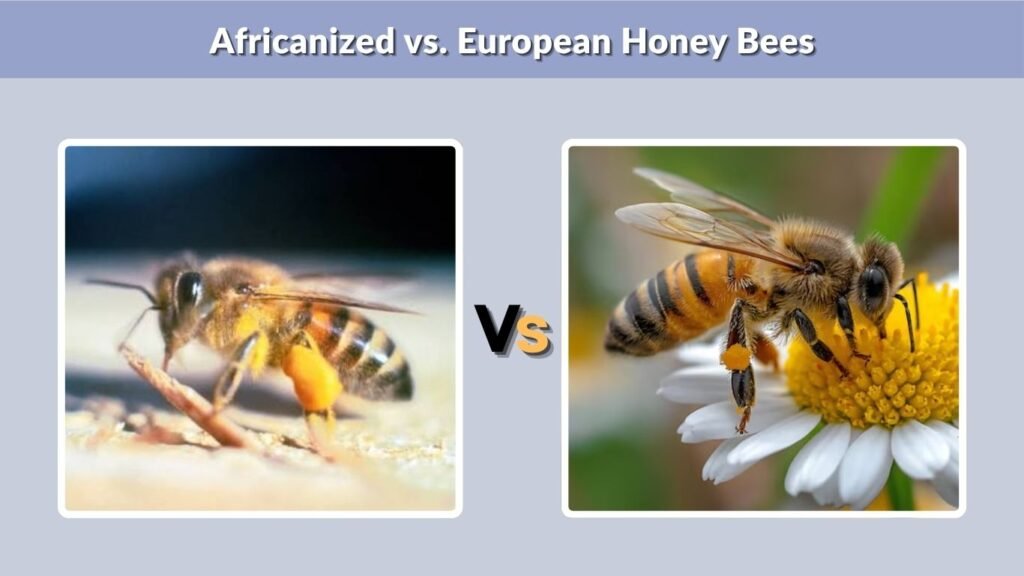
Both types share the basic anatomy and social organization of honey bees. A colony contains a queen, female workers, male drones, wax combs, brood, pollen, and honey. Their most important differences involve defensiveness, nesting, swarming, migration, and suitability for managed beekeeping.
Quick Comparison
| Feature | Africanized Honey Bee | European Honey Bee |
| Species | Apis mellifera | Apis mellifera |
| Average size | Slightly smaller | Slightly larger |
| Appearance | Golden-brown with dark bands | Golden-brown with dark bands |
| Venom strength | Similar | Similar |
| Colony defense | Rapid and intense | Usually more restrained |
| Number of defenders | Often hundreds or more | Usually fewer |
| Pursuit behavior | May follow intruders farther | Usually stops sooner |
| Swarming | More frequent | Less frequent |
| Absconding | Relatively common | Less common |
| Nest cavities | Uses small and unusual spaces | Prefers larger cavities |
| Honey storage | Often stores less surplus | Usually stores more surplus |
| Cold tolerance | Generally lower | Generally higher |
| Manageability | More difficult | Commonly selected for gentleness |
Individual colonies vary. A defensive European colony can still be dangerous, while an undisturbed Africanized swarm may appear temporarily calm.
Identification and Wing Differences
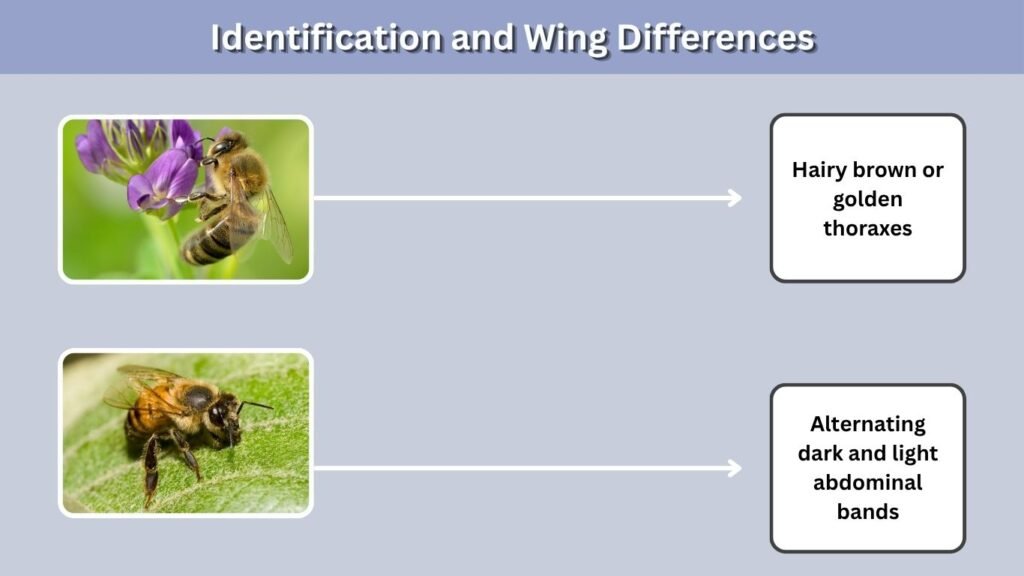
Africanized and European honey bees cannot be reliably separated by color, markings, or a casual size comparison. Africanized workers are slightly smaller on average, but the difference is usually too small for a person to see accurately.
Shared Physical Features
Both generally have:
- Hairy brown or golden thoraxes
- Alternating dark and light abdominal bands
- Two pairs of transparent wings
- Pollen baskets on the hind legs
- Elbowed antennae
- Barbed worker stingers
- Similar body shapes and flight behavior
An unusually dark, small, or defensive bee is not automatically Africanized. Color and size vary within both populations.
Can Wing Veins Identify Africanized Bees?
Specialists can measure wing length, wing-vein angles, legs, and small exoskeletal structures using standardized laboratory methods. DNA testing may also reveal ancestry.
A person cannot confirm Africanization by looking at wing veins in a photograph. Professionals usually examine samples from an entire colony because one worker’s measurements may overlap with those of European bees. The University of Arkansas Extension notes that minute anatomical measurements or DNA testing are required for confirmation.
Behavior and Nesting Differences

Africanized honey bees evolved under conditions involving frequent predation, competition, and seasonal food shortages. Colonies that reacted quickly, reproduced frequently, and moved when resources disappeared were more likely to survive. These characteristics remain noticeable in Africanized populations in the Americas.
Colony-Defense Response
Compared with commonly managed European bees, Africanized colonies may:
- Detect disturbance sooner
- Maintain more guard bees
- Defend a larger area around the nest
- Release more workers during an attack
- Respond strongly to noise and vibration
- Remain agitated longer
- Pursue people or animals farther
The bees release alarm pheromones when they sting. These chemical signals recruit additional workers and mark the perceived threat, allowing an attack to escalate rapidly.
Swarming and Nest Locations
Africanized colonies swarm more frequently, allowing them to establish new colonies quickly. They are also more likely to abscond, meaning the entire colony abandons its nest after food shortages, repeated disturbance, or environmental stress.
They may occupy surprisingly small locations, including:
- Water-meter boxes
- Hollow trees
- Wall cavities
- Roof spaces
- Abandoned tires
- Drainage pipes
- Utility equipment
- Empty containers
- Underground animal burrows
European honey bees typically favor larger cavities with enough room for substantial honey storage. However, either type can nest inside buildings or trees.
Sting and Venom Differences
An individual Africanized bee sting is not significantly more venomous or painful than a European honey bee sting. The greater danger comes from receiving numerous stings during a coordinated colony attack.
Why Africanized Bee Attacks Are Dangerous
Africanized colonies may send hundreds of defenders, while a less-defensive managed colony might release only a small group. Therefore, the victim receives a much larger total dose of venom.
Both types have barbed stingers. When a worker stings a person or another thick-skinned mammal, the stinger commonly remains embedded, tearing away from the bee and causing it to die. The attached venom sac may continue delivering venom after the bee leaves.
The University of Florida IFAS confirms that Africanized honey bee venom is not more potent; their danger results from the stronger collective defense response.
What to Do During an Attack
- Run quickly toward an enclosed building or vehicle.
- Cover your face, eyes, nose, and mouth while escaping.
- Do not stop to swat individual bees.
- Do not attempt to collect belongings.
- Help children or people with limited mobility reach shelter.
- Close doors and windows after entering.
- Call emergency services after a serious mass-stinging event.
Once safely sheltered, remove visible stingers promptly. Wash affected areas with soap and water and apply a cold pack to reduce swelling.
Difficulty breathing, swelling of the tongue or throat, widespread hives, faintness, confusion, vomiting, or numerous stings requires emergency medical care. Even one sting can cause anaphylaxis in someone with a severe allergy.
Honey and Pollination Comparison
Africanized and European honey bees collect nectar and convert it into honey through the same biological process. Africanized bee honey is not naturally poisonous, stronger, or more aggressive-making than ordinary honey.
Is Africanized Bee Honey Safe?
Properly harvested and stored Africanized honey is edible. Its flavor, color, and aroma primarily depend on the flowers visited, not whether the colony is Africanized or European.
Africanized colonies can produce valuable honey in tropical environments. However, frequent swarming, absconding, smaller food stores, and defensive behavior make them more difficult to manage commercially. European strains are generally preferred because beekeepers have selectively bred them for gentleness, honey storage, and hive stability.
Both types are effective pollinators. Workers carry pollen among flowers while collecting nectar and pollen for their colonies.
Africanized Bees vs. Wasps and Hornets
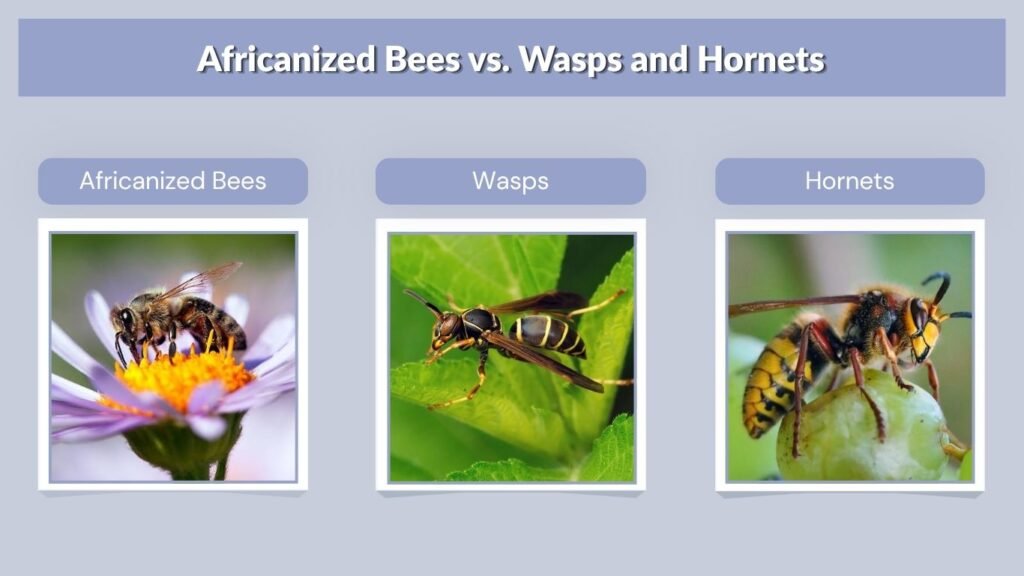
Africanized bees are sometimes confused with yellow jackets or hornets, but these insects belong to different groups.
Important Differences
Africanized honey bees have hairy bodies, collect pollen, make wax combs, and usually die after stinging a person. Yellow jackets have smoother, brighter bodies and can sting repeatedly. Hornets are generally larger wasps with powerful jaws and reusable stingers.
The Asian or northern giant hornet is not a type of Africanized bee. It is a predatory wasp capable of attacking honey bee colonies. Its large body makes it easy to distinguish from either Africanized or European honey bees.
FAQs
Are Africanized bees the same as killer bees?
Yes. “Killer bee” is a sensational nickname commonly applied to Africanized honey bees.
Can you identify an Africanized bee by sight?
No. Africanized and European workers look nearly identical. Reliable confirmation requires professional measurements, genetic testing, or both.
Is an Africanized bee sting more venomous?
No. Its venom is comparable to European honey bee venom. Africanized colonies are more dangerous because they may deliver many more stings.
Is Africanized honey different from regular honey?
No major difference is caused by the bees’ ancestry. Honey characteristics depend mostly on floral sources, processing, and storage.
What should I do if I find a suspected colony?
Keep people and pets away, avoid vibrations near the nest, and contact a qualified bee-removal professional. Do not spray, burn, strike, or block the entrance yourself.
