
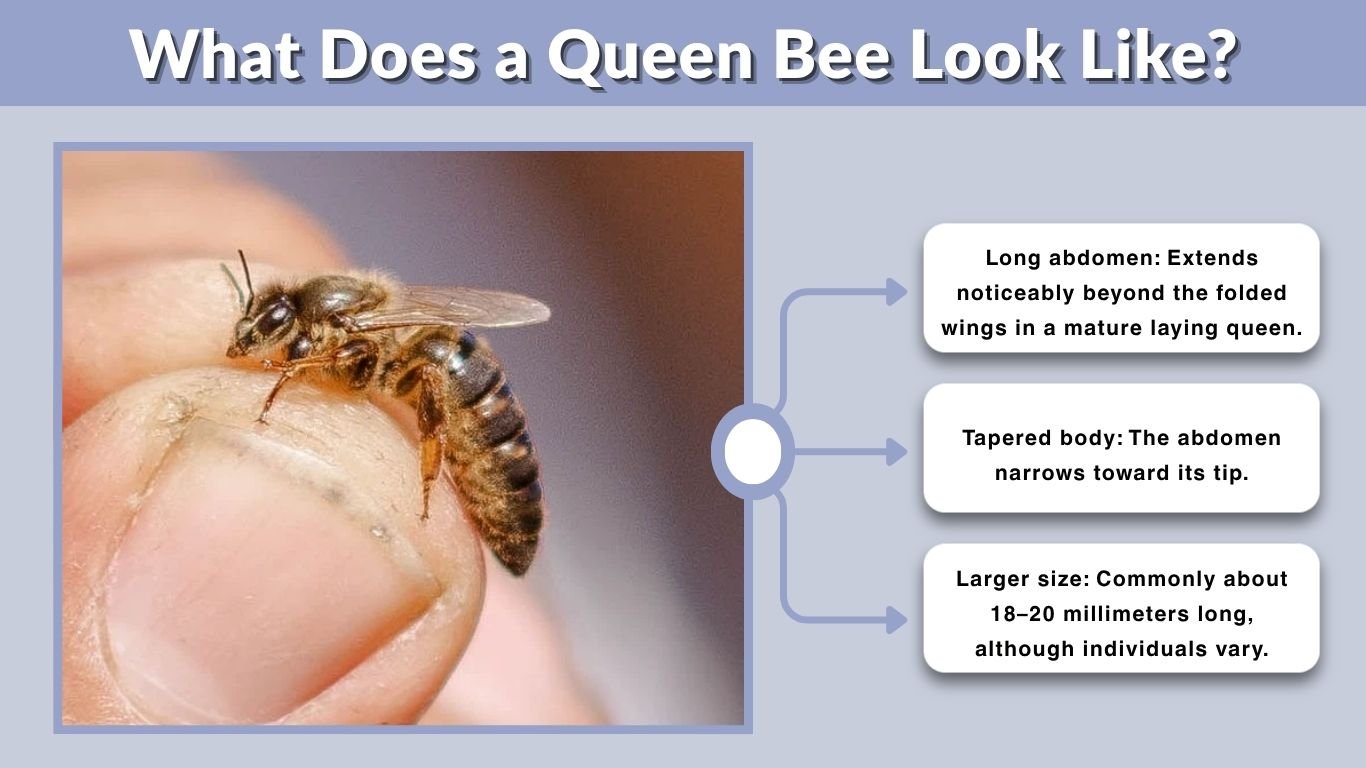
A queen honey bee usually looks longer and more slender than the workers surrounding her. Her most noticeable feature is an elongated abdomen that extends beyond the tips of her folded wings. She may be golden, brown, or nearly black, so color alone is not a reliable identification clue. However, not every queen bee resembles a honey bee queen. Bumblebee queens are rounder and fuzzier, while many solitary bees have no queen caste at all. Understanding these differences makes identification much easier.
What Does a Queen Honey Bee Look Like?
Most people asking about a queen bee mean the queen of a western honey bee colony, Apis mellifera. She has the same basic body parts as other honey bees, but different proportions give her a distinctive outline.
Main Identification Features
- Long abdomen: Extends noticeably beyond the folded wings in a mature laying queen.
- Tapered body: The abdomen narrows toward its tip.
- Larger size: Commonly about 18–20 millimeters long, although individuals vary.
- Relatively short-looking wings: They cover less of her abdomen than a worker’s wings do.
- Smoother-looking abdomen: Often appears less fuzzy than the surrounding workers.
The long abdomen is usually more useful than simply searching for the biggest bee.
Is a Queen Bee Always Golden?
No. Queens can have light, dark, or mixed coloration depending on their ancestry and individual variation. A queen may also look different from some workers in her colony.
Do not assume that the palest bee, darkest bee, or bee with the clearest stripes must be the queen. Body proportions provide a better starting point.
Queen Bee vs. Worker Bee vs. Drone
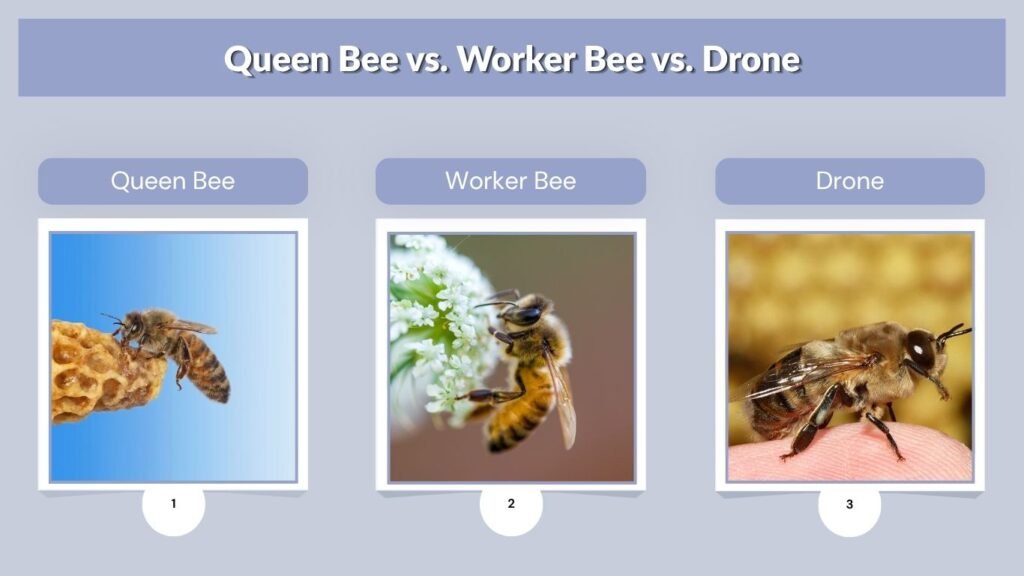
A honey bee colony contains queens, workers, and male bees called drones. Beginners sometimes mistake drones for queens because drones are noticeably larger and bulkier than workers.
Quick Visual Comparison
| Feature | Queen | Worker | Drone |
| General shape | Long and tapered | Smaller and compact | Broad and stocky |
| Abdomen | Elongated in a laying queen | Shorter | Broad with a rounded end |
| Eyes | Smaller than a drone’s | Smaller than a drone’s | Very large |
| Sex | Female | Female | Male |
| Main role | Egg laying | Colony work and foraging | Mating with queens |
A broad bee with enormous eyes is more likely to be a drone than a queen. The queen’s distinctive feature is her length, especially behind the wings.
What Does a Queen Bee Look Like in a Hive?
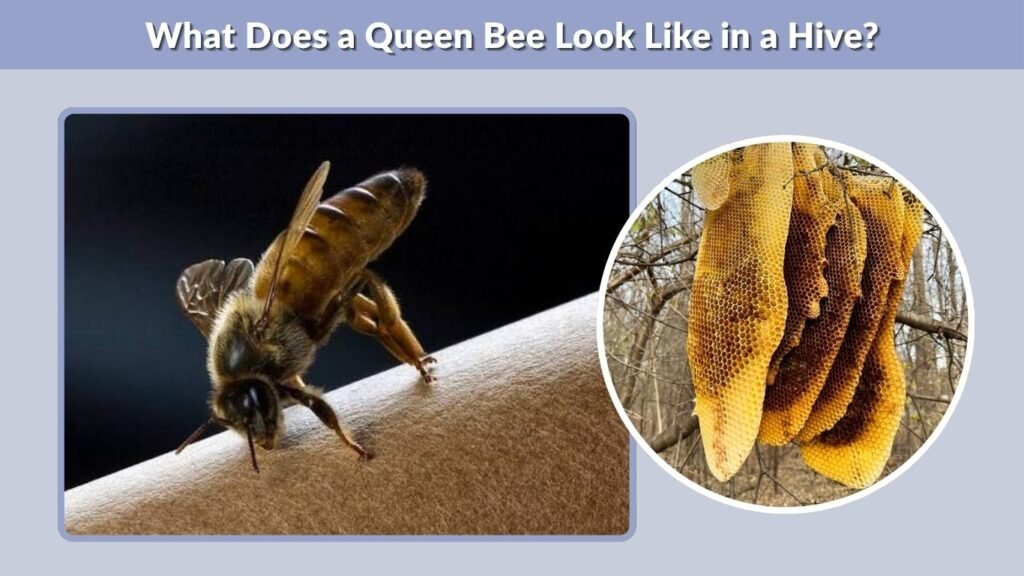
Inside a crowded hive, the queen can be partly hidden beneath workers. Her appearance also changes with viewing angle, making a single overhead photograph less informative than several clear views.
Clues When Looking at Honeycomb
During an appropriate inspection by a trained beekeeper:
- Scan for an unusually long abdomen among the shorter workers.
- Check body shape rather than focusing only on color.
- Look for workers attending and facing one particular bee.
- Remember that attendants do not always form an obvious circle.
- Avoid assuming that failure to spot her means the colony has no queen.
A mature queen may move steadily across the comb while workers feed or groom her. Newly emerged queens can behave differently and be much harder to locate.
Why Do Some Queens Have Colored Dots?
A bright dot on the queen’s back is usually a beekeeper’s identification mark. It is placed on the thorax, the middle body section where the wings attach.
The mark makes her easier to find and may indicate the year she was reared. It is not a natural feature, and many queens are unmarked.
What Does a Virgin Queen Bee Look Like?
A virgin queen is an adult queen that has not yet mated. She already has wings, legs, and the general shape of a queen, but she may not resemble the large, long-abdomened individual shown in familiar beekeeping photographs.
Differences From a Laying Queen
Virgin queens generally have shorter, thinner abdomens than established laying queens. Some are only slightly larger than workers.
They may move rapidly across the comb and lack a conspicuous group of attendants. Their smaller appearance makes identification more difficult. As a queen matures and begins laying, her abdomen typically becomes more developed.
What Do Queen Bee Cells, Eggs, and Larvae Look Like?
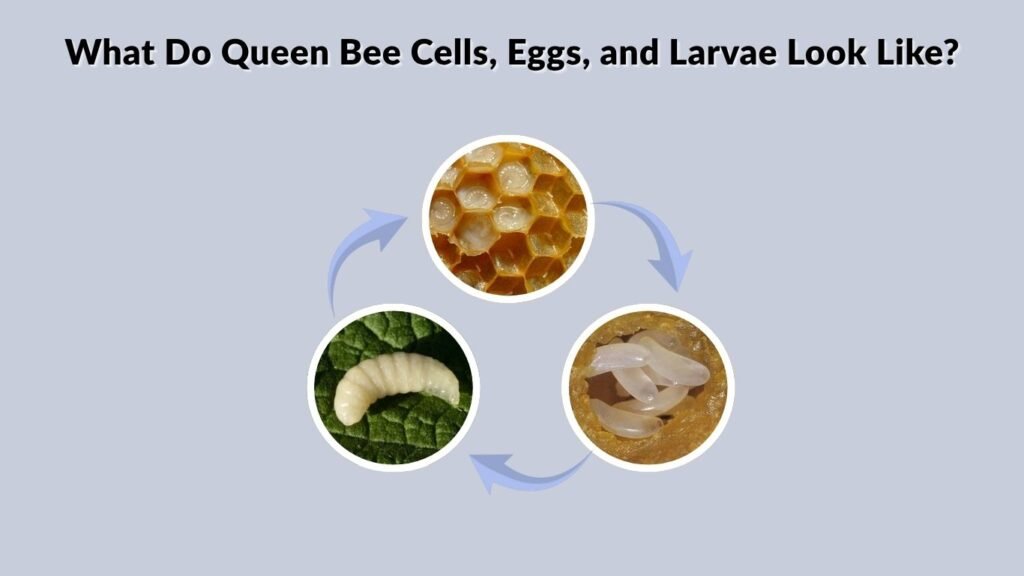
A developing queen does not begin as a miniature winged bee. Honey bees undergo complete metamorphosis, passing through egg, larval, and pupal stages before emerging as adults.
Queen Cells
A developed honey bee queen cell is an elongated wax structure, often compared with a peanut shell. It generally hangs downward and projects beyond the surrounding comb.
Queen cells may occur along comb edges or on the comb’s surface. Their location alone does not provide a complete explanation of what the colony is doing.
Queen Eggs and Larvae
An egg that will produce a queen looks like other fertilized honey bee eggs: tiny, pale, and elongated. It does not have a visible “queen” marking.
After hatching, the larva is pale, soft, legless, and curved. Workers provide the feeding and rearing conditions that allow it to develop into a queen. Queens and workers originate from the same type of fertilized female egg; they are not distinguished by a special egg shape.
What Does a Queen Bumblebee Look Like?
A queen bumblebee usually looks like a larger version of a worker of her species. Unlike a honey bee queen, she is generally rounded, robust, and densely hairy rather than conspicuously long and slender.
Useful Identification Clues
Queens are usually larger than their own species’ workers, but size overlaps between different bumblebee species. A large bumblebee is therefore not automatically a queen.
Color patterns vary widely. Some species have yellow bands and white tails; others have red tails or mostly ginger hair. In temperate regions, large bumblebees seen searching for nest sites in spring are often queens.
What Does a Queen Carpenter Bee Look Like?
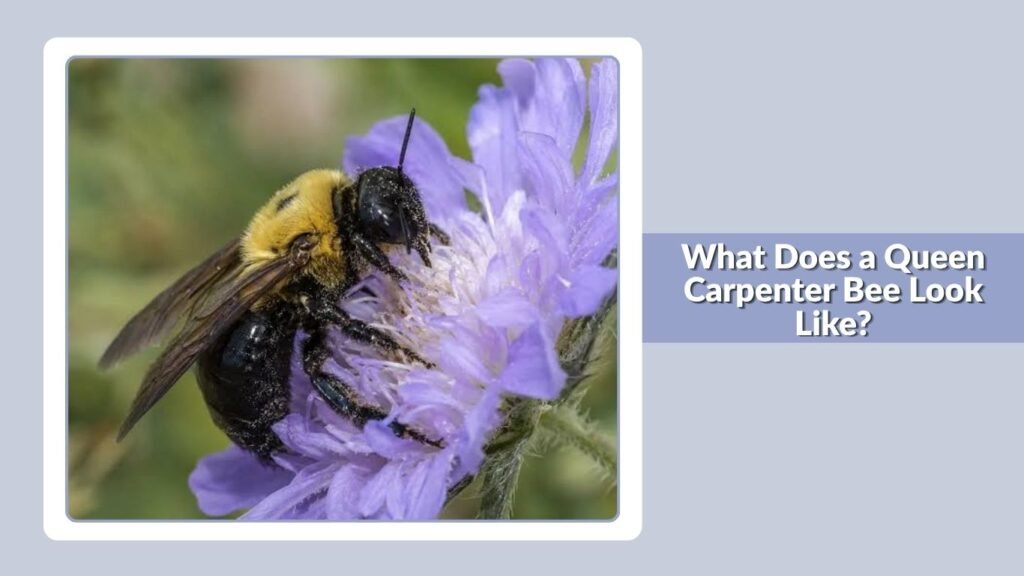
For familiar large carpenter bees, “queen” is usually the wrong identification category. They do not have the same distinct queen-and-worker caste system as honey bees, although some species can share nests or show social behavior.
Female Carpenter Bee vs. Queen Bee
The bee excavating a wooden tunnel is generally a nesting female, not a special queen with a different body shape.
Common large carpenter bees often have a shiny, relatively hairless upper abdomen, unlike the densely hairy abdomen of a bumblebee. Exact markings depend on species, so a shiny abdomen is a supporting clue rather than a universal rule.
What Does a Yellowjacket or Hornet Queen Look Like?
Yellowjackets, hornets, and paper wasps are wasps—not bees. They can have queens, but calling one a “queen bee” mixes together different insect groups.
Yellowjacket Queens
Yellowjacket queens are generally larger than workers and have smoother-looking bodies than honey bees. Most have contrasting yellow-and-black markings, although colors vary.
Southern yellowjacket queens are a notable exception: their abdomens can be predominantly orange-yellow with reduced black markings. Identifying the species is important before using color to identify its queen.
Hornet and Paper Wasp Queens
Hornet queens usually resemble larger, more robust workers of their species. Their colors are species-specific.
Paper wasp queens may be very difficult to distinguish from workers by appearance alone. Long legs and a narrow waist identify the general wasp shape, not queen status. Observe from a distance rather than handling an insect or disturbing its nest.
FAQs
These answers address common uncertainties about queen bee appearance.
What Is the Easiest Way to Recognize a Honey Bee Queen?
Look for a long, tapered abdomen extending beyond her folded wings. Confirm the body shape rather than relying only on size or color.
Does Every Queen Bee Have a Colored Dot?
No. Beekeepers add those marks. An unmarked queen is completely normal.
Can Queen Bees Fly?
Yes. Honey bee queens fly during mating flights and can leave with swarms. Their short-looking wings do not mean they are flightless.
What Does a Ground Bee Queen Look Like?
“Ground bee” describes where a bee nests, not one species. Many ground-nesting bees are solitary and have no queen caste; ground-nesting bumblebees do have queens.
Can You Identify a Queen From One Photograph?
Sometimes, especially with a clear side or overhead view. However, a hidden abdomen, poor scale, or a virgin queen can make confident identification impossible.
