
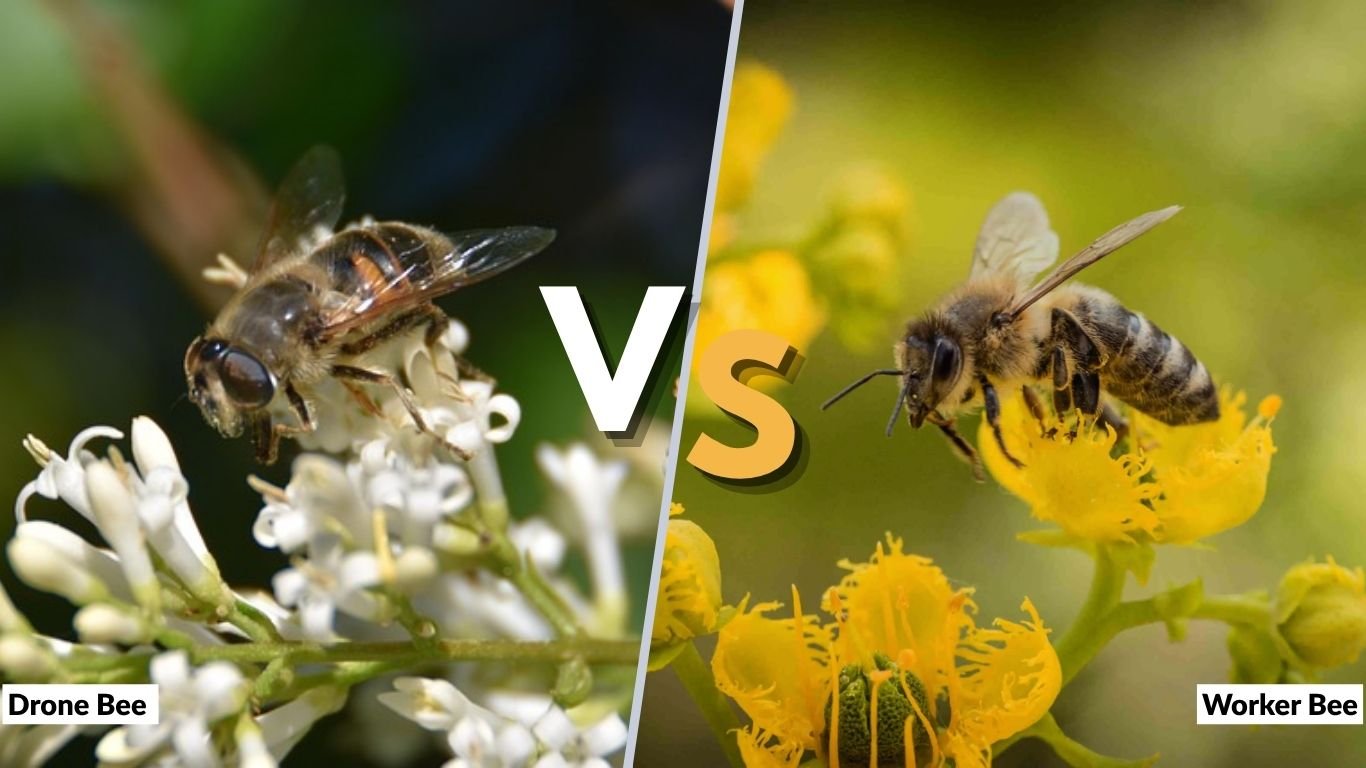
A drone bee and worker bee may live in the same honey bee colony, but they have completely different roles. Drones are male honey bees whose primary biological function is to mate with virgin queens, while workers are female bees responsible for nearly everything needed to keep the colony alive. Workers collect food, care for larvae, build comb, regulate hive temperature, clean the nest, and defend it. Drones are also larger, have much bigger eyes, and lack the worker’s stinger. Understanding these differences makes identifying honey bee castes much easier.
Drone Bee vs Worker Bee: Key Differences
A healthy honey bee colony contains three adult castes: workers, drones, and usually one queen. Workers make up most of the population, while drones are normally present in much smaller numbers and are especially common during the reproductive season.
Quick Comparison
| Feature | Drone Bee | Worker Bee |
| Sex | Male | Female |
| Main role | Mate with queens | Maintain the colony |
| Body | Broad and stocky | Smaller and slimmer |
| Eyes | Extremely large | Smaller |
| Stinger | None | Present |
| Egg origin | Unfertilized | Fertilized |
| Development | About 24 days | About 21 days |
| Collects pollen | No | Yes |
| Makes wax comb | No | Yes |
| Defends hive | No | Yes |
| Mates | Yes | Normally no |
Honey bee drones develop from unfertilized eggs, whereas normal workers develop from fertilized eggs.
What Does a Drone Bee Look Like?
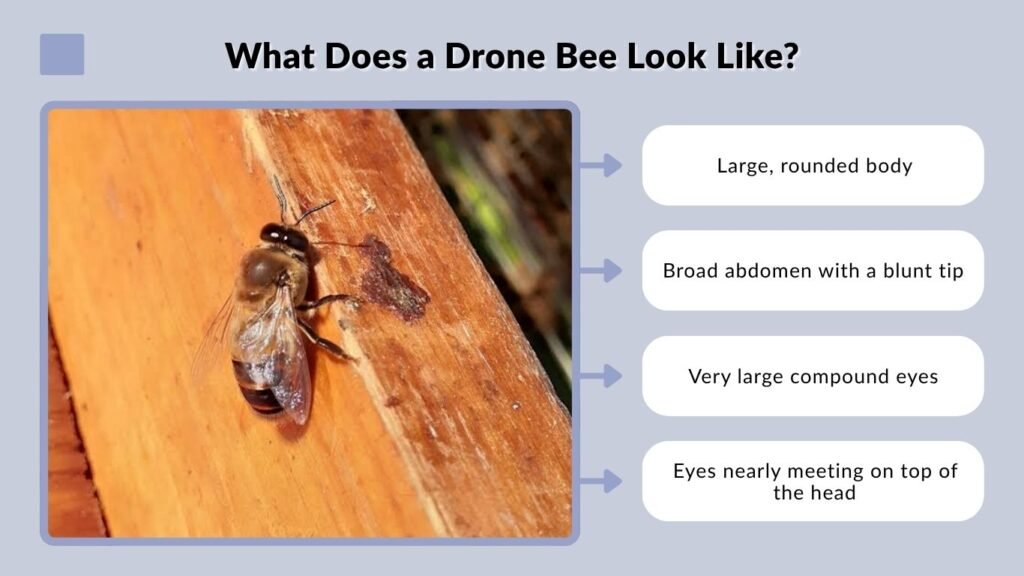
Drones are easy to recognize once they are compared directly with workers. Their bodies are wider and heavier, and their enormous compound eyes dominate the head.
The large eyes are particularly useful because drones must locate flying virgin queens during mating flights.
Drone Bee Identification
Look for:
- Large, rounded body
- Broad abdomen with a blunt tip
- Very large compound eyes
- Eyes nearly meeting on top of the head
- Thick thorax
- No pollen baskets
- No functional stinger
- Larger appearance than worker bees
The University of Missouri notes that drones have large heads and thoraxes, large eyes that nearly meet at the top, and blunt abdomens without stingers.
What Does a Worker Bee Look Like?
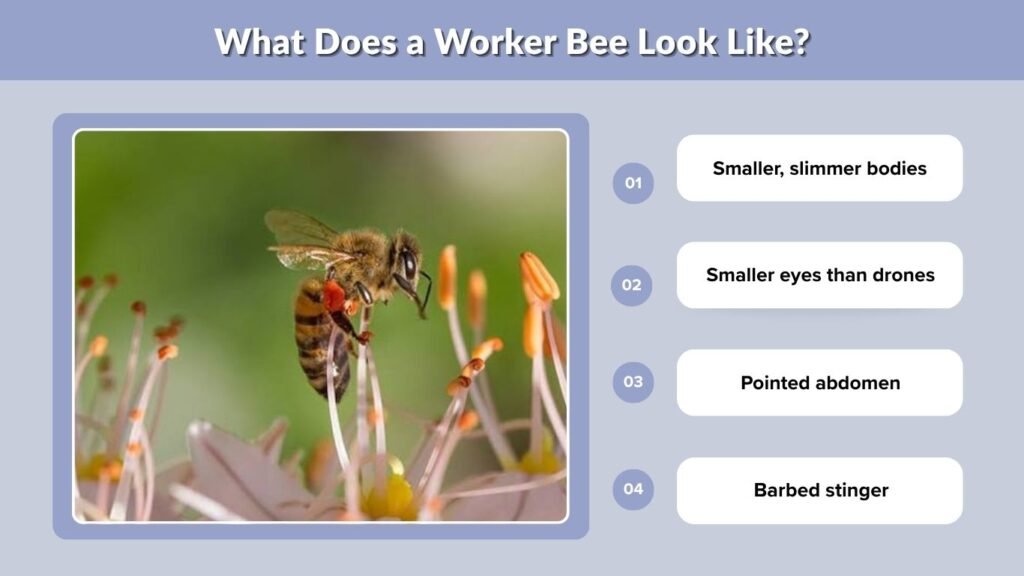
Worker honey bees are the smallest adult caste in a typical colony. Although they are female, they usually do not reproduce while a healthy queen is present.
Their bodies are specialized for the enormous variety of tasks required to maintain a colony.
Worker Bee Identification
Workers typically have:
- Smaller, slimmer bodies
- Smaller eyes than drones
- Pointed abdomen
- Barbed stinger
- Pollen baskets on the hind legs
- Wax-producing glands
- Specialized structures for collecting pollen and nectar
A worker’s appearance changes little as she ages, but her job within the colony changes considerably.
What Is the Job of a Drone Bee?
The primary reproductive function of a drone is to mate with a virgin queen.
Drones do not normally gather pollen, forage for nectar, produce wax comb, clean cells, care for brood, or defend the colony.
What Do Drone Bees Do?
Their activities primarily include:
- Eating food supplied within the colony
- Flying from the hive
- Gathering in drone congregation areas
- Searching for virgin queens
- Attempting to mate during queen mating flights
Successful mating is fatal to the drone. Colorado State University Extension notes that drones die after reproducing.
Although an individual drone performs relatively little hive maintenance, reproduction is essential because drones transfer genes between colonies.
What Is the Job of a Worker Bee?
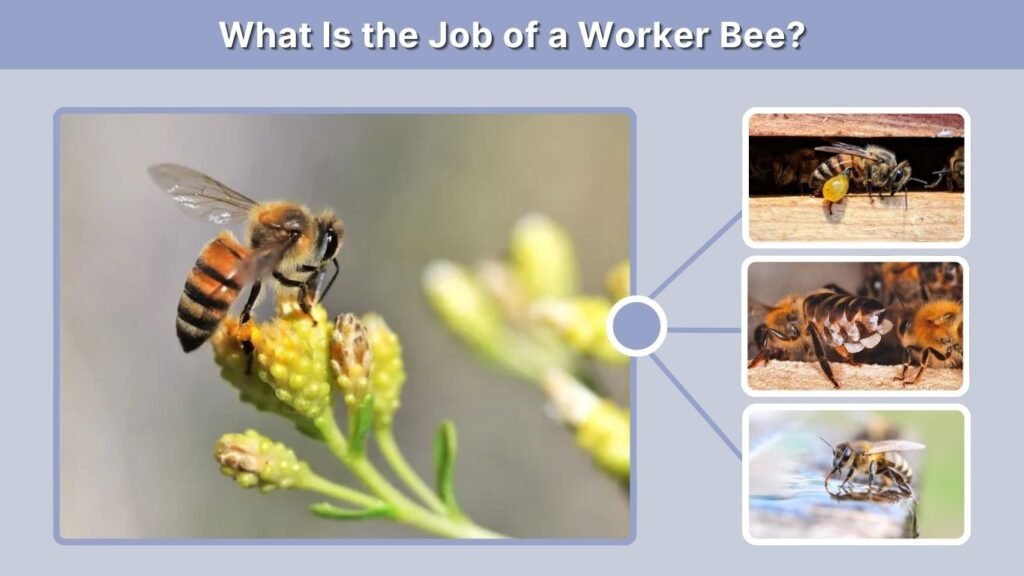
Workers perform almost every task necessary for colony survival.
Their responsibilities change as they age, a system known as age-related division of labor.
Worker Bee Jobs
Workers may:
- Clean empty cells
- Feed developing larvae
- Attend and feed the queen
- Produce wax
- Build honeycomb
- Store nectar and pollen
- Process nectar into honey
- Remove dead bees and debris
- Guard the entrance
- Ventilate and cool the colony
- Collect water
- Gather propolis
- Forage for nectar and pollen
Young workers generally work inside the hive. Older workers eventually become guards and foragers. Utah State University describes workers progressing from cell cleaning and nursing to comb work, guarding, and finally foraging.
Are Drones Bigger Than Worker Bees?
Yes. Drone honey bees are noticeably larger and broader than workers.
Workers are the smallest caste. Drones have particularly large heads and thick bodies, while queens are generally the longest bees because of their greatly elongated abdomens.
The Eyes Are an Easy Clue
Size can vary somewhat between colonies, so the eyes provide an even better identification clue.
A drone’s compound eyes are enormous and nearly touch at the top of its head.
Worker eyes remain clearly separated.
If you see a chunky honey bee with unusually huge eyes and no obvious pointed abdomen, it is probably a drone.
Drone Brood vs Worker Brood
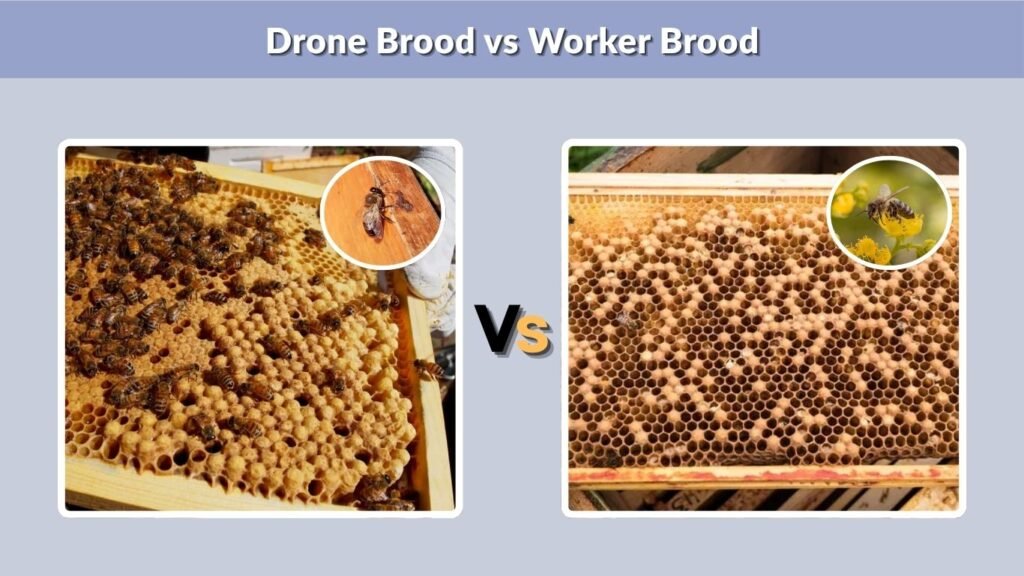
You can also distinguish drones and workers before they emerge as adults.
Workers and drones develop inside different-sized brood cells because drones are larger.
Drone vs Worker Brood
Worker brood typically has:
- Smaller cells
- Relatively flat or gently raised caps
- Large continuous areas across brood combs
Drone brood typically has:
- Larger cells
- Strongly domed cappings
- A raised, rounded appearance
- Frequent concentration near the edges of brood areas
Drone brood takes approximately 24 days to develop from egg to adult, compared with approximately 21 days for workers.
Drone Bee vs Worker Bee Stinger
One major difference is straightforward: worker bees can sting, drones cannot.
Do Drone Bees Sting?
No. Male honey bees do not have a stinger.
The bee stinger evolved from a female egg-laying structure called an ovipositor. Since drones are males, they lack this structure.
Worker bees are females and have barbed stingers used primarily to defend the colony.
Therefore, a large drone buzzing around you may appear intimidating, but it cannot sting.
Drone Bee vs Worker Bee Lifespan
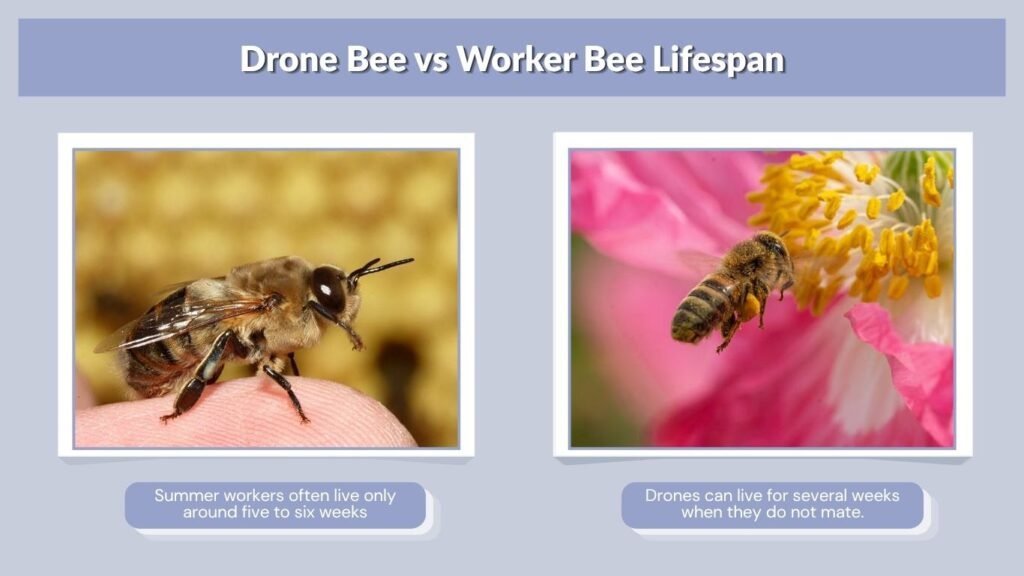
Worker and drone lifespan depends strongly on season, colony conditions, and individual activity.
How Long Do Worker Bees Live?
Summer workers often live only around five to six weeks because strenuous foraging gradually wears down their bodies.
Workers produced for winter can survive considerably longer—often several months—because they perform less intensive outdoor foraging and help maintain the winter cluster.
Honey bee colonies survive winter by clustering, consuming stored honey, and producing heat.
How Long Do Drone Bees Live?
Drones can live for several weeks when they do not mate.
However, successful mating causes the drone to die shortly afterward. Drones may also be expelled from colonies when resources become scarce, particularly as winter approaches.
Worker bees stop supporting unnecessary drones because the colony must conserve stored honey for winter survival.
Can Drones Mate With Worker Bees?
No. Drones mate with virgin queens, not workers.
Workers are female but normally do not mate. Their reproductive systems are largely inactive while the colony has a functional queen.
Drones fly to mating areas where they compete to mate with virgin queens from other colonies.
A queen commonly mates with multiple drones during her mating flights and stores their sperm for use in fertilizing eggs later.
Queen Bee vs Worker Bee vs Drone
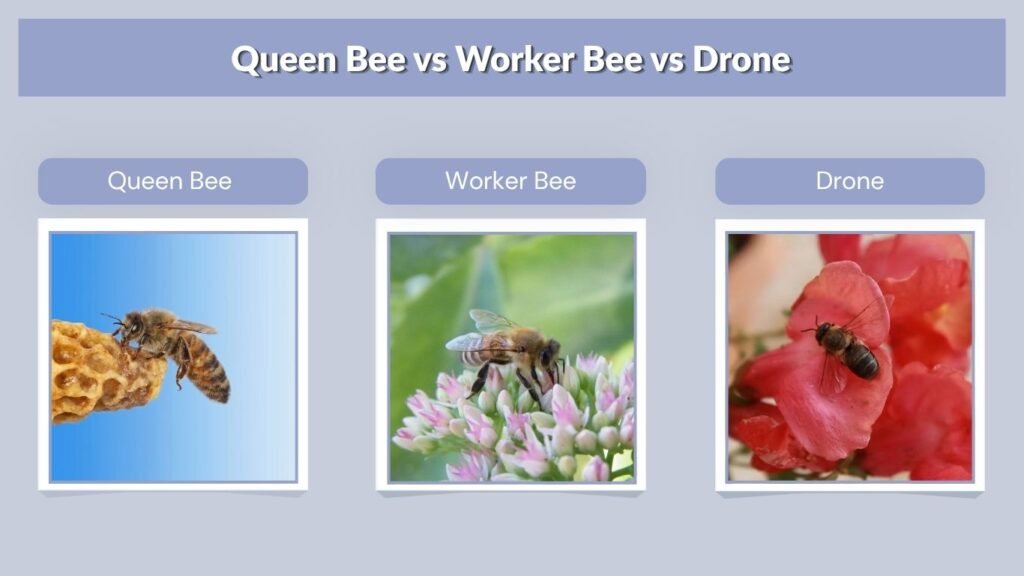
The entire honey bee colony depends on three highly specialized castes.
Queen Bee
The queen is a reproductive female. Her main function is laying eggs, and a productive queen can lay more than 2,000 eggs per day during peak conditions.
Worker Bee
Workers are females responsible for:
- Feeding brood
- Building comb
- Cleaning the colony
- Collecting nectar and pollen
- Making and storing honey
- Guarding the entrance
- Regulating temperature
They represent the overwhelming majority of colony members.
Drone Bee
Drones are males specialized for reproduction. They do not perform the routine labor carried out by workers.
This division of labor is one of the defining characteristics of the highly organized honey bee colony.
Why Are Drones Produced From Unfertilized Eggs?
Honey bees have a genetic system known as haplodiploidy.
Female queens control whether eggs are fertilized as they are laid.
A fertilized egg normally develops into a female worker or queen, while an unfertilized egg develops into a male drone.
As a result:
- Worker = female + fertilized egg
- Queen = female + fertilized egg
- Drone = male + unfertilized egg
Whether a fertilized female larva develops into a worker or queen is strongly influenced by how she is reared and fed.
FAQs
What is the biggest difference between a drone and worker bee?
A drone is a male specialized for mating, while a worker is a female that performs nearly all colony maintenance, defense, brood care, and foraging.
Can drone bees sting?
No. Drones do not have stingers. Worker bees have stingers and use them primarily to defend the colony.
Are drones larger than worker bees?
Yes. Drones are broader and larger than workers and have enormous compound eyes that nearly meet on top of the head.
Do drone bees make honey?
No. Drones do not collect nectar or make honey. Worker bees collect nectar and perform the tasks involved in processing and storing honey.
What happens to drones in winter?
In temperate climates, workers often force drones out of the colony as the productive season ends. This reduces food consumption when the colony must conserve stored honey for winter.
