
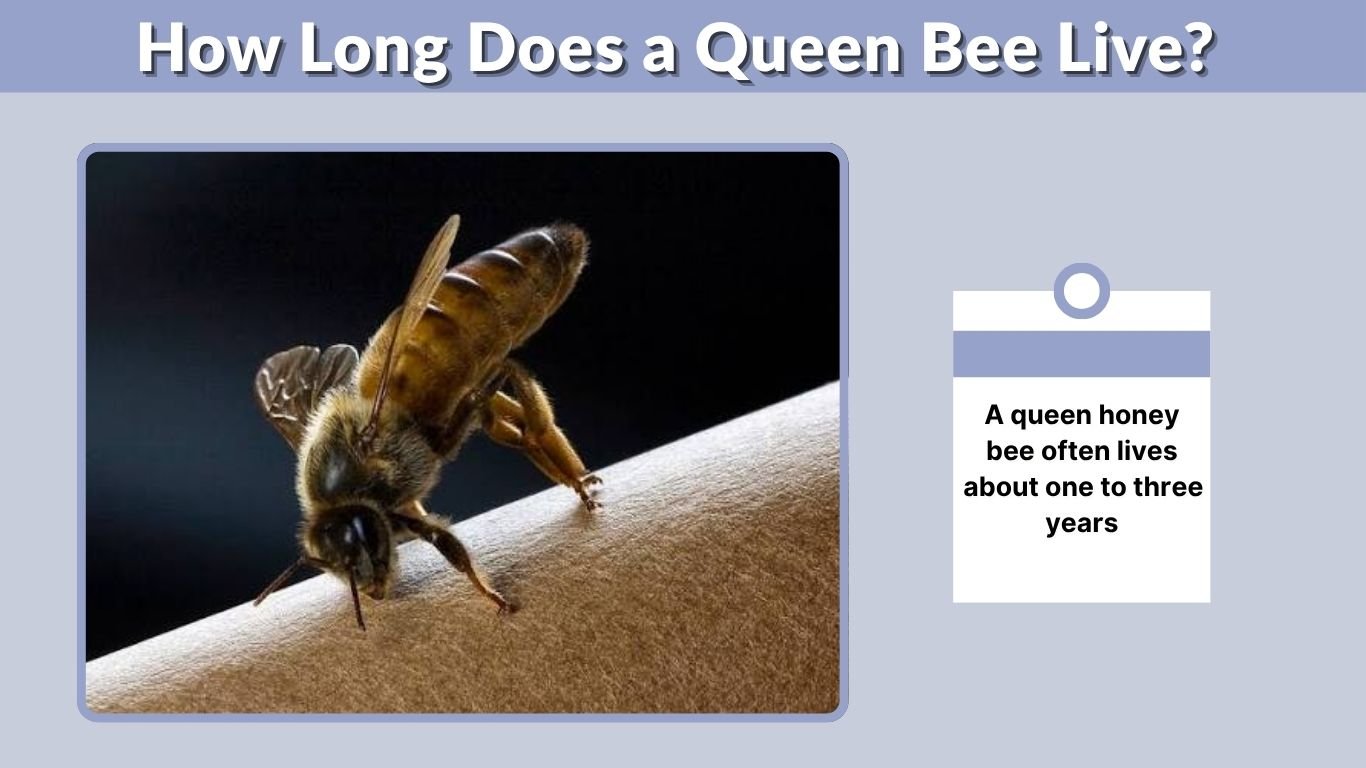
A queen honey bee often lives about one to three years, although some survive five years or longer. Published estimates vary, and a queen’s actual lifespan is different from how long a beekeeper keeps her in a colony. Research reports average lifespans of one to two years, while beekeeping references describe queens surviving several years.
The species matters, too. A queen bumblebee generally lives for approximately one year, following a seasonal cycle quite different from that of a honey bee queen.
How Long Does a Queen Honey Bee Live in a Hive?
A queen honey bee can remain alive for multiple years, but she does not necessarily stay equally productive throughout that time.
Three different measurements help explain the conflicting numbers you may see:
- Actual lifespan: The time the queen survives, regardless of how well she lays eggs.
- Productive lifespan: The period when she produces enough healthy brood to support the colony effectively.
- Time before replacement: How long a beekeeper or the bees themselves allow her to remain the colony’s queen.
Queen productivity commonly declines after the first year or two. For this reason, some beekeepers replace queens annually, while others use different schedules or assess each queen individually. A replacement schedule does not mean every queen naturally dies at that age. Exceptionally long-lived queens can survive beyond seven years, but this is not a normal expectation.
Queen Bee Lifespan Compared With Worker Bees
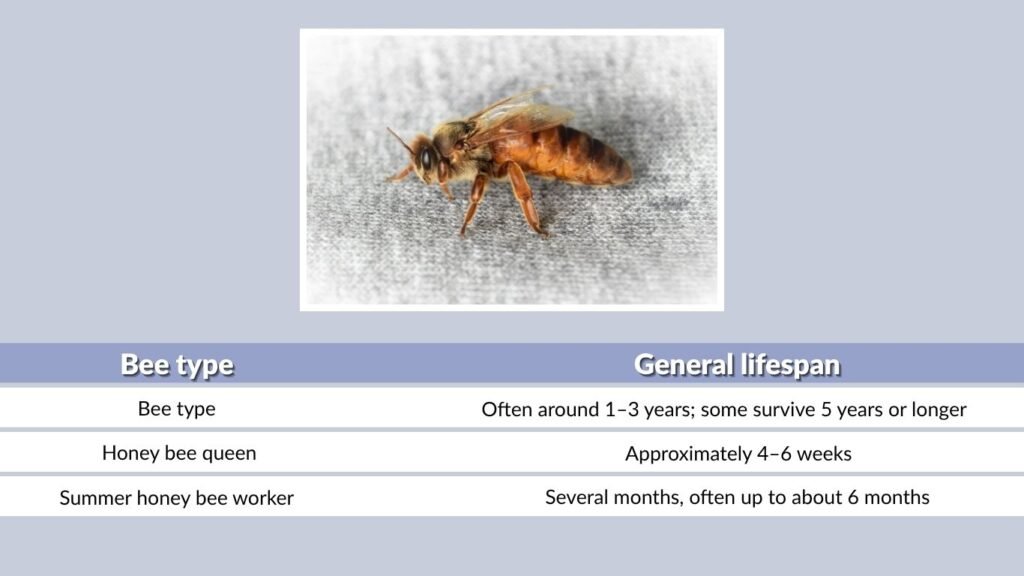
Honey bee queens generally outlive summer workers by a considerable margin. However, winter workers also live much longer than their summer counterparts.
| Bee type | General lifespan |
| Honey bee queen | Often around 1–3 years; some survive 5 years or longer |
| Summer honey bee worker | Approximately 4–6 weeks |
| Winter honey bee worker | Several months, often up to about 6 months |
| Bumblebee queen | Approximately 1 year in a typical annual cycle |
These are broad ranges, not fixed deadlines. Worker longevity changes with season and workload, while bumblebee queen survival includes a substantial period spent overwintering.
Why Do Queen Bees Live Longer?
A honey bee queen’s longevity reflects her development, physiology, and role within the colony—not simply her larger size.
Specialized nutrition and development
Queens and workers are both female honey bees, but differences in larval feeding help produce very different adults. Queen-destined larvae receive abundant royal jelly, supporting the development of their reproductive bodies.
Nutrition is also connected with hormonal and metabolic differences associated with queen longevity. However, saying “royal jelly alone makes queens live longer” oversimplifies a complex biological process.
A more protected adult life
Workers that forage repeatedly face weather, predators, and the demands of flight. An established queen spends most of her time inside the colony, where workers feed and attend her.
This protection reduces some external risks, while her distinctive physiology also contributes to her longer life. Researchers study both factors when investigating why queens outlive workers.
What Affects a Queen Honey Bee’s Lifespan?
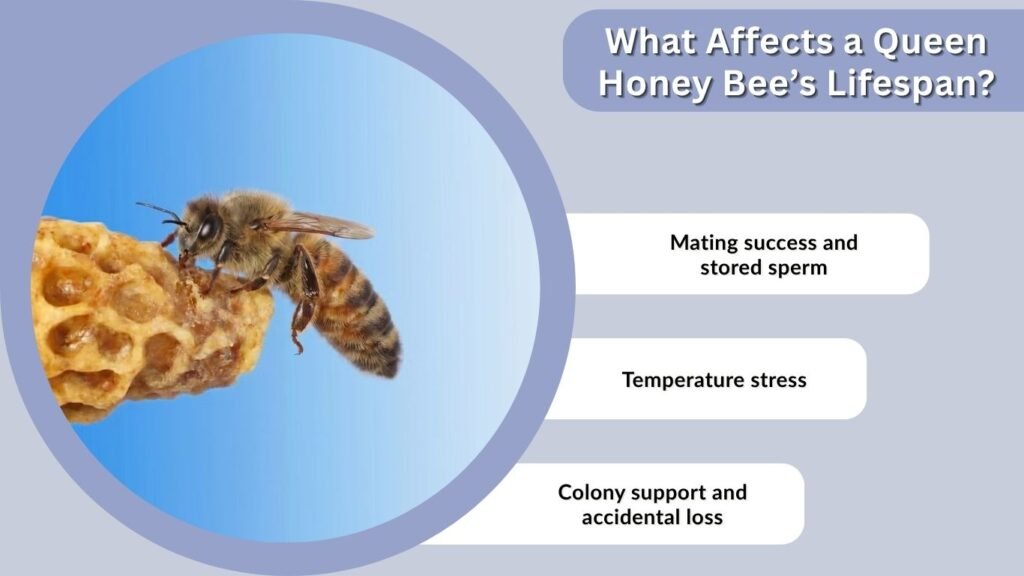
Several factors influence whether a queen survives and continues functioning successfully. Importantly, reproductive failure and death are not the same thing.
Mating success and stored sperm
A young honey bee queen mates with drones and stores sperm for later use. That supply allows her to fertilize eggs that develop into female workers or future queens.
Poor sperm quality can reduce her reproductive success even while she remains alive. Research has linked low stored-sperm viability with poorly performing colonies.
Temperature stress
Extreme temperatures can damage the sperm stored inside a queen. A study examining queen shipments found that temperature extremes could substantially reduce sperm viability.
This does not mean every heat-stressed queen immediately dies. Instead, a living queen may become less capable of producing the workers her colony needs.
Colony support and accidental loss
Queens rely on workers for food and care. Their success therefore depends partly on the condition of the wider colony.
They can also be lost or injured, including during hive handling. A queen that disappears prematurely has not necessarily reached the end of her natural lifespan.
How Long Does a Queen Bumblebee Live?
A queen bumblebee typically lives for approximately one year, including the months she spends dormant over winter.
In many temperate species, her life follows this pattern:
- A new queen emerges during the warmer months.
- She mates and builds energy reserves.
- She overwinters alone in a sheltered location.
- She emerges to establish a nest and raise workers.
- Her colony eventually produces males and new queens, completing the cycle.
The founding queen normally dies as the annual colony comes to an end. Newly produced queens carry the next generation through winter.
This describes the usual temperate cycle, not every species or climate. Seasonal timing varies, and some bumblebee populations remain active during winter.
What Happens When a Queen Honey Bee Dies?
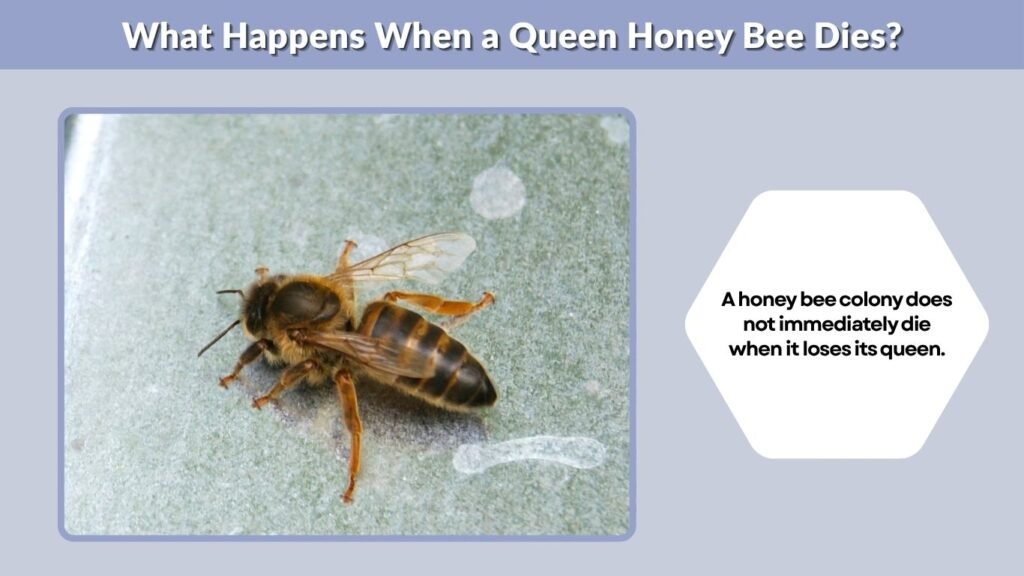
A honey bee colony does not immediately die when it loses its queen.
If suitable fertilized eggs or very young female larvae are available, workers may rear emergency queens. They modify cells and provide the developing queens with appropriate food.
However, successful replacement is not guaranteed. The colony must raise a queen that survives, mates successfully, and begins producing workers.
Without suitable young brood, the colony cannot simply turn an adult worker into a replacement queen. Prolonged queenlessness can lead to laying workers, whose unfertilized eggs produce males rather than replacement female workers.
FAQs
Can a queen bee live for five years?
Yes. Some honey bee queens survive five years or longer, although many have shorter lives. Maximum longevity should not be confused with the age a typical queen reaches.
Does a queen bee die after laying eggs?
No. Honey bee queens lay eggs repeatedly throughout their reproductive lives. Egg laying is their continuing role, not a one-time event.
Does a queen honey bee hibernate?
Not like a bumblebee queen. Honey bee queens overwinter with their colonies, supported by workers. The colony forms a cluster to conserve warmth, and egg laying may decrease or pause according to conditions.
Do all queen bees live for several years?
No. Multi-year lifespans are associated with honey bee queens. Bumblebee queens generally follow an approximately annual cycle, so identifying the kind of bee is essential.
Can you tell a queen’s age by looking at her?
Not reliably. Beekeepers use records and colored identification marks to track queen age. Appearance alone cannot establish her exact age or remaining lifespan.
