
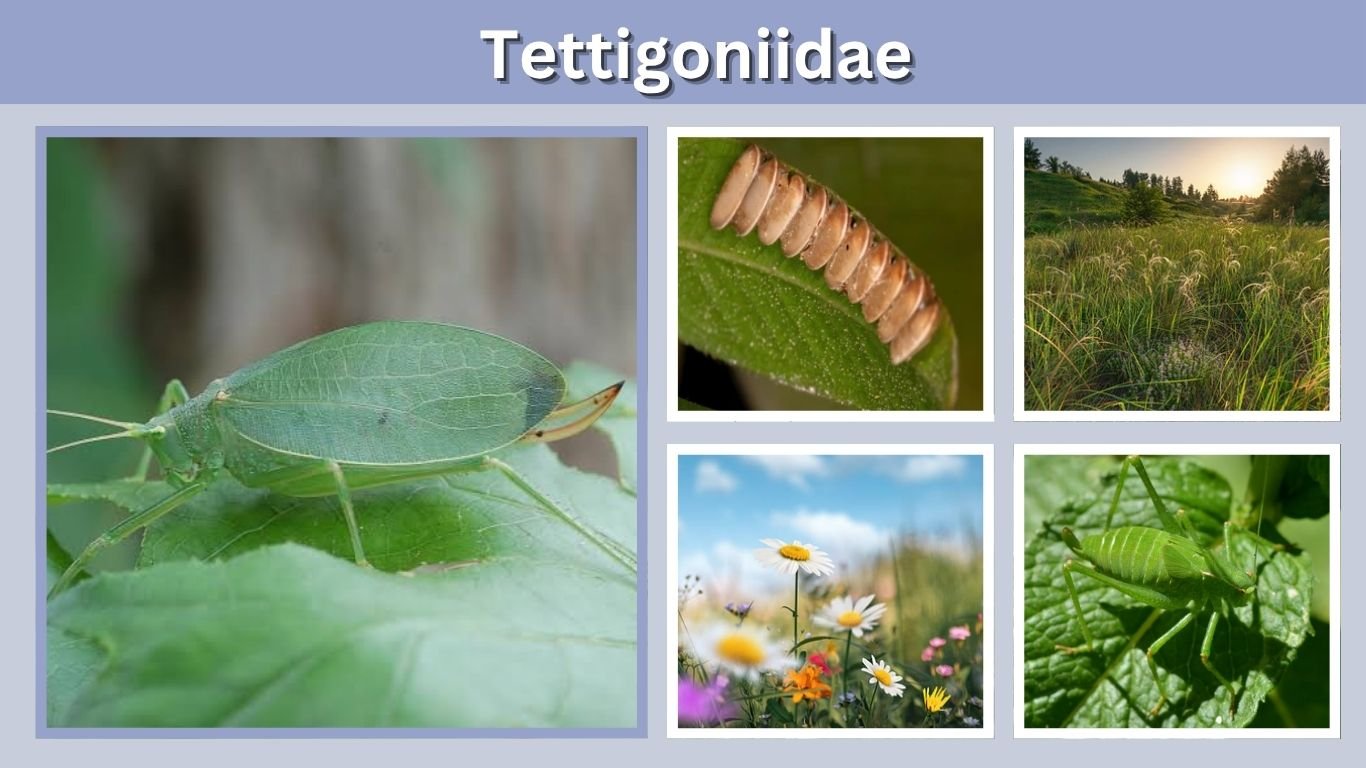
Tettigoniidae is the insect family that includes katydids, bush crickets, and many closely related long-horned orthopterans. These insects are famous for their extremely long antennae, powerful hind legs, leaf-like camouflage, and distinctive nighttime calls. Members of Tettigoniidae occur across much of the world, from temperate meadows to tropical rainforests. Although they are sometimes mistaken for grasshoppers or crickets, their body structure, sound-producing organs, diet, and reproductive features make them a distinctive and diverse group within the order Orthoptera.
What Is Tettigoniidae?
Tettigoniidae is a large family within the order Orthoptera and suborder Ensifera. Its members are commonly called katydids or bush crickets. Thousands of species have been described worldwide, with particularly high diversity in tropical regions. They occupy forests, grasslands, gardens, wetlands, and agricultural habitats, where many species blend almost perfectly into surrounding vegetation.
Tettigoniidae Identification
Typical characteristics include:
- Extremely long, thread-like antennae
- Large hind legs adapted for jumping
- Green, brown, or leaf-like coloration
- Four wings in most adult species
- Forewings that can resemble leaves
- Strong chewing mouthparts
- Hearing organs on the front legs
- Long ovipositor in many females
- Body commonly longer and slimmer than many true crickets
- Powerful jumping and climbing abilities
Some tropical species have extraordinarily detailed camouflage, including markings that resemble leaf veins, damaged leaves, moss, or bark.
Tettigoniidae Size
Size varies greatly between species. Small meadow katydids may have bodies only a little over a centimeter long, while some large tropical species can reach several centimeters in body length.
Their long antennae can exceed the length of the entire body. Large wings and elongated legs may also make an individual appear considerably bigger than its actual body measurement.
Scientific Classification
Tettigoniidae belongs to:
- Kingdom: Animalia
- Phylum: Arthropoda
- Class: Insecta
- Order: Orthoptera
- Suborder: Ensifera
- Family: Tettigoniidae
- Common names: Katydids and bush crickets
Tettigoniidae is closely related to true crickets but differs from short-horned grasshoppers in several important anatomical characteristics.
Tettigoniidae Habitat and Distribution
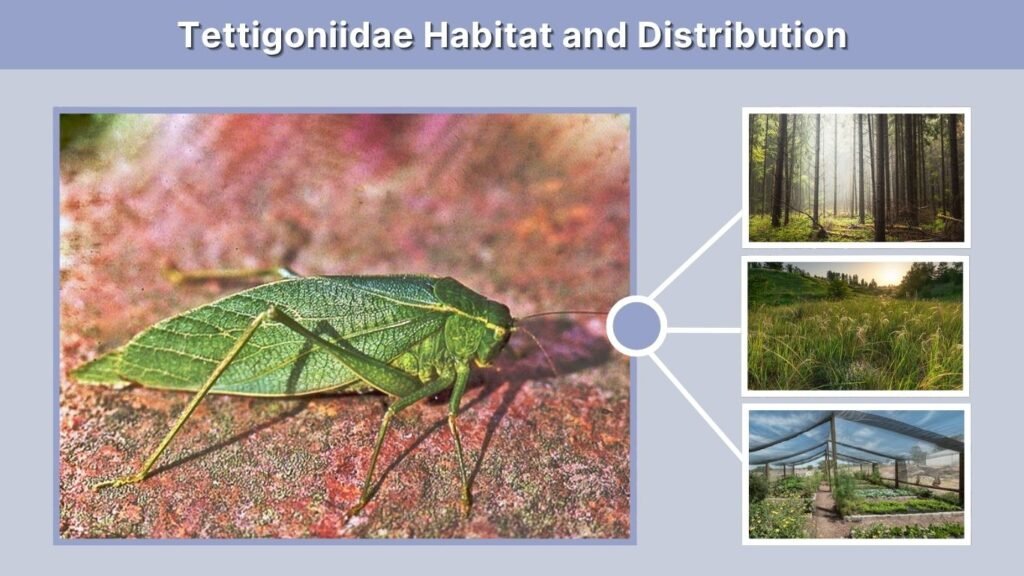
Members of Tettigoniidae are distributed across most regions where suitable vegetation and climates exist. Tropical forests contain exceptional diversity, but katydids are also familiar inhabitants of North American gardens, European meadows, Australian bushland, and many Asian habitats. Most species depend heavily on plants for shelter, feeding, camouflage, calling sites, and reproduction.
Where Do Tettigoniidae Live?
Katydids commonly inhabit shrubs, trees, tall grasses, weeds, crop fields, forest edges, and gardens. Some specialize in dense rainforest vegetation, while others thrive in open meadows or dry environments.
Many remain above ground on stems and leaves. Their coloration often closely matches the plant species or vegetation structure in which they spend most of their lives.
Tettigoniidae in Rainforests
Rainforests support an especially impressive variety of katydids. Many tropical species have evolved elaborate camouflage that makes them resemble leaves, twigs, bark, lichens, or other parts of plants.
This camouflage helps protect them from birds, reptiles, mammals, and predatory insects. Some remain almost motionless during daylight hours before becoming active after sunset.
Why Katydids Are Often Hard to See
A katydid may be producing a loud call just a few feet away yet remain difficult to locate. Its green wings can mimic living leaves, while brown species may resemble dried foliage or bark.
Many species also remain motionless when approached. This combination of camouflage, nighttime activity, and careful positioning makes Tettigoniidae much easier to hear than to find.
What Do Tettigoniidae Eat?
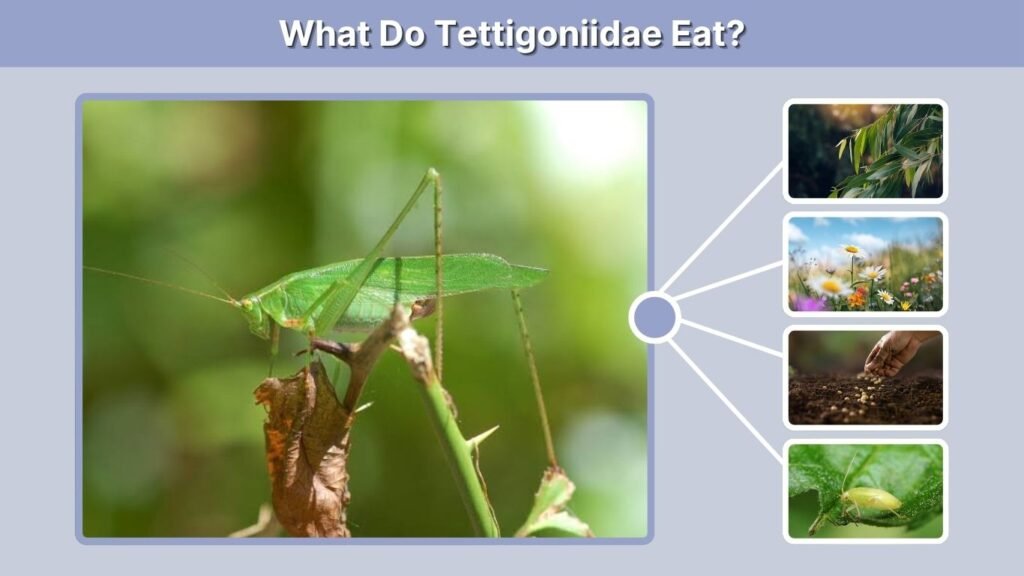
The diet of Tettigoniidae varies considerably among species. Many are primarily herbivorous, feeding on leaves, flowers, seeds, or fruits. Others are omnivorous and readily consume small insects. A smaller number are strongly predatory and use their powerful mouthparts and spiny legs to capture other arthropods.
Common Foods
Depending on the species, Tettigoniidae may eat:
- Leaves
- Flowers
- Pollen
- Seeds
- Fruits
- Grass
- Plant stems
- Aphids
- Caterpillars
- Small insects
- Insect eggs
- Other small arthropods
Diet can even change with age or food availability.
Tettigoniidae Mouthparts
Katydids possess chewing mouthparts with strong mandibles. Herbivorous species use them to cut through leaves and other plant tissues, while predatory species can use the same structures to seize and consume animal prey.
A large katydid can sometimes deliver a noticeable defensive nip if handled roughly, but katydids do not possess venomous fangs or stingers.
Are Katydids Helpful or Harmful?
Most katydids cause little noticeable damage and are simply part of a healthy ecosystem. Herbivorous species occasionally chew holes in garden leaves, but serious infestations are relatively uncommon.
Predatory and omnivorous katydids may even consume insects that feed on plants. Their overall ecological role includes serving as both consumers and important prey for numerous animals.
Tettigoniidae Sound
Katydids are perhaps best known for the calls produced by adult males. These sounds may consist of chirps, clicks, buzzes, rattles, or repeated phrases. Calling is primarily associated with attracting females, although sound can also play roles in communication and spacing between competing males.
How Tettigoniidae Produce Sound
Male katydids usually produce sound by rubbing specialized areas of their forewings together, a process known as stridulation.
One wing carries a file-like structure, while the other has an edge that acts like a scraper. Repeated movement creates vibrations that are amplified by parts of the wings, producing the species-specific call.
Why Katydids Call at Night
Many Tettigoniidae are primarily nocturnal. Calling after sunset helps males communicate while they remain hidden within vegetation.
Temperature can influence calling rate in some species. Warmer evenings often result in more rapid calling, while cooler temperatures may slow the rhythm. Each species has its own characteristic pattern that females can recognize.
How Katydids Hear
Katydid ears are located on their front legs rather than on the head. Small tympanal organs near the upper part of the front tibiae detect sound vibrations.
This unusual placement allows them to recognize calls from other katydids and potentially detect predators. Their acoustic communication system can be remarkably sophisticated, especially among nocturnal tropical species.
Tettigoniidae Life Cycle
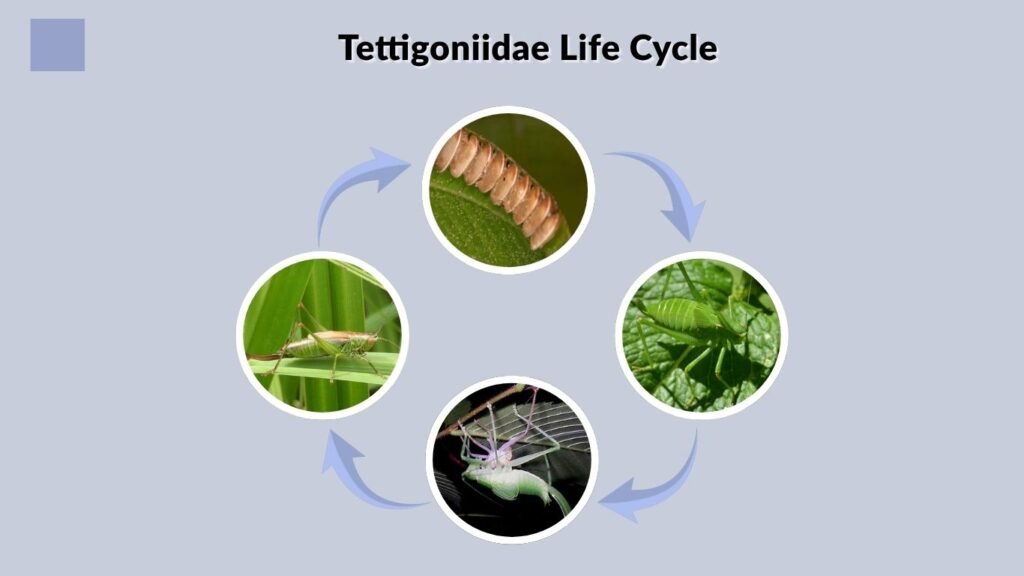
Like other Orthoptera, members of Tettigoniidae undergo incomplete metamorphosis. There is no caterpillar or pupal stage. Instead, young katydids emerge as nymphs that resemble miniature wingless adults. With each molt, their bodies become larger and their wings and reproductive structures gradually develop.
Main Life Cycle Stages
The life cycle consists of:
- Egg: Females place eggs in plant tissue, soil, bark, stems, or other protected sites.
- Nymph: The young insect emerges without fully developed wings.
- Molting: Nymphs shed their exoskeleton several times as they grow.
- Adult: The final molt produces a sexually mature insect with developed wings in winged species.
- Reproduction: Adults mate, and females deposit another generation of eggs.
Life-cycle timing depends heavily on climate and species.
Tettigoniidae Eggs
Female katydids use an ovipositor to position their eggs. Depending on the species, eggs may be inserted into leaves, plant stems, bark, soil, or narrow cracks.
In seasonal climates, eggs may remain dormant through unfavorable weather and hatch when temperatures become suitable. This allows populations to survive winter or dry seasons even when adults are absent.
Tettigoniidae Nymph
Nymphs resemble adults but are smaller and lack fully developed wings. Young individuals may also have slightly different colors or patterns.
They feed and grow between molts, gradually developing adult structures. Because nymphs already possess long antennae and enlarged jumping legs, they can usually be recognized as young katydids fairly easily.
Tettigoniidae Female and Ovipositor
Female Tettigoniidae are often easily distinguished by the prominent ovipositor extending from the end of the abdomen. Depending on the species, it can be straight, curved, blade-like, or sword-shaped. Despite its intimidating appearance, this structure is used for laying eggs rather than stinging humans.
What Does the Ovipositor Do?
The ovipositor allows a female to place eggs in protected locations. Its shape frequently corresponds to the type of material into which eggs are deposited.
Species that lay eggs inside leaves may have flattened cutting structures, while species depositing eggs into soil may possess longer, more robust ovipositors. The structure is therefore closely connected to reproductive behavior.
Male vs Female Tettigoniidae
Adult males generally lack the long egg-laying structure seen in females. They are often identified instead by their sound-producing wings and reproductive structures at the end of the abdomen.
In many species, males call repeatedly from vegetation. Females locate suitable males by listening to these calls and moving toward them.
Tettigoniidae vs Grasshoppers and Crickets
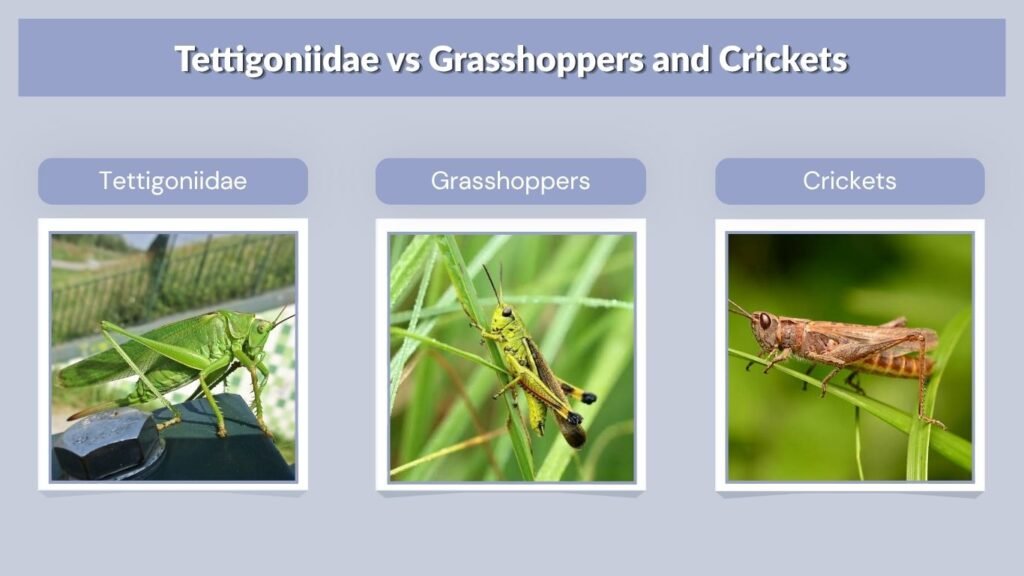
Katydids, grasshoppers, and true crickets all belong to Orthoptera, which explains their similar jumping legs and chewing mouthparts. However, they belong to different families and can usually be separated by their antennae, body shape, sound-producing structures, and behavior.
Tettigoniidae vs Grasshopper
Important differences include:
- Katydids usually have antennae longer than their bodies.
- Grasshoppers generally have much shorter antennae.
- Katydids often look more leaf-like.
- Many katydids are most active at night.
- Grasshoppers are frequently more active during daylight.
- Katydid females often have a conspicuous blade-like ovipositor.
Long antennae provide one of the easiest field clues.
Tettigoniidae vs Gryllidae
Gryllidae is the family containing true crickets. Both crickets and katydids belong to Ensifera and possess long antennae.
True crickets often have more cylindrical bodies and commonly live near the ground, although exceptions occur. Katydids are frequently associated with shrubs, grasses, and trees and often have wings shaped like leaves.
Tettigoniidae Facts
Tettigoniidae includes an extraordinary range of forms, from tiny meadow species to large tropical leaf mimics. Their combination of camouflage, sound communication, jumping ability, and unusual hearing organs makes them one of the most recognizable groups of Orthoptera.
Quick Facts
- Tettigoniidae includes katydids and bush crickets.
- They belong to the order Orthoptera.
- Their antennae are typically extremely long.
- Most species are active at night.
- Males commonly produce mating calls.
- Their ears are located on the front legs.
- Many species resemble leaves.
- They undergo incomplete metamorphosis.
- Females commonly possess a visible ovipositor.
- Diet ranges from plants to insects.
- They occur on most continents with suitable terrestrial habitats.
- They are closely related to true crickets.
FAQs
What is Tettigoniidae?
Tettigoniidae is a family of insects within the order Orthoptera. Its members are commonly called katydids or bush crickets. They are recognized by very long antennae, enlarged jumping legs, chewing mouthparts, and, in many species, wings that resemble leaves.
What is the scientific name for katydids?
Katydids belong to the family Tettigoniidae. The family contains many genera and species, so individual katydids also have their own genus and species names. Tettigoniidae belongs to the suborder Ensifera, which also includes true crickets and related insects.
What do Tettigoniidae eat?
Many Tettigoniidae eat leaves, flowers, seeds, fruits, and other plant material. Some species are omnivorous and also consume insects, eggs, or other small arthropods. A few groups are predominantly predatory, so diet varies considerably across the family.
Can Tettigoniidae bite humans?
Katydids can use their chewing mouthparts defensively if they are trapped or handled roughly. A large individual may produce a painful pinch, but katydids do not have venomous fangs or stingers and are not generally dangerous to people.
How do Tettigoniidae make sounds?
Male katydids usually produce sound through stridulation by rubbing specialized structures on their forewings together. The resulting chirps, clicks, or buzzes are primarily used to attract females. Different species produce characteristic calls that help them recognize members of their own species.
